
Drainage & Erosion Control
Drainage Solutions in Oxford, CT and Western Connecticut
Standing water, soggy yards, and water moving toward your foundation are problems that get worse every season. Prestige Property Maintenance designs and installs surface swales, French drains, catch basins, and pipe systems that move water away from your home and keep it there.
What Is a Drainage Solution and What Will It Do for Your Property?
A drainage solution is a designed system of grading, pipe, stone, and collection points that captures surface and subsurface water and moves it to a safe discharge location away from your home, driveway, or outdoor structures. Prestige Property Maintenance installs French drains, catch basins, channel drains, surface swales, and solid pipe systems across residential and commercial properties in Oxford, Seymour, Southbury, Shelton, and the surrounding western Connecticut towns. Most residential drainage projects take between one and three days depending on the size of the yard, the number of problem areas, and how far the water needs to travel to reach a proper outlet. When the work is done, water that used to pool near your foundation, flood your driveway, or erode your lawn has a clear, engineered path off your property.
Water problems in Connecticut are rarely simple. The soil here is a mix of glacial till, clay, and buried rock, which means rainwater often cannot absorb fast enough to keep up with a heavy storm. Add a sloped lot, a low-lying yard, or a roof that dumps runoff near the house, and you can end up with standing water that lingers for days. Left alone, that water works its way into basements, undermines driveways, collapses lawn areas, and shortens the life of any finished outdoor work you have already paid for. Drainage is not a cosmetic fix. It is a structural one, and it needs to be planned before the water does more damage.
What Signs Tell You That Your Property Has a Drainage Problem?
Most homeowners call about drainage after they have watched the same problem return year after year. Standing water that takes more than 24 hours to drain from your yard after a rain is one of the clearest signals. So is a soggy patch of lawn that stays wet even during dry stretches, which usually points to subsurface water rising toward the surface or traveling underground from another part of the property.
Water moving toward your home after a hard rain is a more urgent sign. If water pools against your foundation, runs along the side of the house, or collects near basement windows, the grade around your home may be directing runoff the wrong way. Driveway washouts, eroding slopes, and soft spots that keep reappearing are also common early indicators that water is moving through soil it should not be touching.
In western Connecticut, the combination of rocky glacial soil and heavy clay layers makes drainage problems more common than in areas with deep, well-draining loam. Rain that would soak in quickly on a sandy lot can sit on the surface for hours here, especially on sloped ground where it picks up speed and carries topsoil with it. If you have noticed ruts forming along a slope, silt washing onto a paved surface, or grass dying in low areas, those are signs that water is controlling your property rather than the other way around.
What Types of Drainage Systems Does Prestige Property Maintenance Install?
Different drainage problems need different solutions. Prestige Property Maintenance works with several system types and often combines more than one on a single property to handle both surface and subsurface water.
French Drains
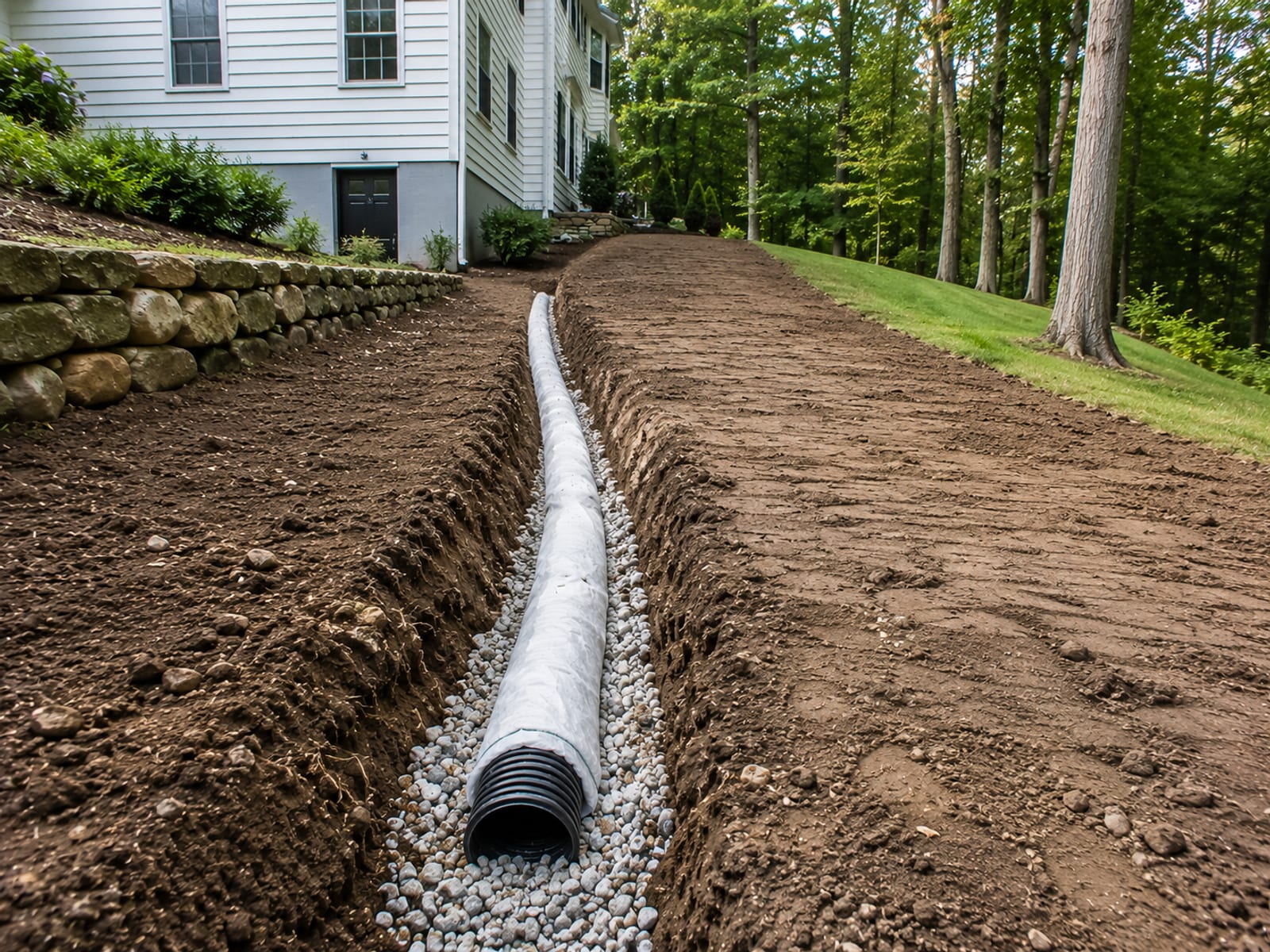
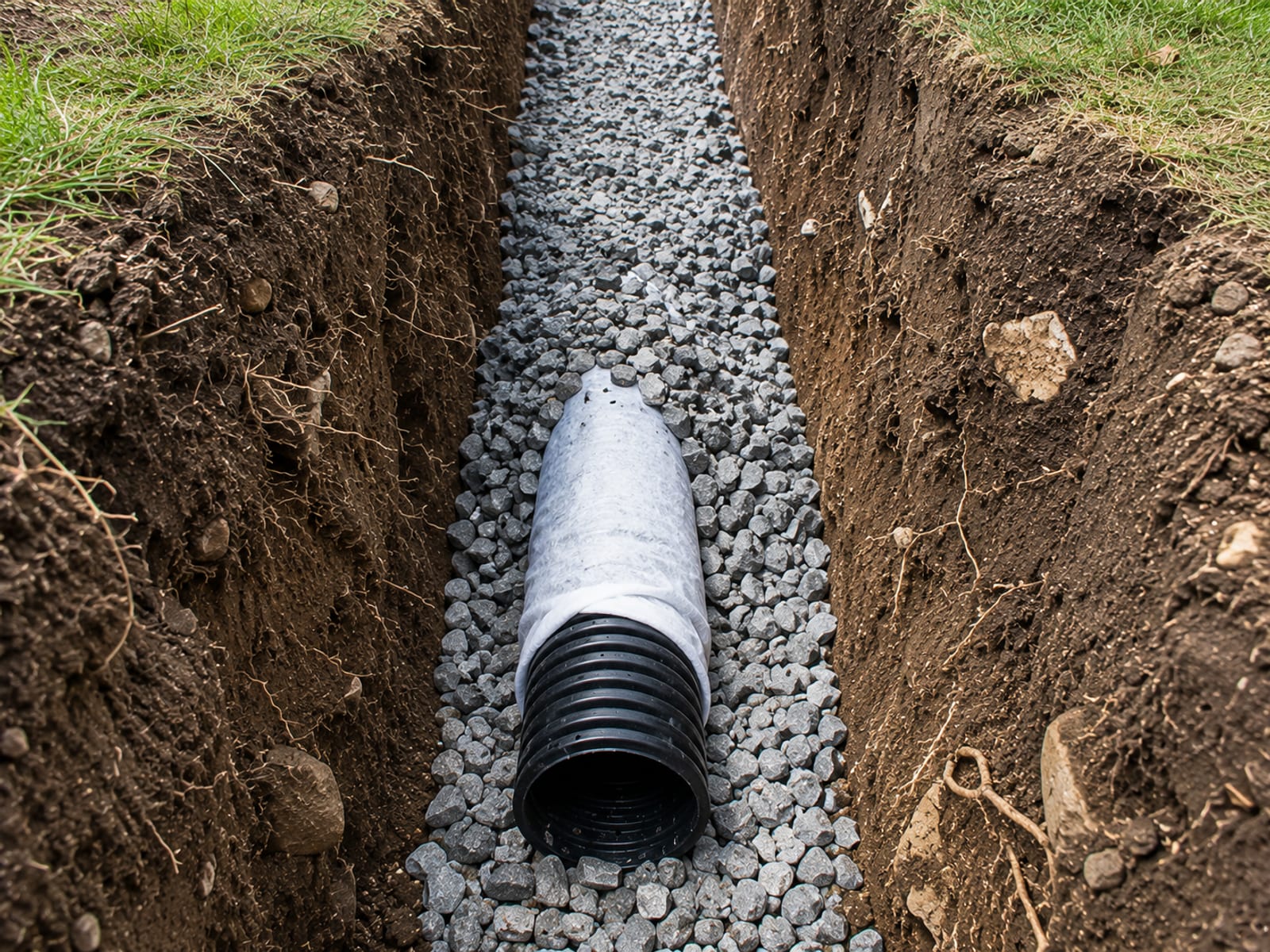
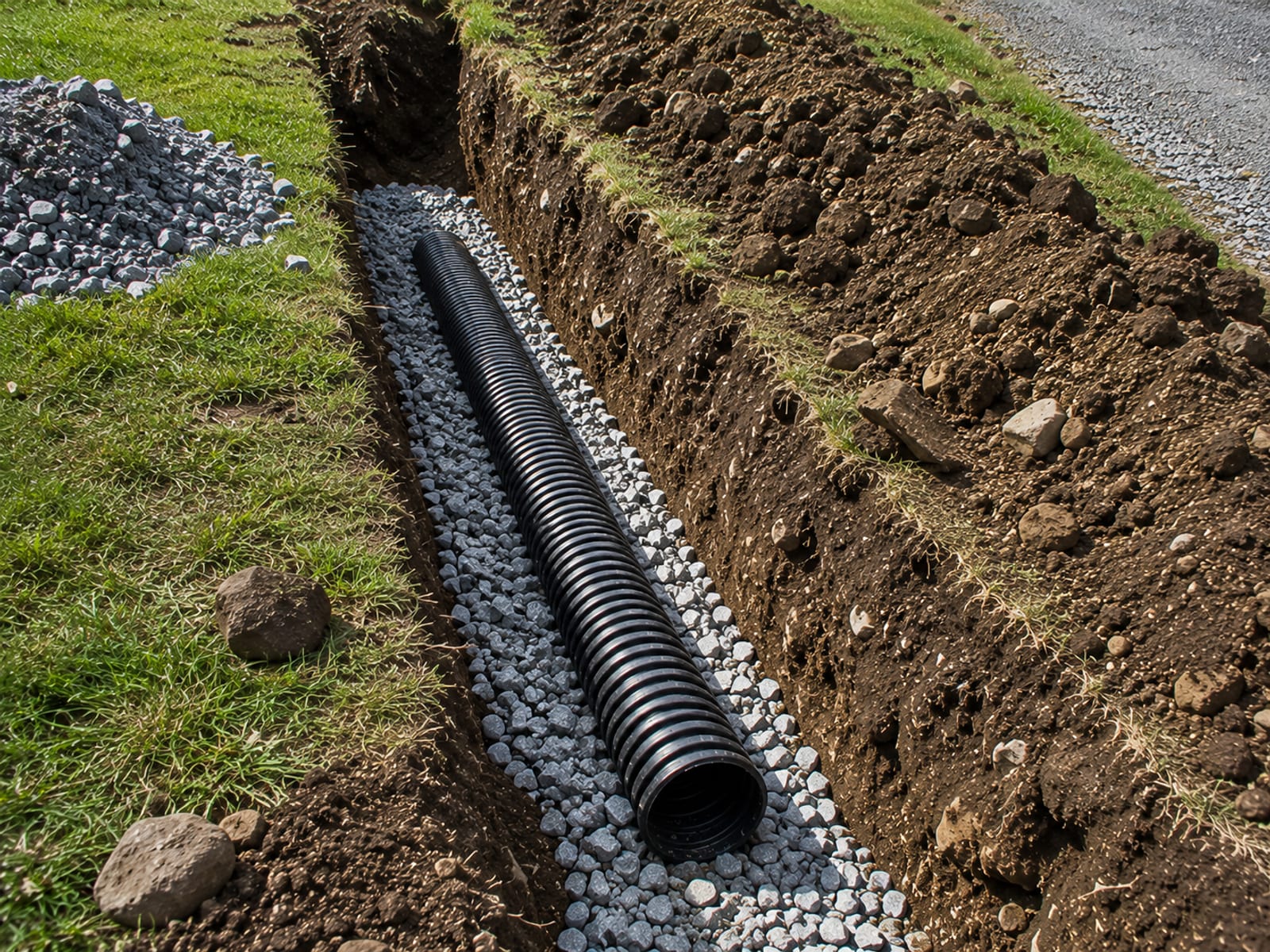
A French drain is a gravel-filled trench with perforated pipe that collects groundwater and subsurface runoff and moves it to a discharge point. It is the right tool when water is saturating soil, rising from below, or traveling underground toward your foundation or a low area of the yard. The trench is lined with geotextile fabric to keep soil from clogging the stone and pipe over time.
Catch Basins
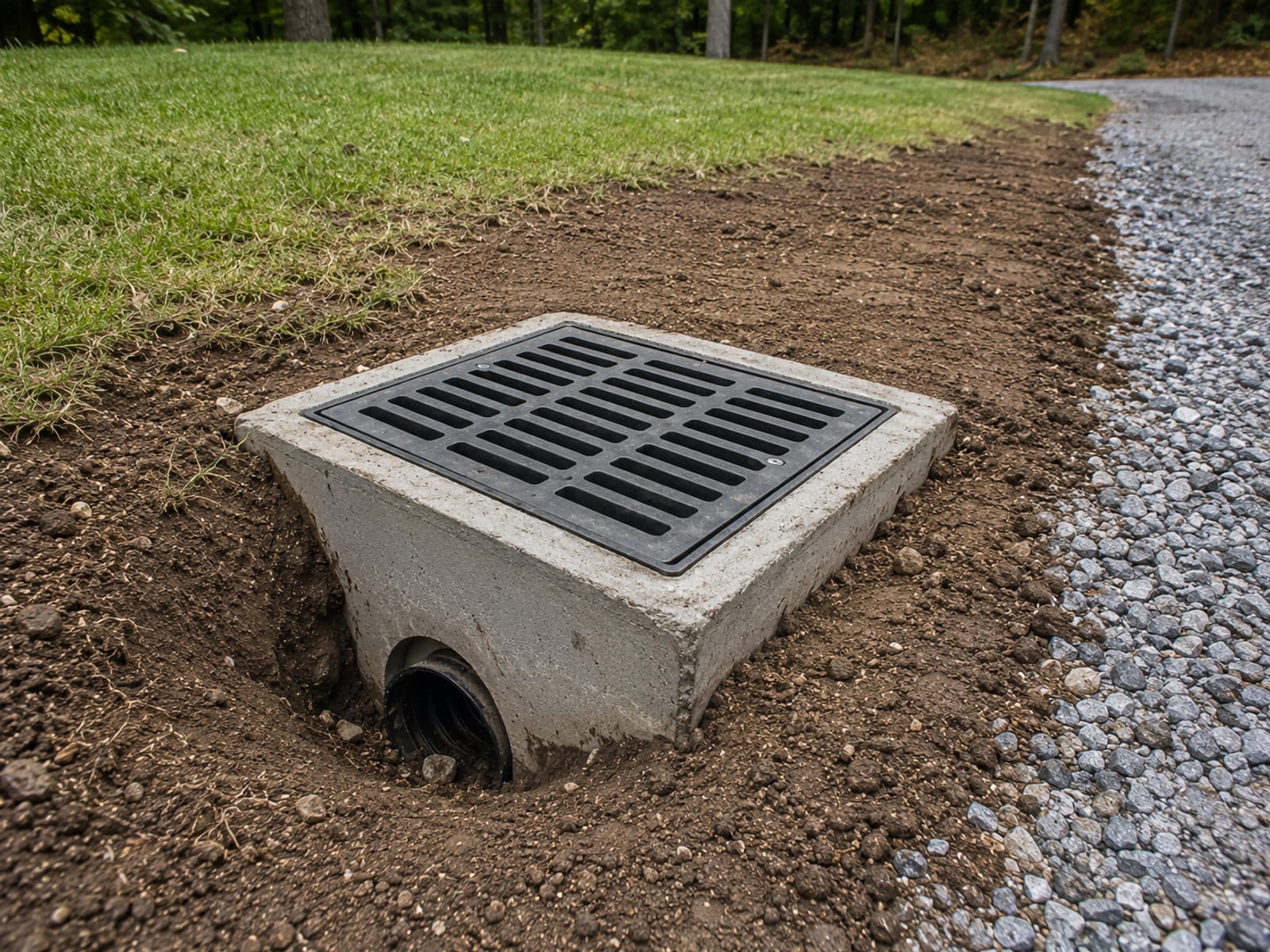
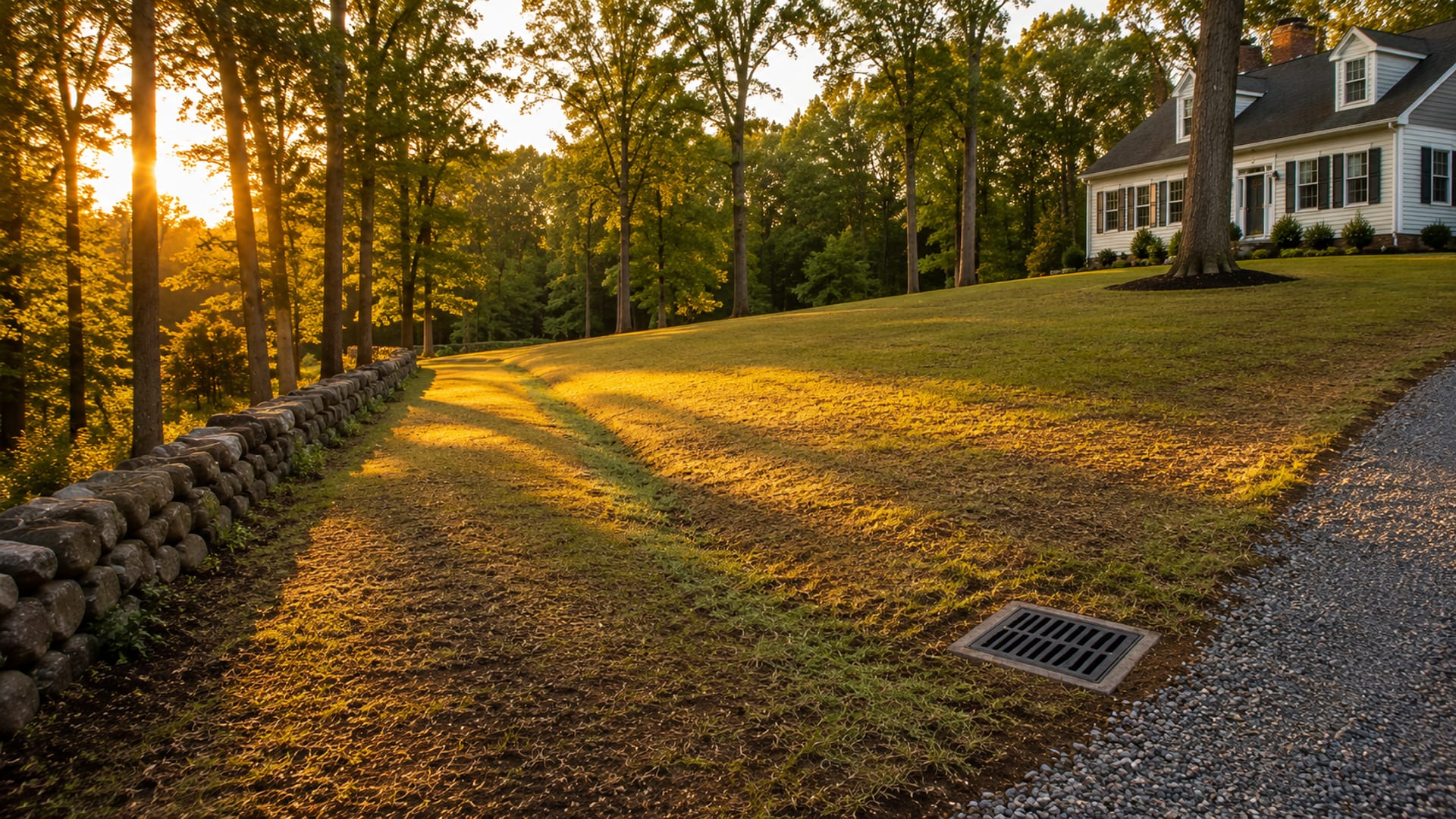
A catch basin is an underground collection box with a surface grate that pulls surface water down and into a discharge pipe. Catch basins work well in low spots in yards, at the bottom of sloped driveways, and near patio edges where water consistently pools. The basin holds debris so it does not travel into the pipe and cause clogs downstream.
Surface Swales
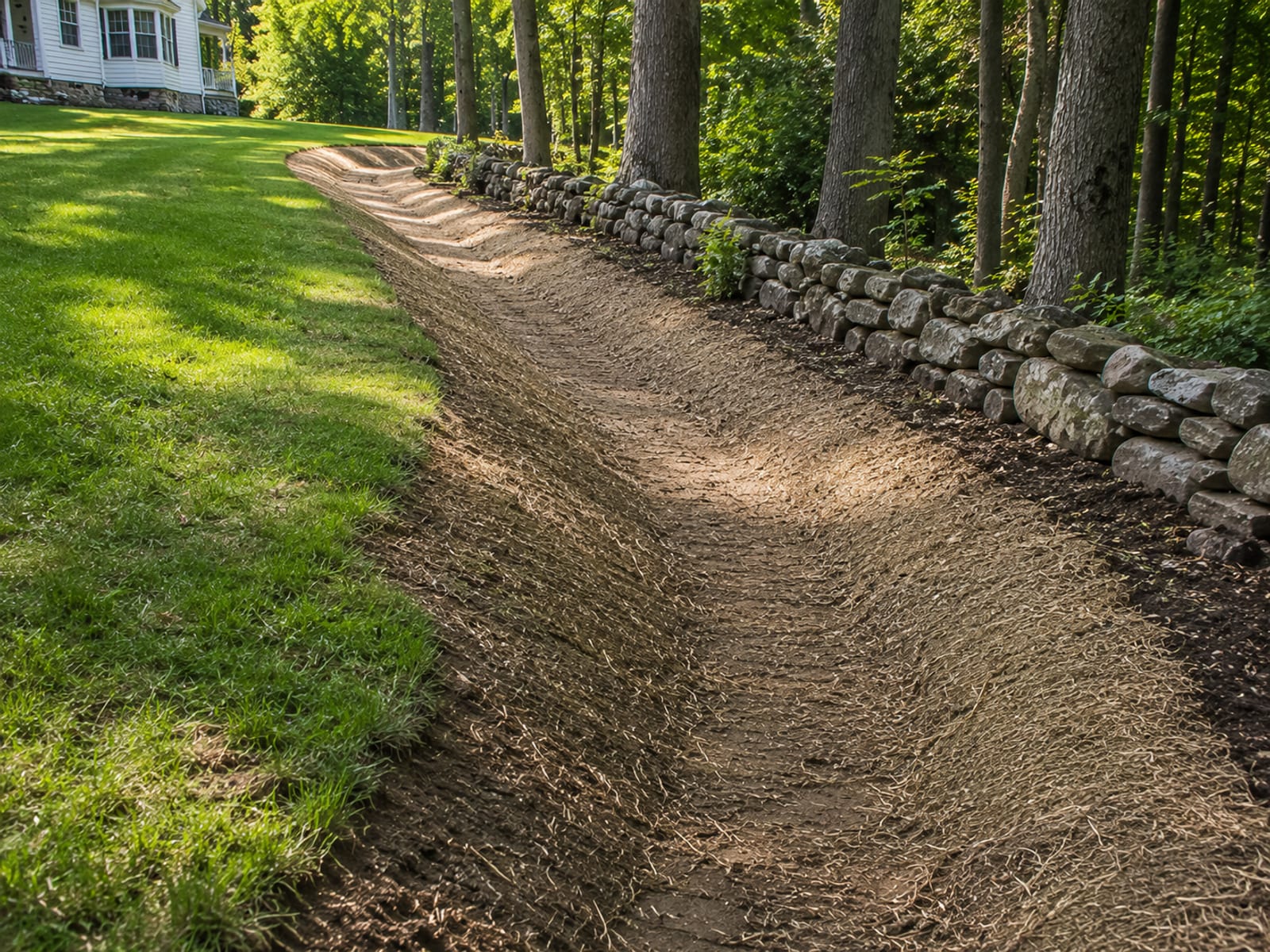
A swale is a graded channel cut into the ground that redirects the path surface water travels across your property. Unlike a pipe system, a swale works entirely above ground by shaping the land so water flows in a controlled direction rather than sheeting across the yard or toward structures. Swales are often the least disruptive option for open areas with moderate slopes.
Channel Drains
Channel drains are long, narrow grates set flush with a hard surface, most commonly at the bottom of a driveway apron, across a garage approach, or along a patio edge. They intercept sheet flow before it can enter a garage, pool against a foundation, or run down a slope uncontrolled. Channel drains connect to a solid pipe that carries water to a discharge point.
Solid Pipe Discharge Systems
In many cases the fix is routing water that has already been collected through solid, non-perforated pipe to a safe outlet. This might mean extending a downspout line underground to carry roof runoff away from the foundation, or connecting multiple basins to a single outlet at the edge of the property. Without a stable discharge point, water returns to the same area or erodes the outlet itself.
Grading Corrections
Sometimes drainage problems start with how the ground is shaped. If the grade around your home slopes toward the foundation rather than away from it, no pipe system will fully solve the problem. Correcting grade as part of a drainage project reshapes the soil so surface water moves in the right direction before it can pool or accumulate near structures.
Learn more about GradingHow Does the Drainage Installation Process Work?
Every drainage project at Prestige Property Maintenance follows the same disciplined sequence. Skipping steps is how drainage systems get installed in the wrong place, pitched the wrong way, or discharged somewhere that creates a new problem.
Site Assessment
Before any digging starts, the crew looks at the full picture: where roof drains and downspouts discharge, how the yard slopes, where water visibly flows or pools, what soil conditions look like, and where a legal and practical discharge location exists. Properties near wetlands or watercourses in Connecticut may need review from the municipal inland wetlands agency before work begins, and that review starts with understanding the site layout.
Utility Marking
Drainage installation requires trenching, and trenching near underground utilities without marking them first is both dangerous and against Connecticut law. Prestige Property Maintenance contacts CT DEEP's Call Before You Dig service before any excavation so that underground utilities are clearly marked on the property. This step is non-negotiable on every project regardless of size.
System Design and Material Selection
Once the site is assessed, the right combination of components gets selected. A wet yard with subsurface water needs different tools than a driveway that sheets runoff at the garage door. This step also pins down the discharge outlet location, whether that is a daylight outlet at a slope, a dry well, a road ditch connection, or another approved point. Pitch and fall calculations happen here so the pipe will carry water rather than let it sit.
Excavation and Installation
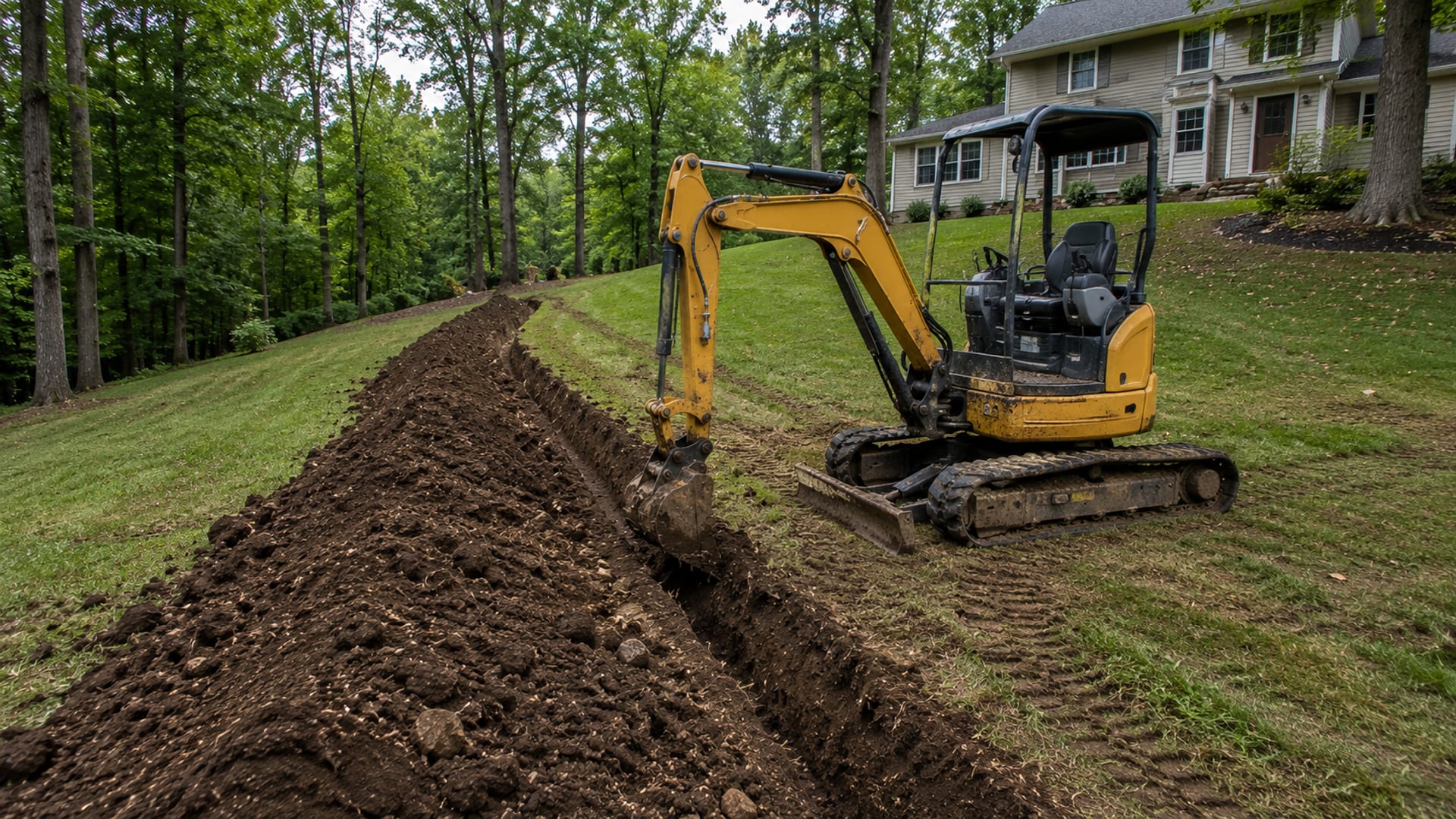
Trenches get cut to the planned depth and grade. Geotextile fabric lines the trench where perforated pipe and washed stone are used. Catch basins and channel drains get set at the correct elevation relative to the surrounding surface. Pipe runs are laid with consistent pitch. Cleanouts are added at accessible points so the system can be checked and flushed in the future. On residential lots, compact equipment limits the footprint of the work area to protect septic systems, lawns, and existing trees.
Learn more about ExcavationBackfill and Site Restoration
After pipe and components are in place, trenches are backfilled with appropriate material and compacted so the surface does not settle unevenly over time. Disturbed soil areas are raked, graded, and stabilized to prevent erosion during the period before grass or ground cover re-establishes. Outlets are protected from erosion with stone or other stable material. The property is left in a condition that matches the scope of work agreed to before the project started.
Why Do Connecticut Properties Have More Drainage Problems Than Other Areas?
Connecticut's soil history is the short answer. The glaciers that covered this region thousands of years ago left behind a landscape full of buried boulders, ledge rock close to the surface, heavy clay deposits, and soil that shifts from free-draining to nearly impermeable within a few feet of elevation change. That combination makes water management unpredictable, especially on rural and semi-rural lots where the land has not been graded or engineered the way a newer subdivision lot might be.
Rocky ground means that when a French drain trench hits ledge at two feet, the plan has to adapt on the spot. Clay-heavy soil means that water moves slowly downward even when the surface looks dry, creating saturated layers underground that can push upward toward foundations or seep into crawlspaces without any visible surface pooling. These are not problems you can diagnose from a driveway. They show up during the work, and a crew that has not dealt with Connecticut soil conditions before can end up installing a drainage system that solves the symptom but misses the source.
Prestige Property Maintenance works exclusively in western Connecticut, across Oxford, Derby, Bethany, Seymour, Ansonia, Shelton, Monroe, Bridgewater, Roxbury, Woodbury, Middlebury, Southbury, Naugatuck, Woodbridge, Prospect, Newtown, Oakville, Watertown, and Wolcott. The crew has encountered the full range of soil conditions this part of the state produces, which means fewer surprises during installation and more realistic expectations about how each system will perform after the job is done.
How Drainage Connects to the Rest of Your Property Work
Drainage is rarely a standalone problem. Water that moves incorrectly across a property tends to affect everything built on it. A retaining wall that holds back a slope is doing twice the work if water behind it has nowhere to go. Drainage behind and beneath a retaining wall is a standard part of building one correctly, and Prestige Property Maintenance handles both sides of that equation on the same project.
Driveways are another common connection point. A long gravel or asphalt driveway that lacks proper crown and side ditching will wash out, develop ruts, and push water toward the house or garage. Getting the drainage right at the grading stage costs far less than correcting it after the paving crew has already finished.
Property owners who are planning to add a patio, a garage addition, a pool, or any other finished outdoor structure should address drainage before that work begins. Water problems do not respect new construction. A well-installed patio sitting on poorly drained ground will heave, settle, and crack within a few seasons. Sorting out the drainage first means the finished work goes in on stable, correctly draining ground, and it holds up the way it should.
Why Homeowners and Contractors Choose Prestige Property Maintenance for Drainage Work
Prestige Property Maintenance is a licensed and insured excavating contractor serving 19 towns across western Connecticut. The company handles the full range of site work that typically surrounds a drainage project, including grading, retaining wall construction, land clearing, rock removal, and earth moving. Most drainage problems are connected to how the land is graded, whether rock is blocking proper trench depth, and whether the slope needs structural support as well as water management.
Running one crew through the full scope of a project eliminates the scheduling gaps and finger-pointing that can happen when a drainage contractor finishes trenching and a separate grading contractor has to come behind them to clean up. On properties where clearing, grading, and drainage all need to happen before a finished surface goes in, having one company handle the sequence from start to finish makes the timeline shorter and the result more consistent.
The equipment fleet includes compact machines suited for residential lots where protecting existing trees, septic systems, and lawn areas matters. Every project starts with a site assessment, includes utility marking before any trenching begins, and finishes with stabilized disturbed soil and protected outlets.
Drainage Solutions: Frequently Asked Questions
These questions come up regularly from property owners dealing with water problems across western Connecticut.
Do I need a permit for drainage work on my Connecticut property?
It depends on the scope and location of the project. Work near inland wetlands or watercourses may require review and approval from your municipality's inland wetlands agency before excavation begins. Projects that disturb a significant amount of soil can trigger erosion and sediment control requirements. Some towns also require permits when drainage connects to a road right-of-way or municipal system. Your contractor should be familiar with these requirements in your specific town before work starts.
What is the difference between a French drain and a catch basin, and which one do I need?
A French drain collects water that is moving through soil or rising from below ground and redirects it through a gravel-and-pipe trench. A catch basin sits at a low point and pulls surface water down through a grate into a pipe. Many properties need both. If your yard stays wet after rain but does not have a clear low spot where water visibly collects, you likely have a subsurface water issue that calls for a French drain. If you have a specific spot where water visibly pools on the surface, a catch basin positioned at that low point is usually part of the solution.
Can drainage work be done on a lot with ledge rock close to the surface?
Yes, but the system design needs to account for the rock. When ledge is close to the surface, a French drain trench may not be able to reach the standard depth. In those cases, the contractor may use shallower trenching combined with surface grading, swales, or catch basins to work around the ledge rather than through it. Prestige Property Maintenance works in Connecticut's rocky glacial terrain regularly and adjusts the approach based on what the site presents during excavation.
How do I know where the water from my drainage system will discharge?
Outlet planning is part of the design phase before any digging starts. A drainage system needs a legal and stable endpoint, whether that is a daylight outlet at a slope edge, a connection to a roadside ditch, or another approved location. Discharging water onto a neighboring property or into a regulated wetland without proper review is not acceptable, and a well-designed system accounts for this from the beginning. Your contractor should show you the planned discharge location and explain how the outlet will be protected from erosion.
How much maintenance does a French drain or catch basin system need after installation?
A properly installed drainage system with geotextile fabric, quality pipe, and accessible cleanouts should require minimal maintenance for many years. Catch basin grates should be checked and cleared of debris after heavy leaf fall or storms. Cleanouts in French drain lines allow the pipe to be flushed if flow ever becomes restricted. Outlets should be checked periodically to make sure they have not been blocked by vegetation or sediment. Keeping these access points clear is the main thing a homeowner can do to extend the life of the system.
Will drainage work disrupt my lawn or landscaping?
Trenching does disturb the ground along the pipe run, and that area will need restoration after the pipe is in place. Compact equipment on residential lots limits how much of the yard is affected outside the trench line. After backfilling and compaction, the disturbed area is raked smooth and stabilized. Grass in trench areas typically re-establishes within one to two growing seasons. If existing trees, a septic system, or established planting areas are near the work zone, the site assessment stage is the time to flag those concerns so the installation route accounts for them.
Should I fix drainage before installing a retaining wall or new driveway?
In most cases, yes. A retaining wall on a sloped lot needs drainage behind it to prevent hydrostatic pressure from building up and eventually pushing the wall out. A driveway needs proper crown and side drainage built into the excavation before any base material goes in. Installing either of these finished features over unresolved drainage problems shortens their lifespan and usually leads to more expensive repairs down the road. Addressing drainage as part of the planning for a wall or driveway project, rather than after the fact, is consistently the more cost-effective approach.
Ready to Stop Watching Water Win? Call Prestige Property Maintenance.
Tell us about your project and get a clear, no-pressure quote. Same-day callbacks on most requests.