

Site Preparation & Excavation
Driveway and Roadway Excavation in Oxford, CT and the Naugatuck Valley
Prestige Property Maintenance cuts, shapes, and grades the ground profile for new driveways and private roads across 19 towns in Connecticut. From proper crown and drainage pitch to full sub-base preparation, every project is built to last through Connecticut's freeze-thaw cycles.
What Does Driveway and Roadway Excavation Include?
Driveway and roadway excavation is the process of cutting and shaping the ground profile for a new driveway or private road. The work includes removing unsuitable soil, establishing the correct depth, setting a proper crown and drainage pitch, and preparing the surface for stone base and paving. For most residential properties in Connecticut, a correctly excavated driveway runs anywhere from 150 to 500 feet, and the process covers everything from the road connection point to the parking area or garage apron. The result is a graded, compacted roadbed that sheds water properly and supports vehicle weight without rutting or settling over time.
What makes driveway excavation more involved than it looks is what happens below the surface. Connecticut's ground is loaded with glacial till, clay pockets, buried boulders, and ledge. A driveway cut shallow or built without proper drainage prep will fail inside a few years, no matter how clean the asphalt looks on top. The excavation phase is where driveways are either built right or built to fail.
Prestige Property Maintenance handles the full excavation scope for driveways and private roads in Oxford, Seymour, Southbury, Monroe, Shelton, and throughout the Naugatuck Valley. The crew arrives with the right equipment for the site, assesses soil and drainage conditions, and builds a roadbed ready for the next phase, whether that is gravel, paving prep, or finished asphalt.
Why Do So Many Driveways in Connecticut Fail Early?
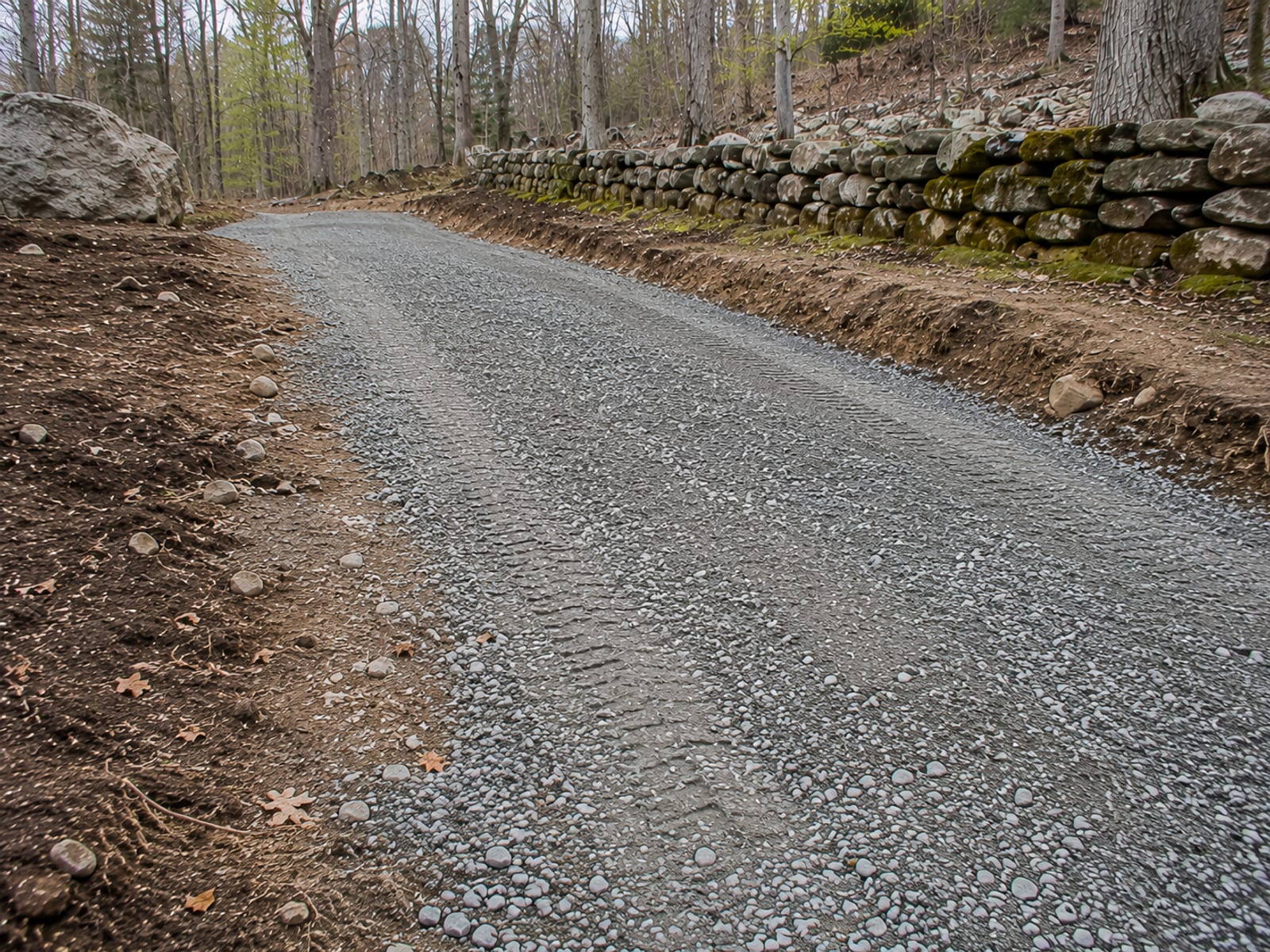
It almost always comes back to one of two problems: not enough depth or not enough drainage. Connecticut's frost line runs deep, and ground that freezes and thaws repeatedly will heave, shift, and crack a poorly built driveway faster than almost anything else. When the base material is too thin or water gets trapped under the surface, the freeze-thaw cycle does its damage and the driveway starts breaking apart within a few seasons.
Clay soil, which is common across much of the Naugatuck Valley, holds water instead of draining it away. If excavation does not remove that clay and replace it with properly compacted crushed stone, the sub-base stays wet, stays soft, and eventually fails under load. Buried boulders and ledge add another layer of complication, since they can create uneven bearing points under the finished surface if not addressed during excavation.
The other common failure point is drainage pitch. A driveway that does not shed water off its surface and away from the edges will pool, erode, and undercut its own base. Getting the crown right and directing runoff into swales or off the shoulder is not optional on a quality driveway project. It is the deciding factor in long-term performance.
What the Excavation Process Looks Like, Start to Finish
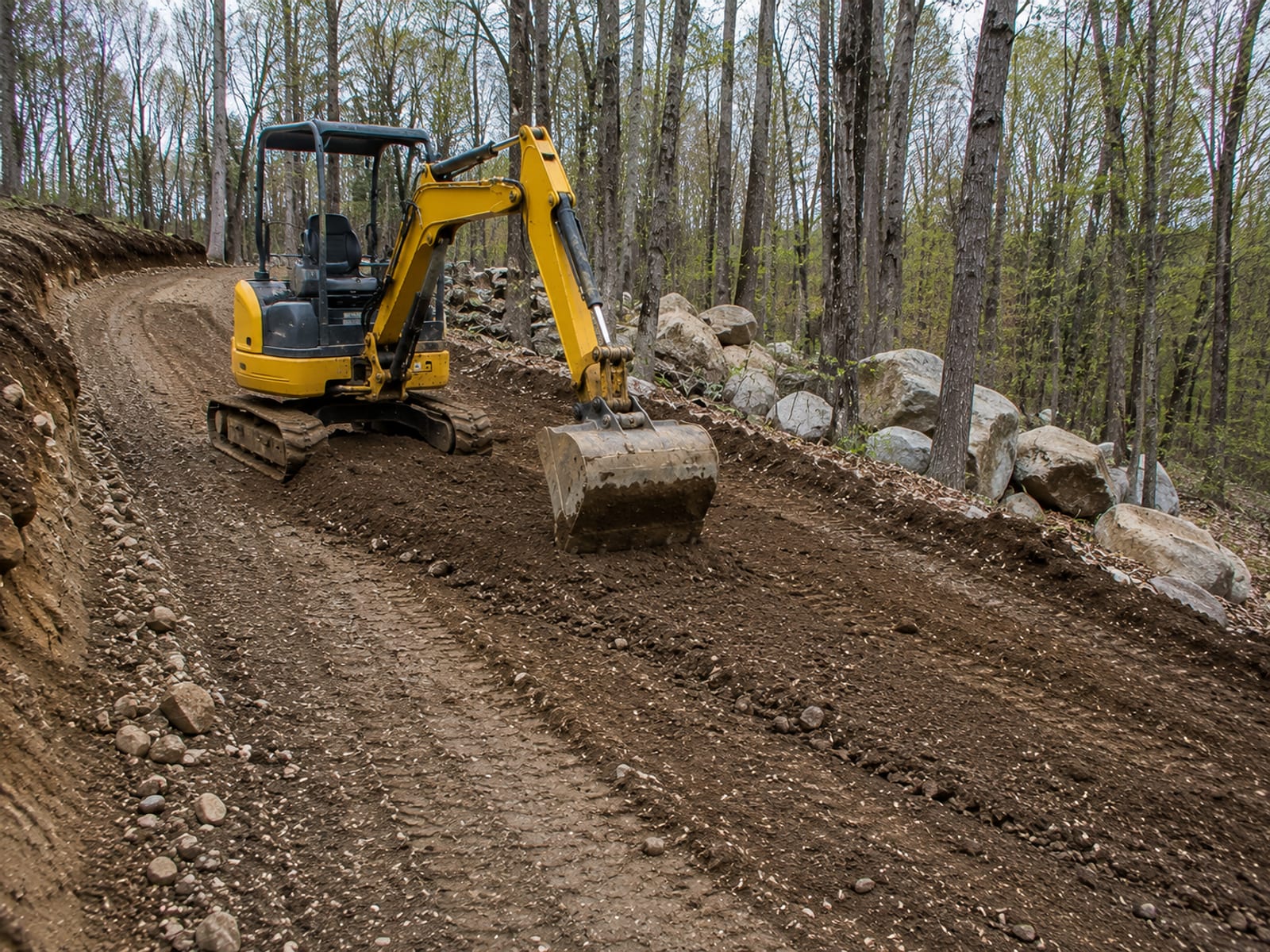
Every driveway and roadway excavation project follows a clear sequence. Skipping steps is how problems get buried and show up three winters later.
Site Review and Access Planning
Before any digging starts, the crew walks the site to check slope, drainage flow, soil type, tree and rock locations, and how equipment will access the work area. Road connection points and any existing culverts or utilities are noted. Potential problem areas, including low spots, clay zones, and buried stone, are flagged so the plan accounts for them from the start.
Utility Marking Through Call Before You Dig
Connecticut requires all excavation work to go through the Call Before You Dig system before any ground is broken. Underground utilities including electric, gas, water, and telecom are marked in the work area. This is a legal requirement and a safety step that protects both the crew and the property owner. Prestige Property Maintenance handles this coordination before mobilizing equipment.
Excavation to Proper Depth
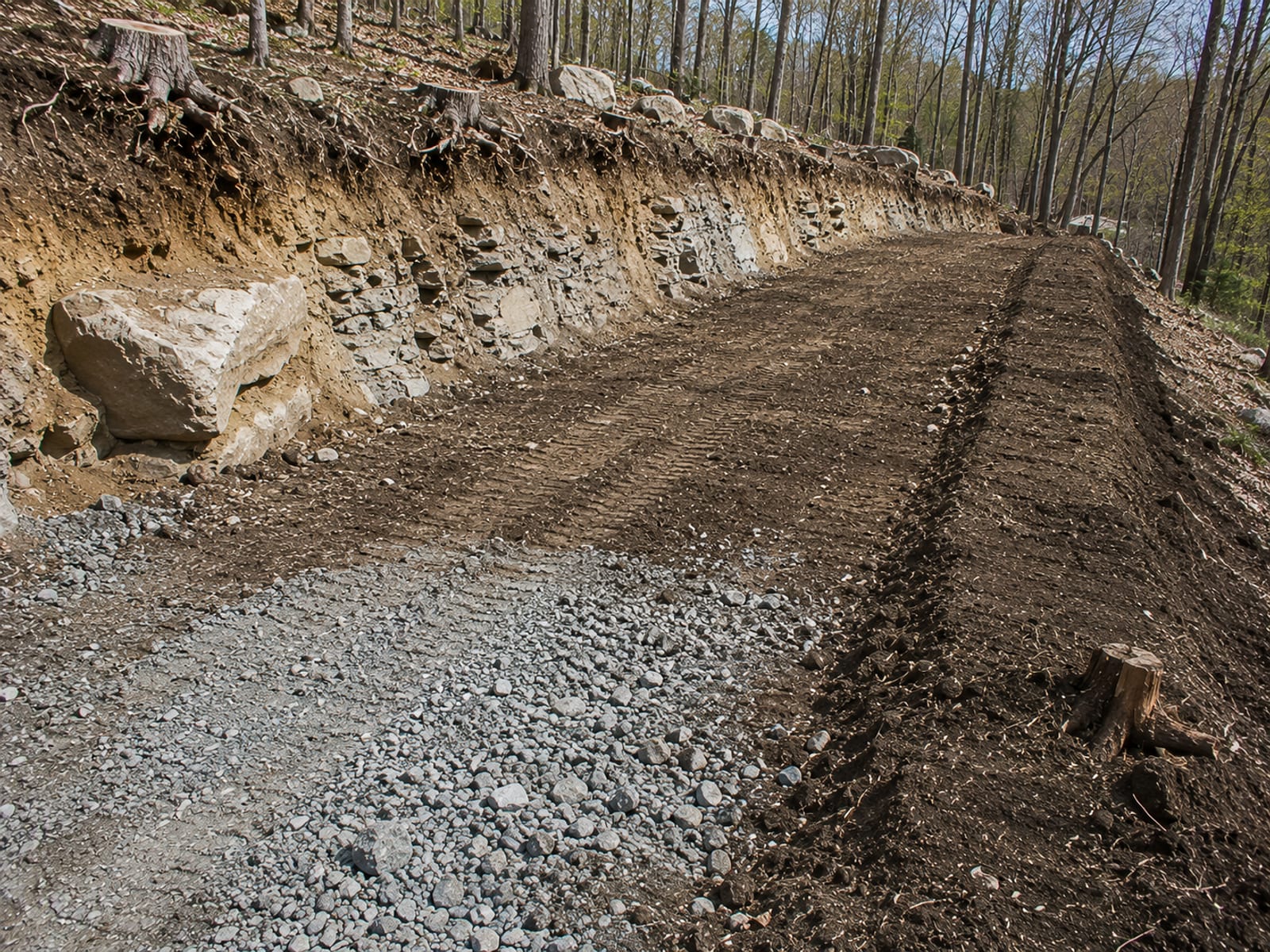
The crew strips out topsoil, organic material, old failed base, and any unsuitable soil. Depth depends on the soil conditions found on site, the expected vehicle loads, and the final surface type. In soft or clay-heavy ground, excavation goes deeper to reach stable bearing soil. Buried boulders and ledge encountered during excavation are addressed at this stage rather than worked around.
Learn more about ExcavationCrown and Drainage Pitch Established
The roadbed is shaped with a slight crown in the center so water runs toward the shoulders rather than pooling in the travel path. Side drainage pitch and runoff direction are set at this stage, and any culvert crossings or swale connections are incorporated into the graded profile. Getting this right during excavation is far easier and less expensive than correcting drainage problems after paving.
Base Material and Compaction
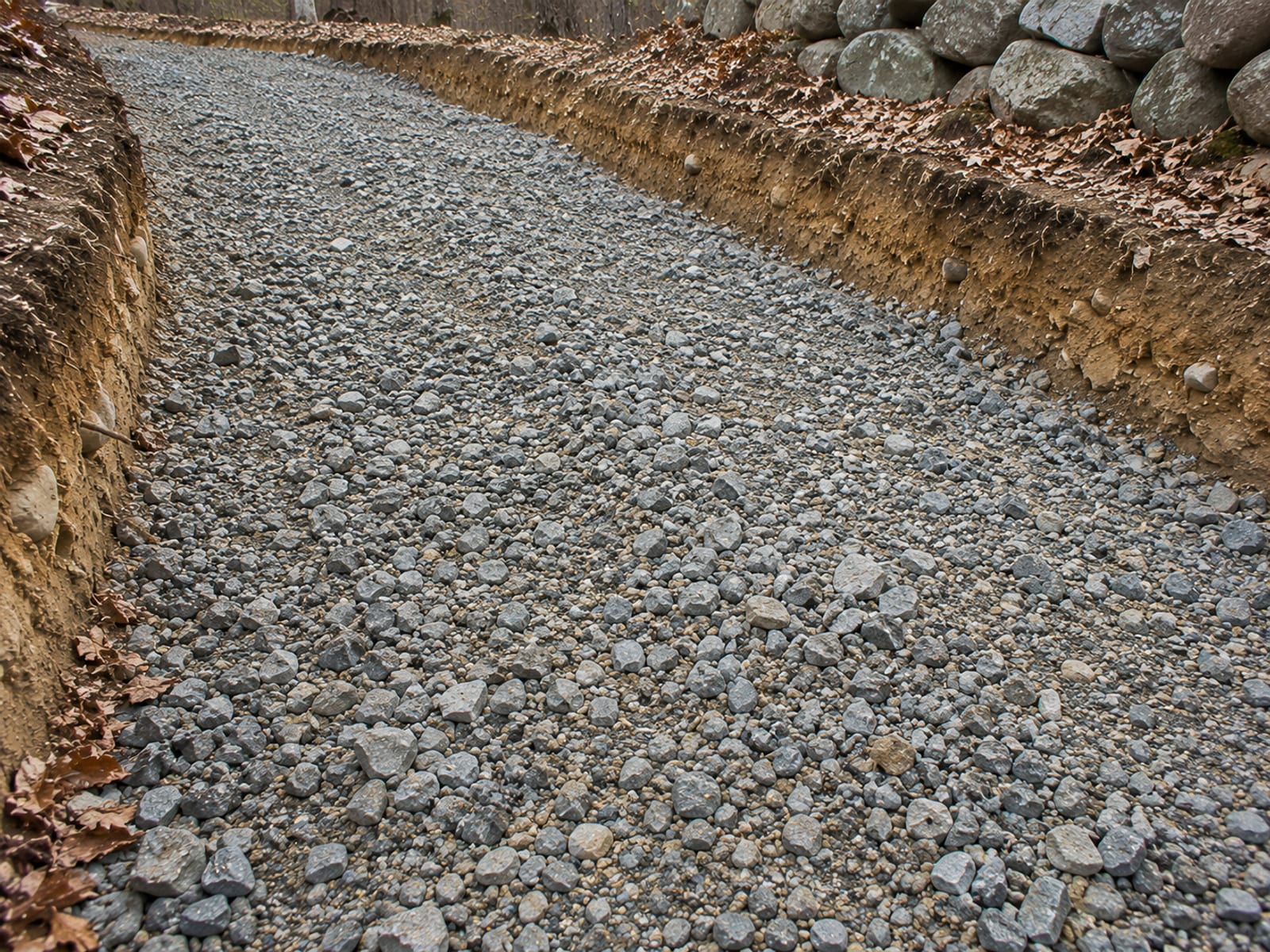
Crushed stone is brought in and spread in lifts, with each layer compacted before the next is added. Compaction is what gives the driveway its long-term load-bearing strength. Weak or improperly compacted base is the most common reason driveways rut and develop soft spots. Where soft or wet soil conditions are severe, geotextile fabric is placed between the subgrade and base stone to prevent mixing and maintain separation over time.
Final Grade and Surface Prep
The finished roadbed is graded smooth, checked for consistent pitch, and prepared for the next trade, whether that is a gravel application, a paving crew, or a paving prep phase. At this point the driveway or road corridor is ready to receive its final surface with a stable, properly drained foundation underneath.
What Types of Projects Does This Cover?
Driveway and roadway excavation at Prestige Property Maintenance covers a range of residential and private road situations common across rural and semi-rural Connecticut.
New Residential Driveways
Full excavation for a new driveway from the road connection to the parking area or garage. Includes soil removal, sub-base preparation, crown and pitch grading, and surface prep for gravel or paving.
Long Rural Driveways
Rural properties in towns like Monroe, Roxbury, Bridgewater, and Woodbury often have long access drives crossing slopes, wet areas, and rocky ground. These projects require drainage planning, culvert crossings, and sometimes rock removal alongside the excavation work.
Private Roads and Shared Lanes
Shared private lanes serving two or more properties, or private roads on larger parcels, need the same engineering approach as a public road at a smaller scale. Proper crown, drainage structures, and a compacted base make the difference between a road that lasts and one that washes out every spring.
Driveway Replacement and Rebuilds
When an existing driveway has failed due to poor original construction, drainage problems, or frost damage, the right fix is to excavate the entire failed section, correct whatever was wrong below the surface, and rebuild it properly rather than top-dress over the original problem.
Steep Slope and Hillside Driveways
Driveways cut into hillsides present specific challenges around slope stability, cut bank erosion, and drainage management. Prestige Property Maintenance has experience grading steep access drives that require careful bench cutting and slope drainage to stay passable year-round.
Paving Prep Coordination
When a paving contractor is coming in to lay asphalt, the excavation and sub-base work has to be done first and done correctly. Prestige Property Maintenance regularly works as the excavating sub on paving projects, handling everything below the surface so the paving crew arrives to a ready roadbed.
Learn more about Paving PrepWhat Makes Connecticut Driveway Excavation Harder Than Most People Expect
Connecticut sits on some of the most challenging glacial soil in the Northeast. The glaciers that moved through this region left behind a mix that includes dense clay, sandy loam, gravel, buried boulders, and exposed ledge rock, sometimes all within the same project site. What you hit when you start digging can change significantly within twenty feet. A crew that has worked this ground knows to expect it and comes prepared with equipment and a plan for handling what comes up.
Ledge is a good example. In towns like Oxford, Woodbury, Naugatuck, and Wolcott, hitting ledge during driveway excavation is not unusual. If a contractor is not equipped to break and remove it, the project stops. Prestige Property Maintenance handles rock removal as part of its own excavation scope, so a ledge encounter does not mean calling a second contractor and waiting weeks to get the project moving again.
Clay soil is the other variable that catches people off guard. Clay holds water, and a driveway base sitting on clay will stay saturated through wet seasons and lose its load-bearing strength. When the crew encounters significant clay pockets during excavation, the solution is to remove the clay to a stable depth and replace it with properly compacted crushed stone. That costs more upfront, but it is the only way to get a driveway that performs for ten to twenty years instead of three to five.
Slope and drainage are the third piece. The Naugatuck Valley has a lot of hilly terrain, and a driveway that drains poorly on a slope will erode the shoulder, undercut the base, and eventually wash out. Setting the right pitch, building in culverts where needed, and directing runoff away from the roadbed is part of the excavation work, not something to figure out after paving.
Why Property Owners in Oxford and the Naugatuck Valley Call Prestige Property Maintenance
One of the biggest frustrations with driveway projects is the coordination gap. You hire a tree service to clear the corridor, then wait for an excavator, then call a separate paving prep contractor, and then schedule the paving crew. Every handoff is a scheduling risk, and a mistake by one trade creates problems for the next. Prestige Property Maintenance handles the clearing, stump grinding, rock removal, excavation, grading, drainage work, and paving prep under one crew. That means one schedule, one point of contact, and no waiting for trades to line up.
The company has been working in this part of Connecticut since 2015 and has specific experience with the soil conditions, terrain, and permit considerations that come up in the Naugatuck Valley and western Connecticut. When the crew shows up to a job in Shelton or Southbury, they are not guessing at what they will find. They know this ground.
Prestige Property Maintenance is licensed and insured, holds HIC# 0704432, and works Monday through Saturday from 7 AM to 5 PM. Those credentials are easy to verify and they matter.
Driveway and Roadway Excavation: Questions We Hear Often
These are the questions that come up most often when homeowners are planning a driveway excavation project in Connecticut.
How deep does a driveway need to be excavated in Connecticut?
The excavation depth depends on the soil type, the expected vehicle loads, and the final surface. In most Connecticut residential situations, excavation removes topsoil and unsuitable material to reach stable subgrade, then a compacted crushed stone base of eight to twelve inches is installed on top. Clay-heavy or soft ground requires going deeper to find stable bearing soil. The freeze-thaw cycle here makes proper depth non-negotiable. A base that is too shallow will heave and crack within a few winters.
Do I need a permit for driveway excavation in Connecticut?
Permit requirements depend on where the driveway connects and what it disturbs. Work that touches or affects a state highway right-of-way may require a CTDOT encroachment permit. Work within a municipal road right-of-way typically requires a local road opening or driveway permit from your town. Projects disturbing larger areas may trigger stormwater or erosion control requirements at the state or local level. Any driveway project near wetlands or inland watercourses may also need inland wetlands review. Prestige Property Maintenance coordinates utility marking through Connecticut's Call Before You Dig system before all excavation work.
What happens if we hit ledge rock or boulders during the driveway excavation?
It is a real possibility in most of the towns Prestige Property Maintenance serves. Oxford, Woodbury, Naugatuck, Wolcott, and much of the Naugatuck Valley sit on glacially deposited terrain with buried boulders and ledge close to the surface. When that comes up during excavation, rock removal becomes part of the project. Because Prestige Property Maintenance handles rock removal as part of its own scope, hitting ledge does not stop the job or require bringing in a separate contractor.
How long does a residential driveway excavation typically take?
A straightforward residential driveway excavation, from stripping to graded sub-base, usually takes one to three days depending on the length of the driveway, the soil conditions, and whether rock removal or drainage structures are part of the work. Longer private roads, steep hillside driveways, or projects that include clearing and stump removal will run longer. Prestige Property Maintenance reviews each site before providing a schedule estimate so there are no surprises once work begins.
Should I fix the drainage at the same time as the driveway excavation?
Yes, and it is much less expensive to do drainage work during excavation than to come back and cut open a finished driveway later. If there are areas that hold water, sections that wash out seasonally, or low spots along the route, those problems need to be addressed at the sub-base level. Culvert crossings, side swales, and catch basins are all far easier to integrate into the project while the ground is already open. Drainage solutions are part of Prestige Property Maintenance's service scope, so both pieces can be handled without bringing in a separate contractor.
Can you excavate a driveway and prepare it for paving in the same project?
That is a common project sequence for Prestige Property Maintenance. The excavation and sub-base work are completed, and then the roadbed is handed off ready for a paving contractor to lay asphalt. Paving prep, including the final grade check, compaction verification, and surface leveling, is a listed service. For property owners coordinating with a paving company, Prestige Property Maintenance can work directly with the paving crew to make sure the sub-base meets their requirements before they mobilize.
Do you handle driveway excavation for commercial properties or just residential?
Both. Prestige Property Maintenance works with residential homeowners on new driveways and rebuilds, and also serves commercial developers, builders, and general contractors who need excavating and site prep for access roads, parking areas, and private road construction. The equipment fleet handles residential-scale projects and larger commercial site work within the 19-town service area.
Serving These Connecticut Towns for Driveway and Roadway Excavation
Prestige Property Maintenance provides driveway and roadway excavation services across 19 towns in the Naugatuck Valley and western Connecticut. The service area includes Oxford, Derby, Bethany, Seymour, Ansonia, Shelton, Monroe, Bridgewater, Roxbury, Woodbury, Middlebury, Southbury, Naugatuck, Woodbridge, Prospect, Newtown, Oakville, Watertown, and Wolcott.
Each of these towns has its own character in terms of terrain, soil, lot size, and road access. Rural towns like Bridgewater and Roxbury have long driveways on wooded hillside lots where drainage and rock removal are routine parts of the job. More developed towns like Shelton, Naugatuck, and Watertown often involve residential rebuild projects where a failing original driveway needs to be excavated and reconstructed properly. Prestige Property Maintenance has worked across all of them and brings that local experience to every project.

Ready to Build a Driveway That Holds Up?
Call (203) 258-3395 or email dig@prestigectexcavation.com