Drainage Excavation Services in Middlebury, CT
Kash CochranePublished Updated
- drainage
- erosion control
- middlebury ct
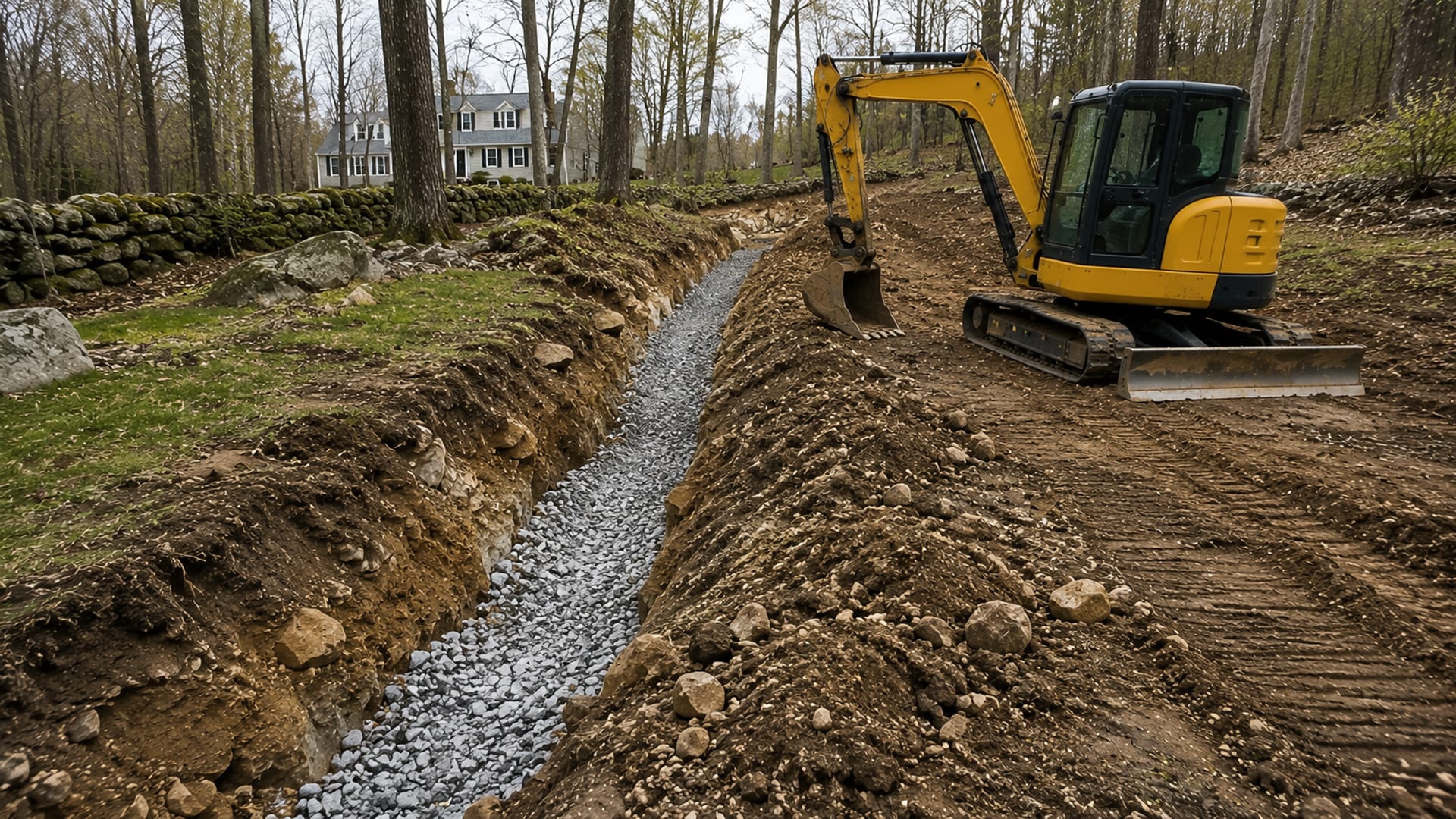
Same spot, same puddle, every storm, and you already know something is wrong. Maybe a landscaper came out and said you need an excavator. Maybe you got a quote from someone who couldn't really explain what they planned to do or where the water would go when they were finished. Drainage excavation in Middlebury CT comes with a layer of complexity that most homeowners don't anticipate, and that uncertainty can make it hard to move forward with confidence. Middlebury properties often sit on sloped terrain with rocky glacial soil, wooded lots, mature trees, and established drainage patterns that don't behave the way a textbook diagram suggests. A soggy yard, a washed-out driveway, or water creeping toward a foundation after heavy rain isn't just a nuisance; it's a sign that water is moving somewhere it shouldn't be, and a trench alone won't fix that. What you actually need is a contractor who can read the full picture of how water moves across your specific property. The rest of this page walks through what that process looks like in plain language, so you can tell the difference between a thorough approach and one that may leave you with a bigger problem than you started with.
Key Takeaways
Drainage excavation manages water movement
The goal is to move water safely away from problem areas, not simply dig a trench and call it finished.
Middlebury properties can be drainage-sensitive
Slopes, rocky soil, wooded lots, septic systems, and older drainage patterns all affect what solution will actually work.
Grading and drainage often work together
A new drain may not help much if the surrounding grade still directs water toward your home or toward a neighbor's yard.
Utility markouts matter
Drainage trenches should never be dug without first identifying underground utilities through Connecticut's Call Before You Dig system.
Permits or reviews may apply
Wetlands proximity, driveway work, stormwater impact, and discharge location can all bring local review requirements into the project.
Restoration should be part of the plan
Disturbed soil needs proper grading, stabilization, and cleanup after excavation work is complete.
Why Drainage Excavation Matters in Middlebury CT
Water problems on a residential property rarely stay in one place. When drainage fails, the effects can spread to driveways, retaining walls, foundation areas, landscape beds, patios, walkways, and neighboring lots. Connecticut weather adds pressure to all of this: heavy rain events, spring snowmelt, freeze-thaw cycles, and seasonal storm runoff can expose weak points in a drainage system that might hold up fine during a dry stretch. According to the Connecticut DEEP's soil erosion and sediment control guidelines, poorly managed stormwater can cause lasting damage to soil structure and adjacent areas, which is why controlling where water goes matters beyond just the immediate wet spot.
Middlebury's terrain makes this more complicated than it is in flatter parts of the state. Many properties here have significant grade changes, wooded slopes that channel runoff in unpredictable ways, and soil that contains plenty of the rocky glacial material common across central Connecticut. That rock can block water from percolating down through the soil the way it would on a sandy lot. When water has nowhere to go down, it moves sideways, and it tends to find the lowest point it can reach, which may be your yard, your driveway base, or your foundation.
Water problems usually follow a path
A contractor doing yard drainage work in Middlebury CT should not just look at where the water sits. They should trace the full path: where it comes from, what slope or surface it travels across, where it collects, and where it can safely exit the property. Roof runoff, driveway pitch, low spots in the lawn, and existing drain lines all feed into that picture. UConn NEMO's soil erosion guidance makes clear that surface water management requires understanding how water moves across the site before any corrective work begins. Skipping that step is how a drainage project ends up solving one problem while creating another downstream.
Signs You May Need Drainage Excavation
Not every wet yard needs a full excavation, and not every soggy spot is a sign of a failed drainage system. But there are patterns that tend to point toward a need for drainage excavation work rather than a simpler surface-level fix. A contractor who walks the property carefully can usually tell which category a problem falls into, but knowing the signs yourself helps you ask the right questions before anyone picks up a shovel.
Standing water and erosion are the most obvious symptoms, but the cause behind each one shapes the solution, and those causes aren't always obvious from the surface.
Standing water or soggy lawn areas
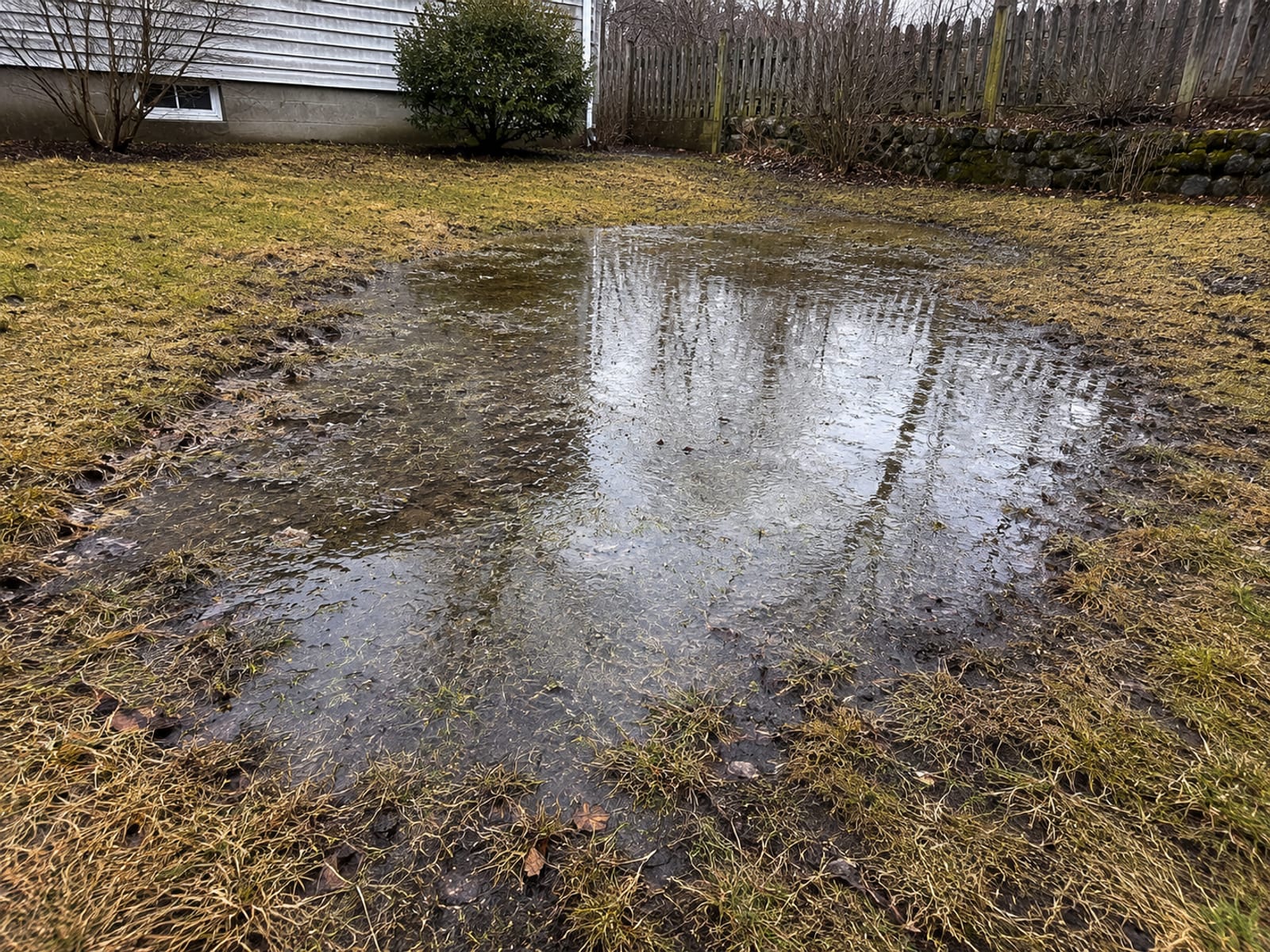
If water sits in the same spot after every storm or takes days to drain away, the yard may need regrading, a French drain, a swale, a catch basin, or a better discharge point. Sometimes the issue is that the grade has settled over time and created a low spot that now acts like a bowl. Other times, the soil is compacted or has a shallow rock layer that prevents water from moving through it. Connecticut's stormwater management standards describe how surface drainage performance depends on both the physical drainage system and the surrounding grade working together. If one element is off, the other can't carry the load alone.
Driveway washouts or erosion
Driveway drainage problems are common on Middlebury properties where the driveway follows a slope and surface water has nowhere to go but straight down it. When gravel, soil, or mulch keeps washing away after rain, water is likely moving too fast across a surface that isn't directing it to a safe discharge point. Erosion guidance from UConn NEMO notes that repeated erosion events can degrade the underlying material and compound the problem over time. Driveway washout repair often requires excavation to correct the grade, install drainage pipe, or add a catch basin at a low point so water exits before it damages the surface.
Drainage Excavation Solutions
The right drainage solution depends on the specific property conditions: the soil type, slope, water source, and most importantly, where the water can safely discharge. Connecticut's stormwater management standards outline how drainage systems need to address both collection and outlet, not just one or the other. There is no single answer that fits every Middlebury property, and a contractor who leads with one solution before assessing those conditions may not be giving you the full picture.
Many projects end up combining more than one approach, and understanding each option helps you follow the reasoning behind a contractor's recommendation.
French drains, pipe, and catch basins
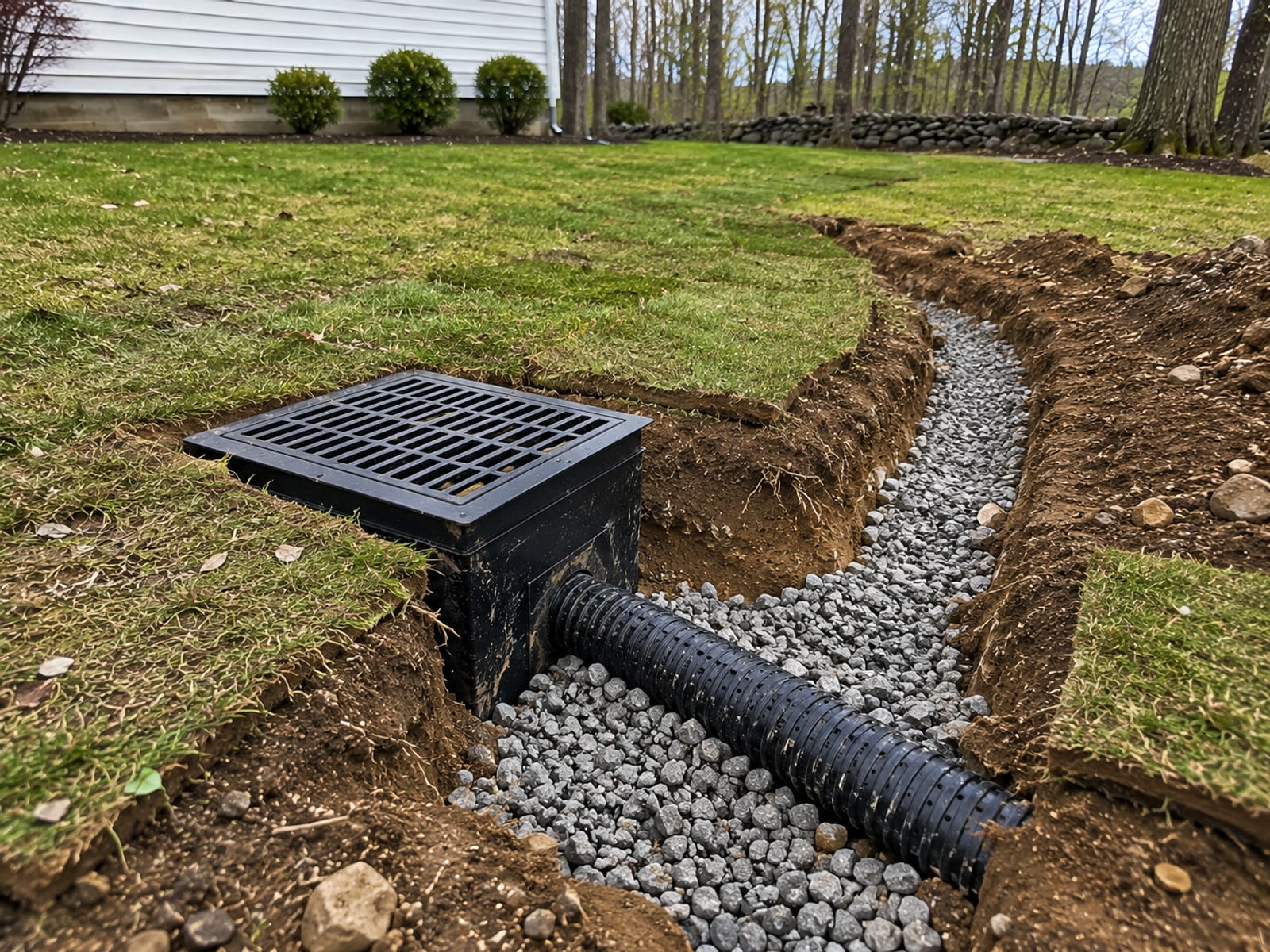
French drain excavation in Middlebury CT typically involves digging a trench, laying perforated pipe in a bed of stone, and directing water away from the problem area toward a safe outlet. Catch basin installation adds a collection point at a low spot where surface water pools, then connects that basin to pipe that carries the water off the property or to a better discharge location. These systems can work well for wet yard problems, foundation-area drainage, and driveway drainage correction, but they depend on having a viable discharge point. A trench that fills with water and has nowhere to send it is just a hole in the ground that takes longer to drain.
Swales and grading
Swale excavation reshapes the land itself to create a channel that guides surface water across the yard and off the property. Grading is often part of this work, correcting low spots and redirecting flow so water doesn't collect in the wrong places. Swales work well on larger lots with enough room to move water gradually downhill, and they can reduce the amount of underground pipe needed. When a yard's grade is significantly off, grading may need to happen before or alongside any pipe work, because a correctly installed drain in a wrongly pitched yard may still leave you with standing water after heavy rain.
Permits, Utilities, and Discharge Rules
Drainage excavation is not always a dig-and-go operation. Because it changes how water moves across a property and potentially onto neighboring land, town roads, or wetland areas, there are local and state-level considerations that may come into play depending on the project scope and location. Understanding these factors before work begins can prevent delays and protect you from liability if something goes wrong downstream.
A contractor familiar with drainage work in Middlebury should be able to identify which of these factors apply to your project and help you understand what needs to be addressed before excavation starts.
Utility markouts
Before any drainage trenching in Middlebury CT, underground utilities need to be identified. Connecticut's Call Before You Dig system, also administered through PURA's pipeline safety program, allows contractors to request utility markouts so gas lines, water lines, electrical conduits, and other buried services are located before anyone digs. Skipping this step is not just a safety issue; it can result in service disruptions, repair costs, and liability. On Middlebury properties that also have wells and septic systems, the underground picture can be complicated, and those systems need to be accounted for in the trench layout.
Wetlands, stormwater, and erosion control
Work near wetlands, watercourses, town roads, or culverts in Middlebury may require review by the Inland Wetlands Commission, the Planning and Zoning Commission, or the Building Department, depending on the scope and location of the work. Middlebury has wetland-sensitive areas throughout the town, and drainage discharge that directs water toward a wetland or watercourse may trigger review requirements. The Connecticut DEEP's Construction Stormwater General Permit applies to certain disturbed-area thresholds, and sediment control measures may be required on active excavation sites to prevent runoff during construction. Erosion control is not just a regulatory checkbox; it's part of doing the work correctly so the soil doesn't wash away before the drainage system is stabilized.
The Drainage Excavation Process
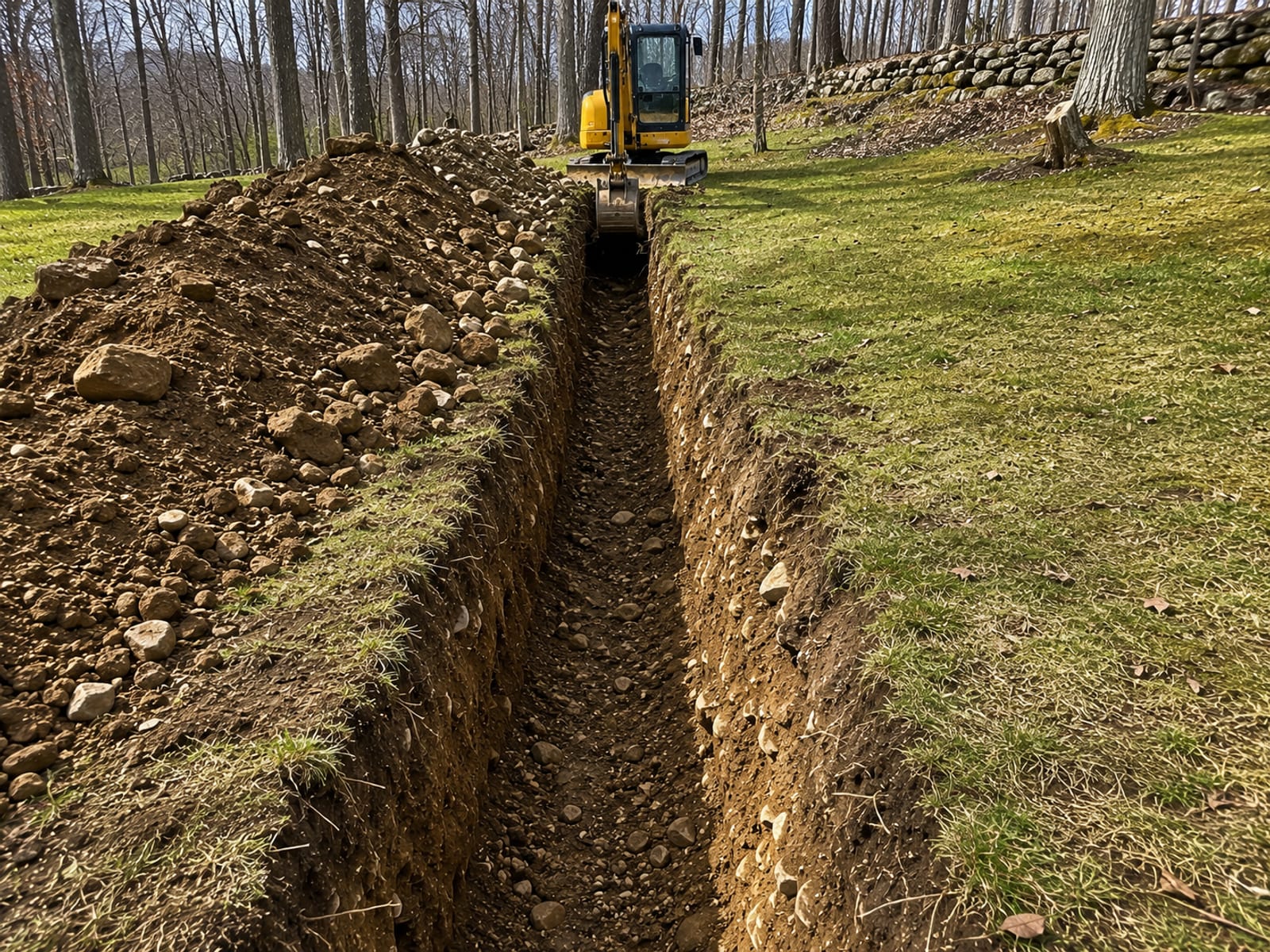
A professional drainage excavation project should follow a clear sequence, and that sequence should be explained to you before any equipment arrives on the property. The steps aren't complicated to understand, but they require a contractor who looks at the whole site rather than just the spot where water is sitting. Connecticut DEEP's erosion and sediment control guidelines describe a site-assessment-first approach that good drainage contractors already follow as a matter of practice.
Each step below builds on the one before it. Knowing what's involved helps you evaluate whether a contractor is giving you a real plan or just a number.
Step 1: Inspect the water path
Before recommending any solution, a drainage contractor in Middlebury CT should walk the full site. That means looking at the slope of the yard, where roof gutters discharge, how the driveway is pitched, where low spots have formed, what existing drains or pipes are present and whether they're functioning, what the soil type is, where utility lines run, and where water can realistically exit the property. On a Middlebury lot with trees, rocks, and elevation changes, this inspection may take time. That time is worth it, because the answers shape every decision that follows, from what kind of drain to install to whether rock removal will be needed, to how the site will be restored when the work is done.
Step 2: Excavate, install, grade, and stabilize
Once the plan is set, the contractor excavates the trenches or swales, installs the drainage pipe, stone, and catch basins where needed, grades the surrounding area so water flows correctly, and stabilizes the disturbed soil. Rock removal is sometimes necessary on Middlebury properties where glacial rock runs close to the surface, and that can affect both the timeline and the scope of the project. After the drainage system is in place, the disturbed soil needs to be properly graded and stabilized, whether that means topsoil, seed, erosion blanket, or some combination. A drainage project that leaves raw, loose soil behind is not finished; it's a step away from a new erosion problem.
Long-Term Strategy for Drainage Control
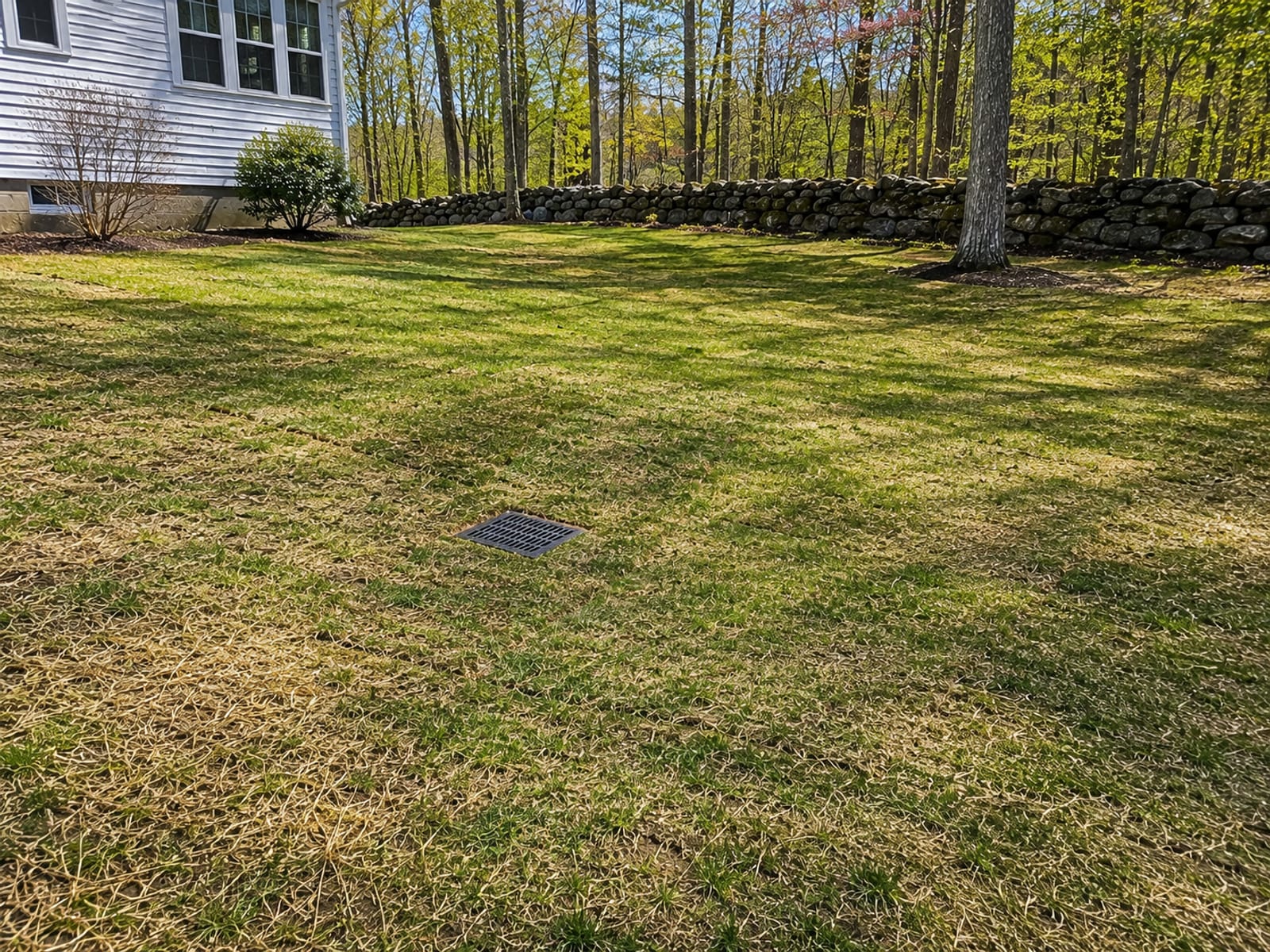
Drainage work done correctly doesn't need to be redone every few years. But getting to that outcome requires treating the property as a whole system rather than fixing one symptom at a time. Connecticut's stormwater management standards describe stormwater management as a site-wide responsibility, and that framing holds true at the residential level too.
When thinking about long-term drainage control on a Middlebury property, the questions worth asking are straightforward. Where does the water start? Where will it go when the new system is in place? Does the grade support that path? What happens during a heavy storm when volume is higher than normal? And what will the site look like after the work is done? A contractor who can answer all of those questions before work begins is in a different category from one who can only describe what they're going to dig.
Common Pitfalls
Drainage excavation projects run into trouble in predictable ways, and most of them trace back to the same handful of mistakes. A thorough contractor anticipates these before the first shovel hits the ground.
- Digging without a discharge plan: A trench that has no outlet is not a functioning drain. Water will fill it and sit there.
- Ignoring grade: If the surrounding yard still pitches water toward the problem area, a drain may reduce standing water without solving it.
- Sending water toward a neighbor: Redirecting water off your property in a way that floods an adjacent lot creates liability and may require correction at your expense.
- Skipping utility markouts: Digging without contacting Connecticut's Call Before You Dig system puts underground services at risk and can be a safety issue.
- Using the wrong material: Pipe size, stone type, and filter fabric all matter. Undersized or incorrect materials reduce how long the system functions correctly.
- Failing to stabilize disturbed soil: Loose, unprotected soil after excavation can erode before vegetation establishes, undoing some of the drainage work.
- Assuming every wet yard needs the same fix: Standing water caused by compacted soil needs a different approach than standing water caused by a failed pipe or a missing discharge point.
Frequently Asked Questions About Drainage Excavation Middlebury CT
What is drainage excavation?
Drainage excavation is the digging and grading work used to install or repair drainage systems such as French drains, swales, catch basins, drainage pipes, and culverts. It addresses the underground and grading elements that surface fixes can't reach. On residential properties in Middlebury, it often includes trenching, stone installation, pipe laying, and site restoration after the drainage system is in place.
Can drainage excavation fix standing water in my yard?
It can help significantly when the problem comes from poor slope, blocked or missing drainage, or a lack of a safe water path off the property. Some yards need both grading and drainage installation together to get a lasting result. Connecticut's stormwater management standards recognize that surface drainage performance depends on the grade and the collection system working in combination.
Do drainage projects need permits in Middlebury CT?
It depends on the scope and location of the work. Factors that may trigger local review include proximity to wetlands or watercourses, driveway work that affects a town road, stormwater discharge volume, and the total area of ground disturbance. The Middlebury town website and its individual departments are the right place to check requirements before work begins.
Do utilities need to be marked before drainage excavation?
Yes. Before excavation starts, utility markouts should be completed through Connecticut's Call Before You Dig system. This applies to drainage trenching just as it does to any other subsurface work. On Middlebury properties that have wells and septic systems in addition to buried utilities, knowing what's underground before digging is not optional.
Is a French drain always the best drainage solution?
No. A French drain works well in certain situations, but the best solution depends on where the water comes from, what the soil and slope conditions are, where the water can discharge, and what other structures or systems are nearby. Some sites need swale excavation, some need catch basins, some need grading corrections, and some need a combination. A site inspection should come before any recommendation.
What should a drainage excavation estimate include?
A complete estimate should cover excavation, trenching, pipe and fittings, stone, catch basins if applicable, grading, material hauling, rock removal if the soil conditions require it, erosion controls during construction, and final site restoration and cleanup. It should also note what conditions could change the scope, because buried rock, undocumented pipes, saturated soil, or unexpected discharge limits can all come up once digging starts.
Final Thoughts
Drainage excavation in Middlebury CT is not a one-size-fits-all service. The right solution depends on understanding how water moves across a specific property, from where it originates to where it can safely discharge, and on managing the soil, grade, and site conditions that affect every step in between. Grading and drainage work together; permits and utilities are real factors; and restoration after excavation is part of the job, not an afterthought. Getting these pieces right is the difference between a drainage system that performs for years and one that shifts the problem somewhere else.
When drainage work is done correctly, the long-term outcome is a property that handles rain, snowmelt, and seasonal runoff without the erosion, soggy spots, or driveway damage that prompted the call in the first place. That kind of result also protects the investment in everything else on the property: the driveway base, the retaining walls, the foundation, and the landscaping.
At Prestige Property Maintenance, we handle the full sequence of drainage excavation work for residential and site-prep projects in the Oxford CT and Seymour CT area, including Middlebury and surrounding towns. Our work spans excavation, grading, trenching, French drain installation, catch basin work, swale shaping, rock removal, erosion and sediment control, retaining wall construction, and complete site restoration. If you're dealing with standing water, a washed-out driveway, or water moving toward your foundation and you want to talk through what your property actually needs, contact us to schedule a site visit. We'll walk the property, trace the water path, and give you a clear picture of what the work involves before any equipment arrives.
Related Articles
Grading in Bethany, CT: Taming a Sloped, Wooded Yard
No flat ground and runoff carving channels every spring? Here is what grading in Bethany, CT actually involves on a wooded, sloped property like yours.
Stop the Washout: Erosion Control and Grading in Oxford CT
Oxford CT homeowners: erosion control starts with grading, not just seed and silt fence. See how Prestige Property Maintenance fixes the real source of runoff damage.
Drainage Excavation to Eliminate Standing Water in Oxford CT
Standing water in Oxford CT means more than a soggy lawn. See how drainage excavation fixes the real problem beneath the surface before it damages your home.