

Bethany, CT Drainage Solutions for a Soft Lawn or Damp Basement
Kash CochranePublished
- drainage
- bethany ct
- wet basement
- wetlands
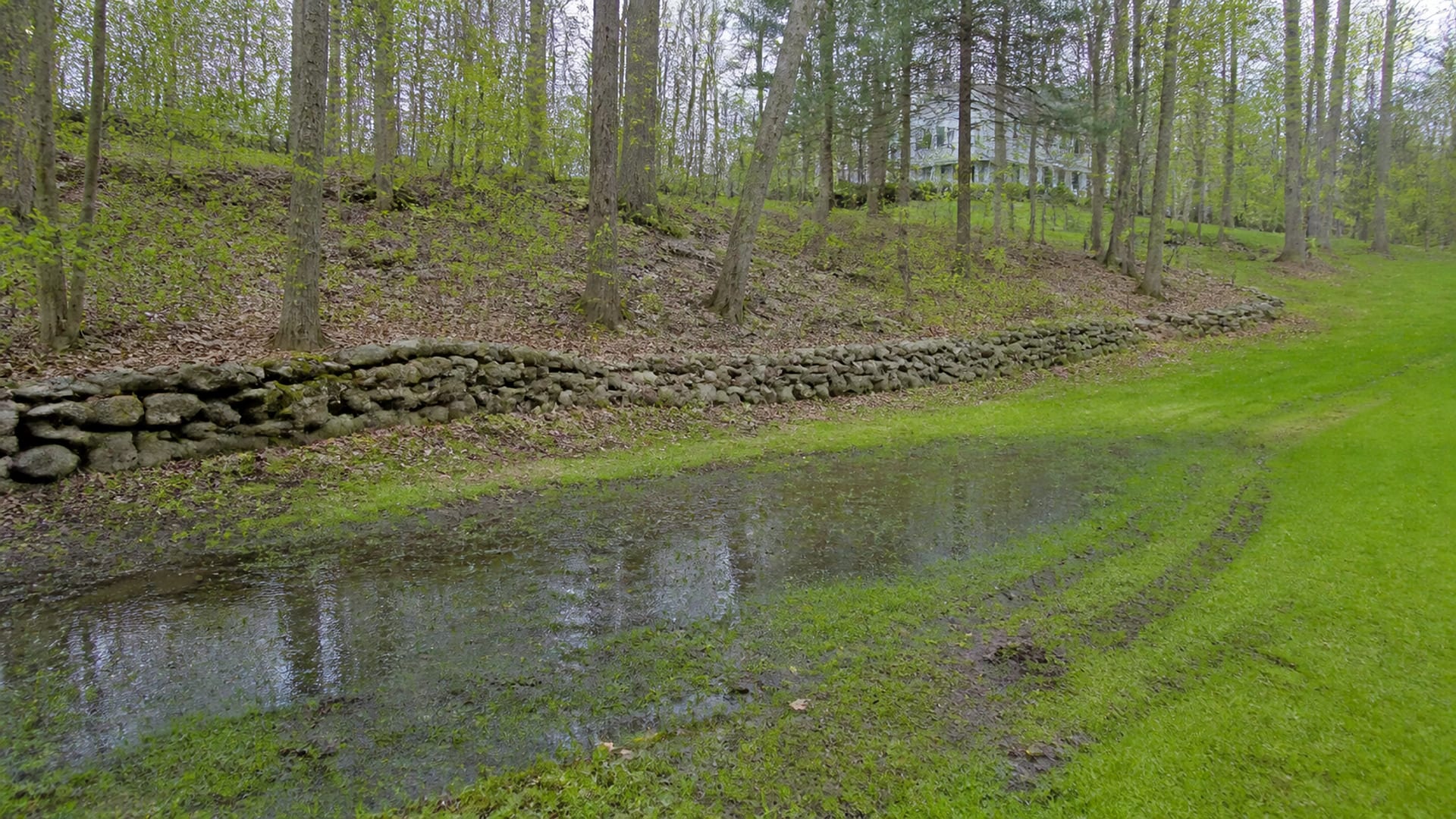
You have already tried the obvious things. The downspouts got extended. A low spot got filled. Somebody suggested a French drain and you nearly booked one. And yet the lawn is still soft enough to leave a footprint in June, the mower still marks it up, and the basement still smells like a basement no matter how long the dehumidifier runs. There is a reason the small fixes only nibble at it: on a rural upland lot in Bethany, a good share of the water on your property never fell on your property. It arrived, moving downhill through the ground from somewhere above you. A drain that does not account for that is a trench full of stone that solves the wrong problem.
Key Takeaways
The source decides the fix, not the symptom
roof water, surface flow, and groundwater moving laterally through soil each call for a different approach, and only one of the three is solved by a perforated pipe in the lawn.
A drain without a destination is not a drain
every system needs an outlet that is stable, reachable by gravity or by design, and lawful, and the outlet is usually the constraint that shapes everything upstream of it.
Bethany regulates a 150 foot band, not just wet ground
the town's wetlands regulations treat clearing, grading, excavation, construction, material movement, and stormwater discharge within 150 feet of a wetland or watercourse boundary as regulated activity, so a trench in dry lawn can still need review.
You cannot send your water onto the neighbor
Bethany's zoning rules require drainage work not to cause erosion, flooding, deposits, or the diversion or concentration of flow onto another property without written consent.
The locate does not find your own lines
a CBYD ticket marks participating utility facilities. Irrigation, invisible fence, a private electric run, propane, septic components, and old site drains are identified separately, usually from your own records.
Stop Buying a Drain and Start Tracing the Water
Almost every wasted drainage dollar comes from the same move: picking a product before finding the source. It is understandable. A French drain is a thing you can buy, and a wet lawn is a problem you want gone. But a drainage system has three parts, and only the middle one is the pipe.
The first part is the source. Water is arriving from somewhere: a roof, a driveway, a compacted path, a neighbor's slope, a wetland seep, or the water table itself. The second part is conveyance, which is the swale, the pipe, or the stone bed that moves it. The third part is the outlet, meaning where it ends up and what happens when it gets there.
Design runs in that order, and the outlet is very often the piece that decides the whole scheme. If the only safe discharge point is at the low corner of the property, everything upstream has to fall toward it. If there is no gravity outlet at all, the answer changes shape entirely. A contractor who starts by walking the property and asking where the water goes is doing something different from one who starts by quoting a trench, and the difference shows up two years later.
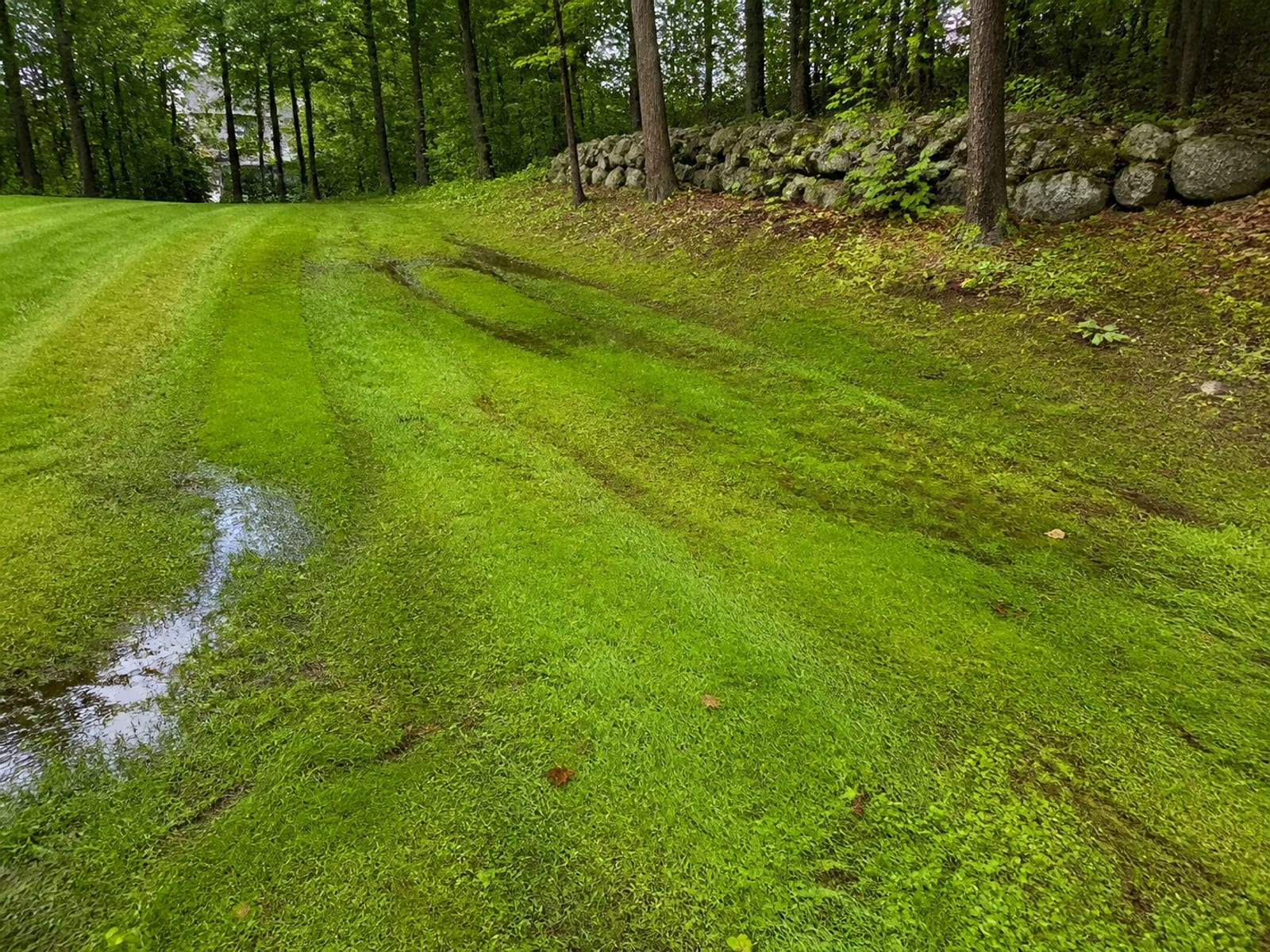
Tell Roof Water, Surface Water, and Groundwater Apart Before You Dig
Most Bethany properties with a persistent wet problem have more than one of these going on at once. Sorting out which is dominant is what a site assessment is for.
| What you observe | Most likely source | What usually addresses it |
|---|---|---|
| Wet ground only within a few feet of the house, worst during and just after rain | Roof runoff discharging too close to the foundation | Gutter and leader work, solid pipe carrying roof water away, grade falling from the wall |
| A puddle that appears in the same low spot and sits for days | Surface grade with no outlet, sometimes over slow draining soil | Surface correction and a shaped route out, or a collection point tied to an outlet |
| Water sheeting off a drive or a hard surface into the lawn | Concentrated runoff from an impervious area upslope | Intercepting and routing at the edge of the hard surface, before it reaches the lawn |
| Ground that stays soft long after rain, sometimes in a band across the slope | Lateral groundwater or a seep moving downhill through the soil | An upslope interception drain, placed to catch it before it reaches the problem area |
| Water appearing at a basement wall or the joint at the floor | Hydrostatic pressure or a failed exterior drainage path | Separate evaluation of the foundation, its exterior drainage, and possibly interior collection |
| A drain that used to work and no longer does | A blocked, crushed, or disconnected existing line or outlet | Inspection of what is already there, which is often cheaper than a new system |
Signs it is roof runoff, surface grade, or a blocked existing line
These are the good news cases, because they are the cheapest to fix. Look for wet ground that tracks the drip line, staining or splash at the base of a wall, a leader that ends in a splash block eighteen inches from the foundation, gutters holding debris, or a grade within the first several feet of the house that falls back toward it. Also look for what is already installed: a catch basin under leaves, a pipe outlet you have not seen in years, a yard drain that has silted up. Inspecting an existing system before replacing it is worth a real conversation.
Signs water is arriving downslope through the soil
This is the pattern that gets missed. The wet area is not the lowest point on the lot. It runs as a band roughly along the contour rather than as a puddle. It persists in dry spells. There may be a change in vegetation across the line, or the ground above it may be markedly drier. Sometimes a seep is visible on a cut bank or at the base of a slope. That signature says the water is moving through soil, and no amount of surface shaping downhill of it will stop it arriving.
Signs the foundation needs its own evaluation
Water at a basement wall, dampness at the wall to floor joint, efflorescence on masonry, or seepage that tracks weather closely all indicate that the structure itself is part of the problem rather than a bystander. Exterior work may fix it. It may not, and where the source cannot reasonably be intercepted outside, interior collection with a sump becomes a legitimate option to consider. That is a decision about the building, not about the lawn, and it should be made on its own evidence.
Match the Fix to the Source Instead of the Symptom
Regrading, swales, and roof water routing
The first thing to try when the source is surface water, and the thing most often skipped in favor of something that sounds more substantial. Roof water carried away in solid pipe, a shallow swale that takes sheet flow across the yard to a safe point, a grade that falls consistently away from the house. Cheap relative to excavation, low disruption, and frequently enough on its own. The limits are real: it does nothing for groundwater, and it needs somewhere for the water to go.
A french drain in Bethany, CT collects water that is already there
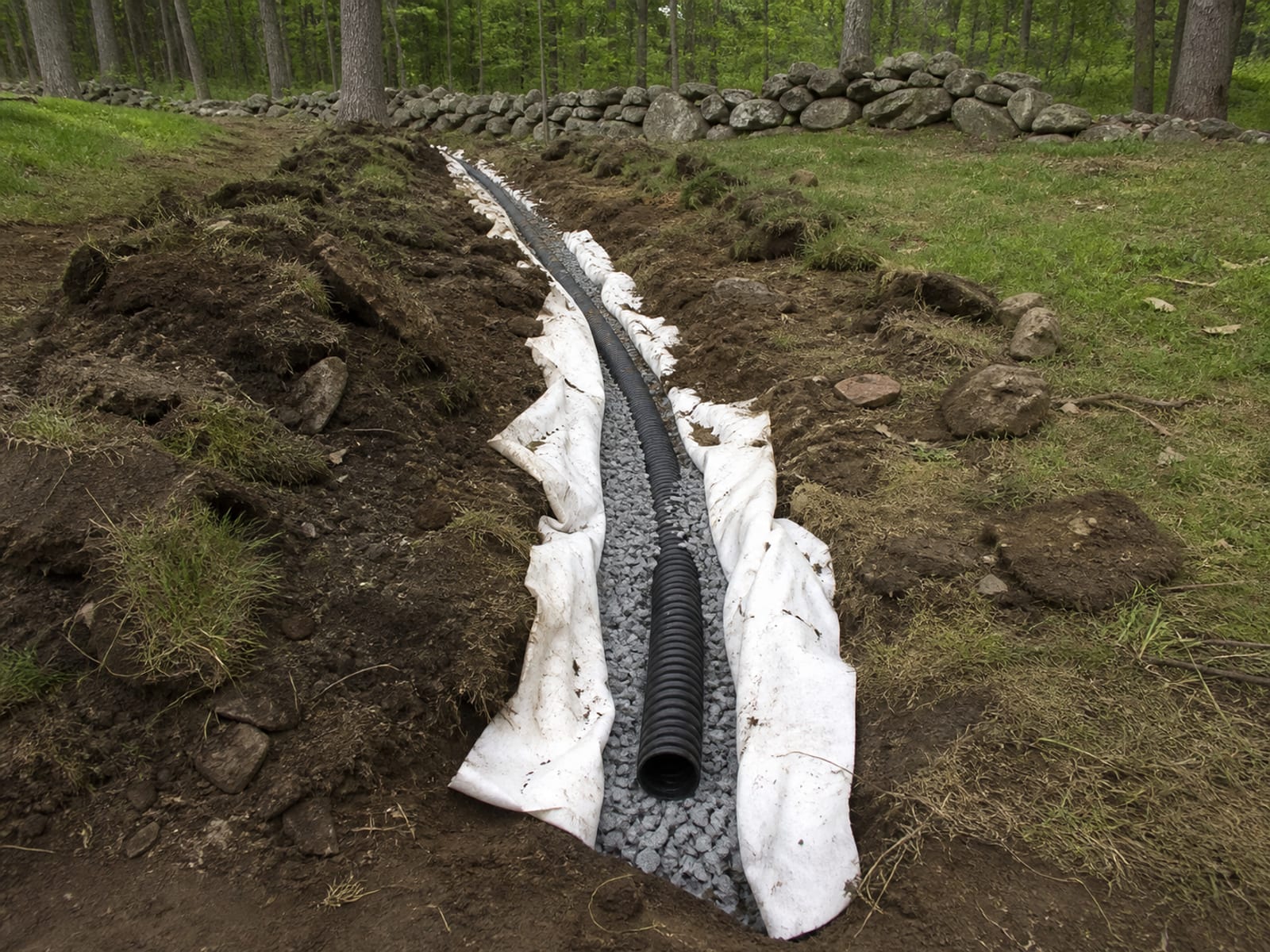
A gravel trench with a perforated pipe in it, wrapped or bedded so that soil does not migrate into the stone, laid at a fall toward an outlet. Water in the surrounding soil enters through the stone and the pipe carries it away. It is genuinely useful where the ground is saturated across an area and there is a workable destination for the collected water.
What it is not is a universal answer. It will not fix a basement wall on its own. It will not help if there is no outlet, because a perforated pipe with nowhere to discharge simply fills up. And the details that decide whether one lasts, meaning the stone gradation, the filter, the fall, the cleanouts, and the outlet protection, are design decisions made against your actual soil and water rather than a standard section copied off a diagram.
A curtain drain in Bethany, CT intercepts water before it arrives
The right tool for the downslope groundwater case above. A curtain drain sits upslope of what you are protecting, cutting across the path of water moving laterally through the soil, catching it and taking it around. On a Bethany hillside where the seep is the problem, this is often the difference between a lasting fix and an annual disappointment.
Its suitability depends on the soil profile, the grade, how the water is actually moving, where it can discharge, and separation from any septic components. That last one matters here: this is septic and well country, and an interception drain routed carelessly can affect a leaching field or be affected by it. It is not a downspout extension with a longer trench.
Foundation drainage and interior collection
When water is reaching the structure and exterior interception cannot reasonably get ahead of the source, managing it at the building is the remaining option: exterior foundation drainage where it can be accessed and rebuilt, or an interior collection drain and sump that takes water after it arrives and pumps it out. It is a different philosophy, treating the symptom deliberately because the source cannot be caught. Even then, the discharge still needs a destination, and roof and surface water outside should still be corrected, because there is no sense pumping water you could have kept away.
Give the Water a Lawful Destination, Not Just a Pipe
An outlet has to satisfy three separate tests, and a plan that satisfies only the first is a plan that will cause trouble.
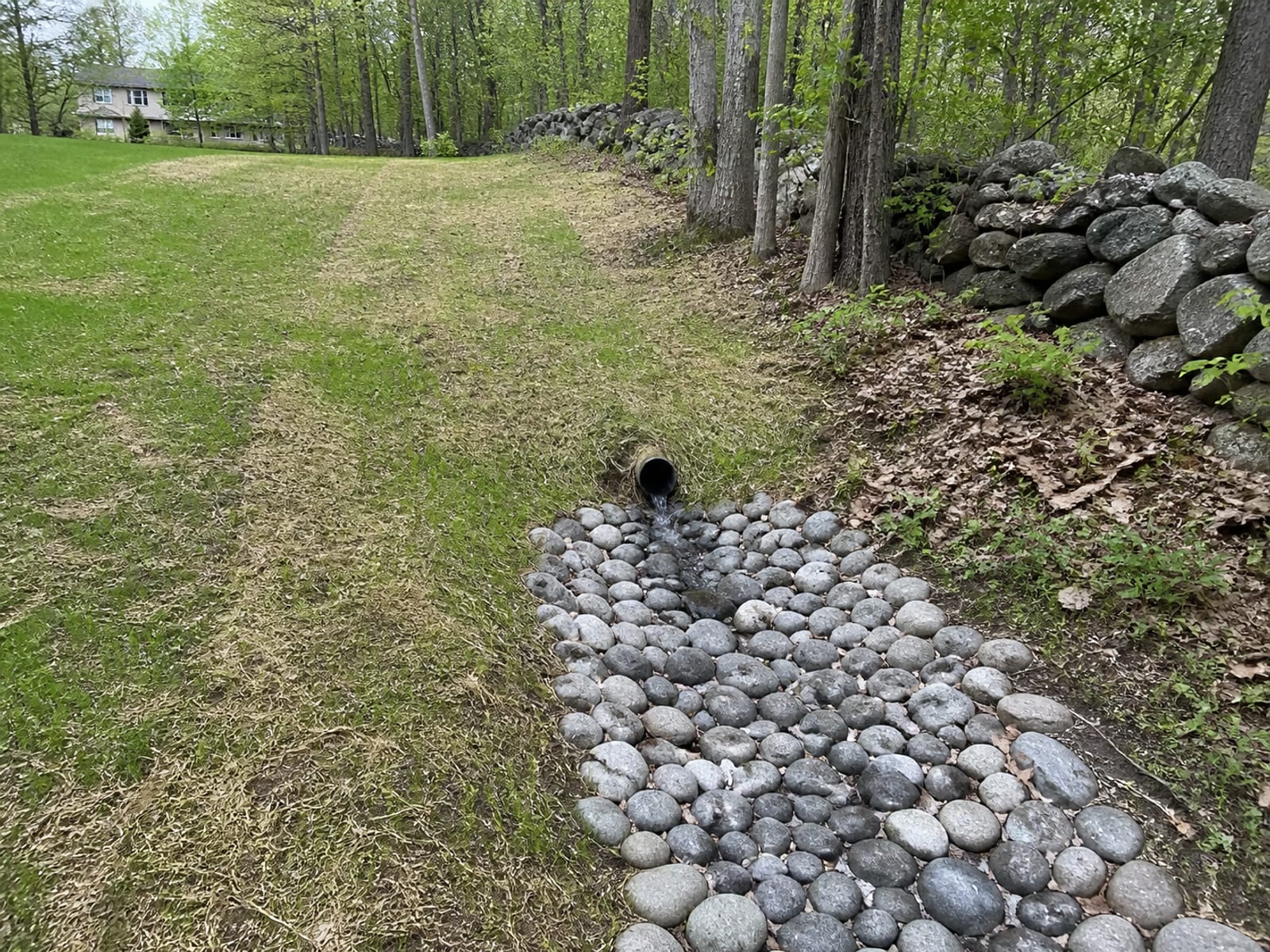
Physically, it has to work: gravity has to get water there, and the point of discharge has to be stable enough to take the flow without eroding. Outlet protection, meaning stone or matting sized for what arrives, is part of the work.
Legally, it has to be yours to use. Bethany's zoning rules are explicit that drainage work must not create erosion, flooding, deposits, or the diversion or concentration of water onto another property without that owner's written consent. Discharging over the property line because the ground falls that way is not a design, it is a dispute.
And it has to survive review. Where the outlet is near a wetland or a watercourse, its placement is a regulatory question before it is an engineering one.
Know That 150 Feet Matters More Here Than the Look of the Ground
This is the single most useful Bethany specific fact in this article. The town's inland wetlands and watercourses regulations treat clearing, grading, excavation, construction, material movement, and stormwater discharge within 150 feet, measured horizontally from a wetland or watercourse boundary, as regulated activity.
Read that again with a tape measure in mind. On a rural parcel with a brook along one edge or a wet area in the woods behind the house, a drainage trench in perfectly dry lawn can easily sit inside that band. So can the outlet. The ground being dry where you are digging tells you nothing about whether the work is regulated, because the trigger is distance from the resource, not the condition of the soil under your boots.
| Item | When it can apply | Who handles it |
|---|---|---|
| Inland wetlands review or permit | Work in a wetland or watercourse, or clearing, grading, excavation, construction, material movement, or stormwater discharge within 150 feet of one | Bethany Inland Wetlands Commission, coordinated through Land Use |
| Jurisdictional determination | Any uncertainty about whether the activity is regulated. Mapping is a planning tool, not a field delineation | Bethany Inland Wetlands Commission. State guidance is that the municipal agency decides |
| Zoning or land use review | Drainage tied to grading, fill, excavation, or site development beyond the wetlands question | Bethany Land Use, Planning and Zoning Commission, and the Zoning Enforcement Officer as applicable |
| Construction stormwater requirements | Where the drainage work is part of a project disturbing one acre or more. Not an automatic rule for a small residential drain | Municipal review for locally approvable private projects of one acre to less than five acres, under the CT DEEP program |
| Call Before You Dig, 811 | Before any powered or mechanized excavation. Notice at least two full business days ahead | CBYD, reached at 811 |
| Private line identification | Always, alongside the locate. Irrigation, invisible fence, private electric, propane, septic, and old site drains are not covered by the utility markout | You and your contractor, from records and observation |
Follow the Sequence That Builds From the Outlet Back
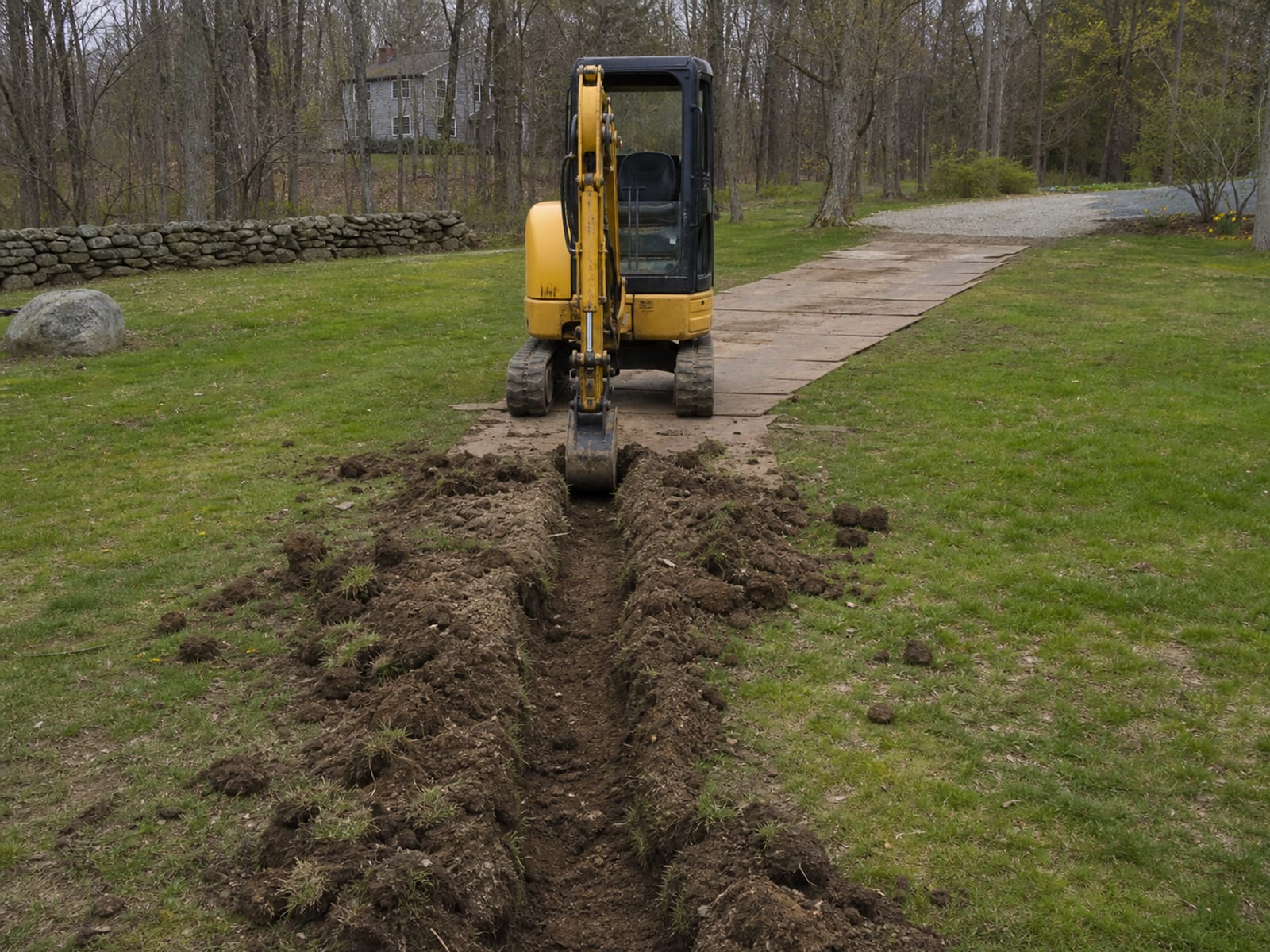
1. Observe the symptom and trace the water path. When and where water appears, how long it stays, the grade, roof discharge points, hardscape runoff, the uphill contributing area, low points, existing pipes and structures, the foundation condition, and every candidate outlet. 2. Screen the constraints before a trench line is drawn. Boundaries and easements, parcel soils and resource maps as planning aids, wetlands and watercourses including the 150 foot band, septic components, the well, utility corridors, significant trees, and walls. Ask Land Use for a determination where the upland review area could apply. 3. Set the water management concept. Source control, regrading or swales, solid roof leader piping, a French drain, a curtain drain, foundation drainage, a catch basin, a sump, or a combination. With a named destination. 4. Complete approvals and give the utility notice. Any Bethany review first, then the CBYD ticket at least two full business days before mechanized excavation, then wait for and verify the markings. Identify private lines separately. 5. Stage and protect. Limits of disturbance marked, wetland and tree protection in place, access protection where the ground is soft, and erosion and sediment controls installed before the trench opens. Stockpile where sediment cannot reach a resource. 6. Excavate from the outlet back uphill where gravity flow is planned. Building toward the discharge point means the fall is proven as you go rather than discovered at the end. Trench conditions that create a safety hazard call for shoring or an engineered approach. 7. Install the system with its controls. Aggregate bed, the right pipe for the job, cleanouts where the design calls for them, filter treatment, the aggregate surround, outlet protection, and cover. Dewatering during construction needs a controlled approach where water or sediment could reach a regulated area. 8. Restore, then test in rain. Backfill and compact appropriately, relieve the compaction that equipment caused in areas meant to accept water, stabilize exposed soil, put the surface back, and confirm water follows the intended path. Keep access to cleanouts and structures.
See What Actually Moves the Number on a Drainage Quote
No Bethany specific installed price for residential drainage work exists in any municipal or state source, and no figure quoted here would mean anything for your property, because the same words describe wildly different jobs. What is worth knowing is which variables are doing the work in an estimate, so you can see whether two quotes are describing the same project.
- Length, depth, and width of the excavation, which is really a question of how much material moves.
- Access for equipment and for stone delivery, and whether the machine can reach the work or the material has to be carried.
- Rock, ledge, and wet trench conditions, including whether dewatering is needed during construction.
- Materials, meaning the pipe type, cleanouts, the volume of crushed stone, and filter treatment.
- What has to be crossed and put back, such as lawn, pavement, walls, or planting beds.
- The outlet, its construction and its erosion protection, which is often more work than people expect.
- Spoil, meaning where excavated soil goes.
- Reviews, including any wetlands or land use approval and the plans or professional input they need.
- Restoration and stabilization at the end.
One more driver that is easy to miss: work that has to be broken into smaller phases to protect a wetland, a septic area, mature trees, or a limited access route costs more than the same footage done in one straightforward pass. That is not padding, it is what protecting those things actually takes.
Sidestep the Six Failures That Waste a Drainage Budget
- Installing a drain before identifying the source. Roof water, an uphill seep, or a broken existing line stays untreated, and the new system quietly does nothing.
- Treating perforated pipe as a substitute for an outlet. With nowhere to discharge, a French drain becomes a long underground reservoir.
- Digging before the locate and before private lines are found. The utility markout does not cover the irrigation main or the septic line.
- Sending water, sediment, or concentrated flow toward a neighbor or a protected area. Both are specifically addressed in Bethany's own rules, and neither is fixed cheaply after the fact.
- Compacting the soil that was supposed to accept water. Equipment tracking over a lawn area intended to infiltrate can undo the point of the work unless the compaction is relieved during restoration.
- Accepting a fixed scope from someone who has not seen the access, the ground conditions, or the outlet. That number will move.
Schedule Around Ground Conditions, Not a Calendar
No Bethany seasonal prohibition on ordinary residential drainage work was found, and there is no local season to plan around. What genuinely affects timing is condition: frozen ground, saturated ground, snow, spring thaw, and heavy rain all affect excavation, access, erosion control, and whether restoration will take.
Two practical points follow. First, a trench dug in saturated ground is harder to build well and harder to keep clean, so where the schedule allows, waiting for workable conditions produces a better system. Second, the seeding and stabilization at the end has its own seasonal window, which means a job finished in late autumn may need temporary protection rather than a finished lawn until spring. If your work is near a watercourse and involves actual in water construction, permit conditions govern the timing and are set case by case, not by anything you will read online.
Do the Homeowner Half Well and the Rest Gets Cheaper
Keep the gutters and downspouts clear and working, because roof water is the one contributing area you control at no cost. Photograph water during and after rain, with dates, and note how long ponding lasts. Note the direction things flow. Keep surface inlets clear of leaves. Move loose items and vehicles out of the likely work area. Dig out your septic records, well location, and any site plans. Call 811 before any powered digging you plan yourself. And where a wet area might be regulated, call Bethany Land Use and ask.
The threshold for professional help is fairly clear: standing water that persists or returns from upslope, a damp basement or foundation seepage, deep or long trenching, or anything involving a wetland, a watercourse, that 150 foot upland review area, an outlet, a septic field, a well, a utility crossing, a steep slope, a retaining wall, ledge, or a discharge anywhere near a neighbor. Those need a designed and coordinated response rather than a generic trench.
Five Questions Before You Commit to a Drainage Fix
1. A wet band runs across the slope and stays soft during dry spells. What does that suggest?
2. What does Bethany's wetlands regulation treat as regulated activity?
3. What happens to a French drain installed with no outlet?
4. What does Bethany zoning say about where drainage sends water?
5. Your CBYD markout is complete. What is still unmarked?
Pick an answer to begin.
Frequently Asked Questions About drainage solutions bethany ct
What does a french drain cost in Bethany, CT? No Bethany specific installed price exists in any municipal or state source, and a per foot figure would be misleading anyway because the same phrase covers a short lawn drain and a long system with a built outlet. The estimate is driven by length, depth, and width, access for equipment and stone, rock or wet trench conditions, materials, what has to be crossed and restored, the outlet and its protection, spoil disposal, and any reviews. A written scope that separates those is what makes a number meaningful, and it comes from a site visit rather than a phone call.
Is a curtain drain better than a french drain for water coming from uphill? For water moving laterally downhill through the soil, an upslope interception drain is the right concept, because it catches the water before it reaches what you are protecting rather than trying to collect it after it arrives. Whether that suits your property depends on the soil profile, the grade, how the water actually moves, where it can discharge, and separation from any septic components. The label is not the deciding factor, the site is.
Do I need a permit for a yard drain in Bethany? Ask Land Use before work, because the answer here is less obvious than people expect. Bethany treats excavation, grading, material movement, and stormwater discharge within 150 feet of a wetland or watercourse as regulated activity, so a trench in dry lawn can still fall inside the review area. Other land use or construction approvals can apply depending on the scope. A determination is a phone call. An enforcement problem is not.
Do I have to call 811 for a drainage trench? Yes. Connecticut requires notice to Call Before You Dig at least two full business days before using powered or mechanized excavation equipment. Wait for the markings and verify the responses before digging. Remember that the markout covers participating utility facilities and will not show your irrigation line, invisible fence, propane run, septic components, or an old drain somebody installed decades ago.
Can a wet yard be fixed by regrading alone? Sometimes, and it is always worth checking first because it is the least disruptive option. Where the problem is roof runoff or surface grade, correcting those can be the whole answer. Where water arrives from upslope through the soil, where it ponds because there is genuinely no outlet, or where it is reaching the foundation, surface work alone will not carry it, and the plan needs either interception, a collection system, or a combination.
Can I discharge the water anywhere downhill? No. The outlet has to be evaluated for erosion at the point of discharge, for wetlands and watercourses nearby, for property boundaries, and for whether it concentrates water onto another parcel. Bethany's zoning rules specifically address diversion and concentration of flow onto another property without written consent. Finding the lawful outlet is often the first design decision rather than the last.
When is the best time of year to do drainage work? There is no Bethany specific season and no blanket work ban. Scheduling should account for frozen or saturated ground, weather, access, the erosion control the job needs, wetland conditions where they apply, permit timing, and the fact that final seeding and stabilization have their own seasonal limits. A job completed in late autumn may sit under temporary protection until spring, which is normal and worth agreeing in advance.
Moving Forward
A wet Bethany property is a puzzle with three pieces, and the pieces have to be solved in order. Where is the water coming from. Where can it lawfully and safely go. What is the least invasive thing that connects those two points. Answer them in that sequence and the system you end up with is usually simpler and cheaper than the one you were bracing for. Answer them out of order and you get a trench that changes nothing.
The Bethany specific parts are worth carrying into your first conversation: the water may be arriving from upslope rather than falling on your roof, the 150 foot upland review area can pull a dry lawn trench into a town review, and where your outlet sits is constrained by your neighbor's rights as well as by gravity.
If your lawn stays soft or your basement stays damp in Bethany, CT, Prestige Property Maintenance can walk it with you, ideally in wet weather, trace the water from source to outlet, and put a written scope together that names the destination and the restoration. We handle drainage solutions, grading, excavation, and trenching with one crew working out of Oxford, so the diagnosis, the dig, and the finished surface are the same responsibility. See what we do across Bethany, call (203) 258-3395, or contact us to arrange a site assessment.
Drainage Words, Defined Plainly
Tap a term to see what it means.
Source. Where the water is actually coming from. A roof, a hard surface, an uphill slope, a seep, or the water table. Everything else in a drainage design follows from this.
Related Articles
Erosion and Sediment Control Bethany, CT: Stopping a Washout
A washout near a wetland is not just a mess, it can be a regulatory issue too. Here is how erosion and sediment control in Bethany, CT works, start to finish.
Driveway Excavation Bethany CT: Fixing a Drive That Won't Hold
Tired of adding stone that disappears from your long Bethany driveway? Driveway excavation in Bethany, CT fixes the failed subgrade, not just the top.
Building a Retaining Wall in Bethany, CT That Lasts
Worried your Bethany retaining wall will lean after a few winters? Retaining wall construction in Bethany, CT depends on frost depth and drainage.