

Driveway Excavation Bethany CT: Fixing a Drive That Won't Hold
Kash CochranePublished
- driveway excavation
- bethany ct
- gravel drives
- drainage
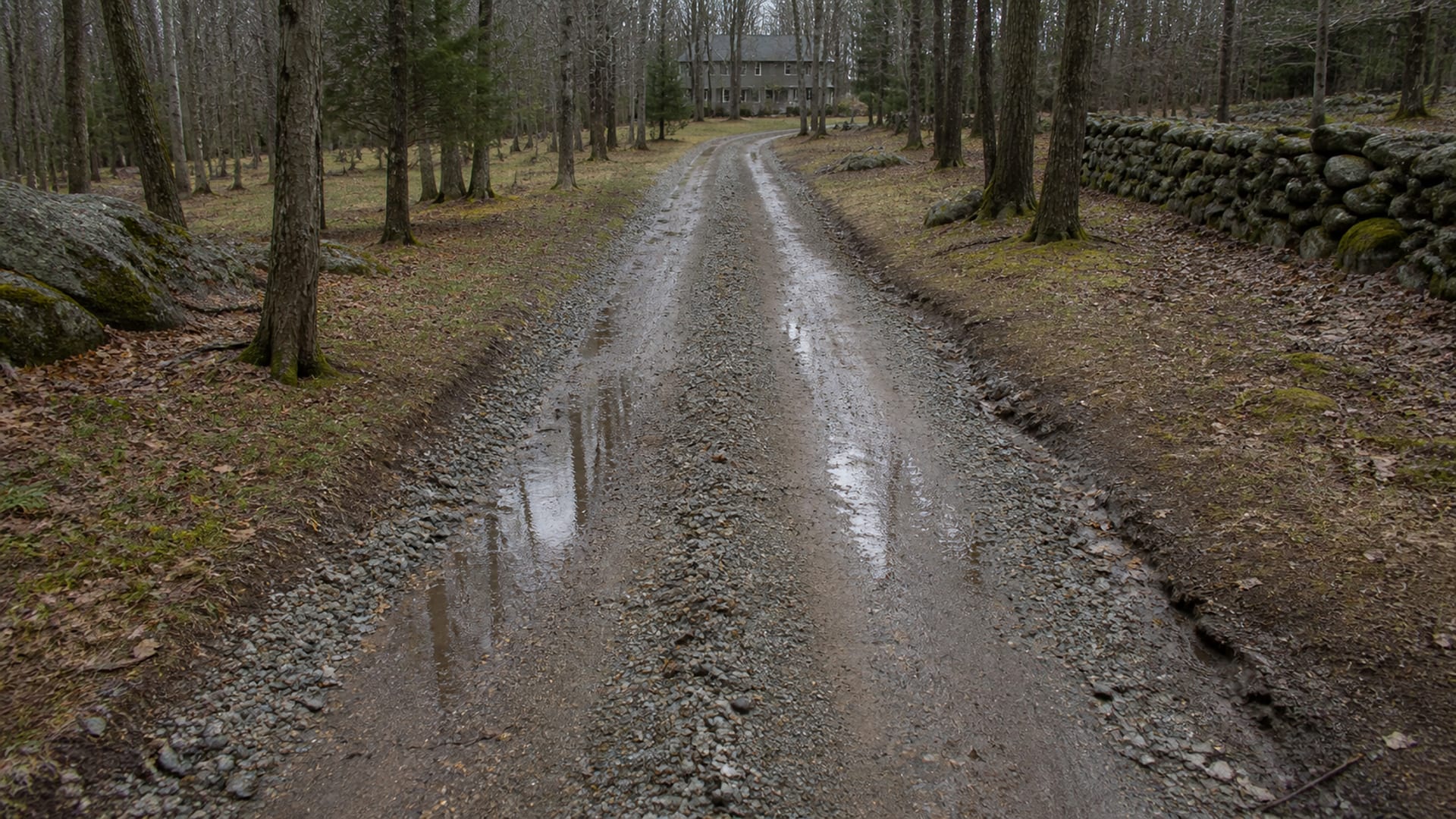
You have bought this driveway more than once. A load of stone in the spring, another after a wet autumn, and by the following March there are ruts in the same three places, the soft spot near the bottom is soft again, and the material you paid for is somewhere between gone and invisible. The natural conclusion is that you need more stone. The uncomfortable one is that stone was never the problem, and every load you add to a drive that is failing underneath is a load that will do exactly what the last one did. Understanding where it goes is what breaks the cycle.
Key Takeaways
Disappearing stone is a subgrade and drainage symptom
unpaved road guidance consistently points to a weak, wet subgrade and poor drainage as the cause of rutting and material loss, rather than simply insufficient surface material.
A drive without a crown cannot shed water
federal gravel road guidance illustrates a 4 percent crown on a reshaped gravel road along with a minimum surface layer thickness where a surface course is used, which are engineering references rather than a prescription for your parcel.
Bethany sets real numbers for rear lot driveways
the zoning regulations require the traveled surface to be at least 12 feet wide, with a maximum 2 percent grade for the first 20 feet from the road right of way, 6 percent for the next 40 feet, and 12 percent for the remainder, plus regrading limits including a maximum 2:1 slope and a maximum 10 foot cut or fill depth.
Touching the town road brings the town in
Bethany's code requires a permit for work that alters or excavates a town road, highway, curb, curb cut, driveway, road drainage, or right of way, and a driveway connecting to a town highway may not be constructed or established until plans are submitted and approved.
Where Is All That Stone Actually Going?
Three things happen to gravel on a failing drive, and none of them involve it evaporating.
The first is that it works down into the subgrade. When the soil beneath is soft and wet, traffic pushes stone into it and pushes soil up between the stone. That mixing is what people mean by pumping, and once it has happened the layer above is no longer a functioning stone base. It is a stone and soil blend with none of the strength of either.
The second is that water carries it away. A drive with no crown, no ditch, or no outlet becomes the channel, because it is the lowest and least vegetated line available. Every storm moves material downhill, and on a long drive that adds up quickly.
The third is that it goes into the ruts. A rut is a low point, it collects water, water softens the ground beneath it, and traffic deepens it. Filling the rut with stone without changing why the water sits there fills the same rut again next year.
So the diagnosis is not really about how much stone is there. It is about two questions: is the ground underneath capable of carrying the traffic, and does water get off the drive quickly rather than travelling along it.
Is This a Top Up or a Rebuild?
| What you observe | What it usually indicates | The appropriate response |
|---|---|---|
| Surface is loose or thin but firm underfoot, shape has flattened | Material loss and lost crown, with the support layers intact | Reshaping, restoring the crown, and a surface course |
| Water runs along the drive rather than off it, gullies at the same places | Drainage and shape problem rather than a strength problem | Crown, ditch, culvert, and outlets, then surface material |
| Soft spots that reappear in the same locations every wet season | Weak or wet subgrade beneath those sections | Excavate the failed material, address the water, rebuild the support layers |
| Stone visibly mixed into soil when you dig a hand hole | Pumping. The base has already lost its function | Excavation and replacement of that section, not another top up |
| Deep ruts that return within a season of being filled | The section is failing structurally under the traffic it carries | Selective reconstruction of the failed lengths |
| The whole drive behaves the same way end to end | A design problem rather than a spot failure | A measured assessment of the full length before any material is ordered |
Most long drives turn out to be a mixture: perhaps eighty percent of the length that only needs shape and drainage, and three or four sections that need excavating and rebuilding. That is the outcome to aim for, because it puts the money where the failure is instead of spreading it evenly across ground that was working fine.
What Does a Crown Do, and Why Does Yours Not Have One?
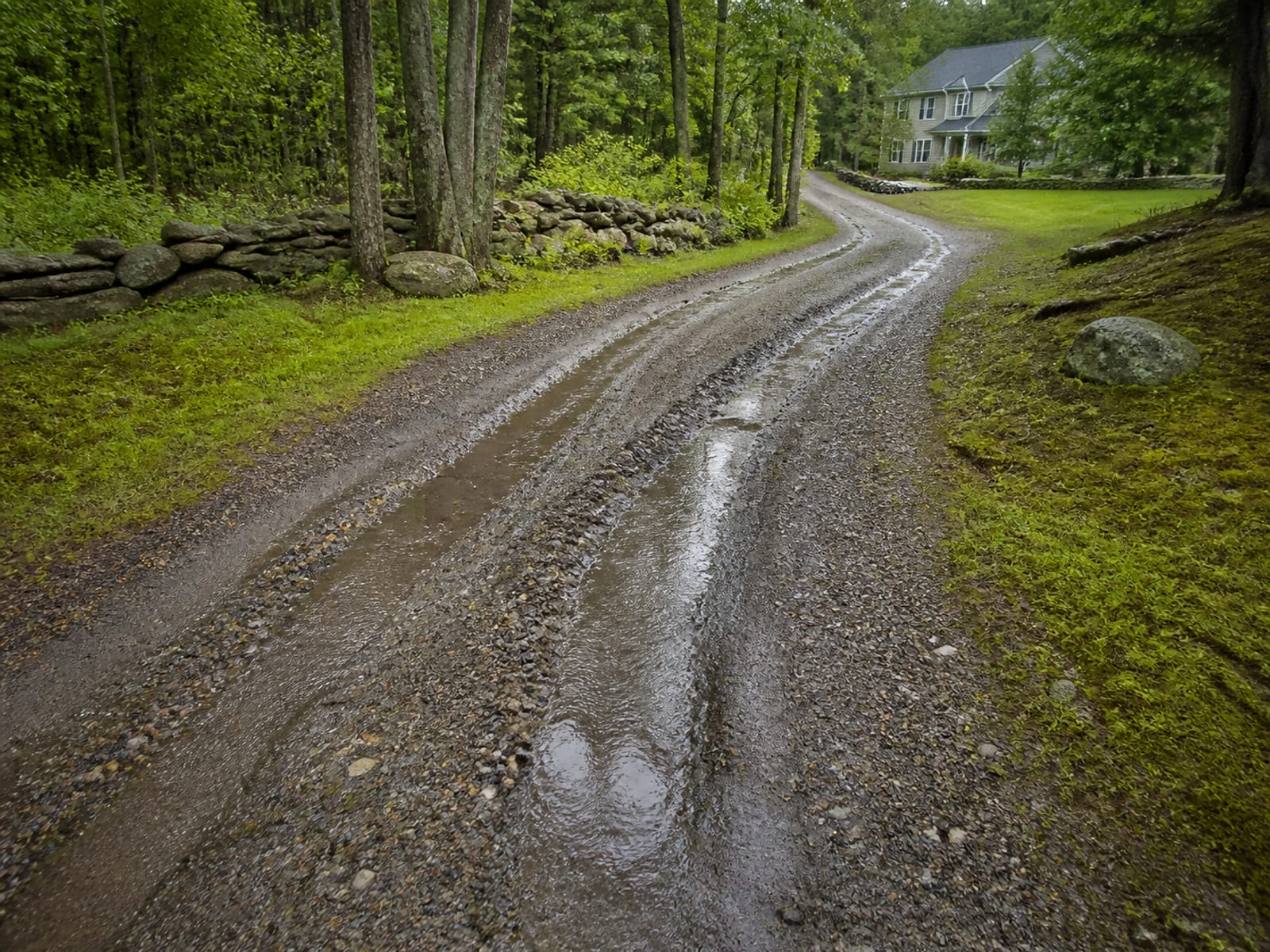
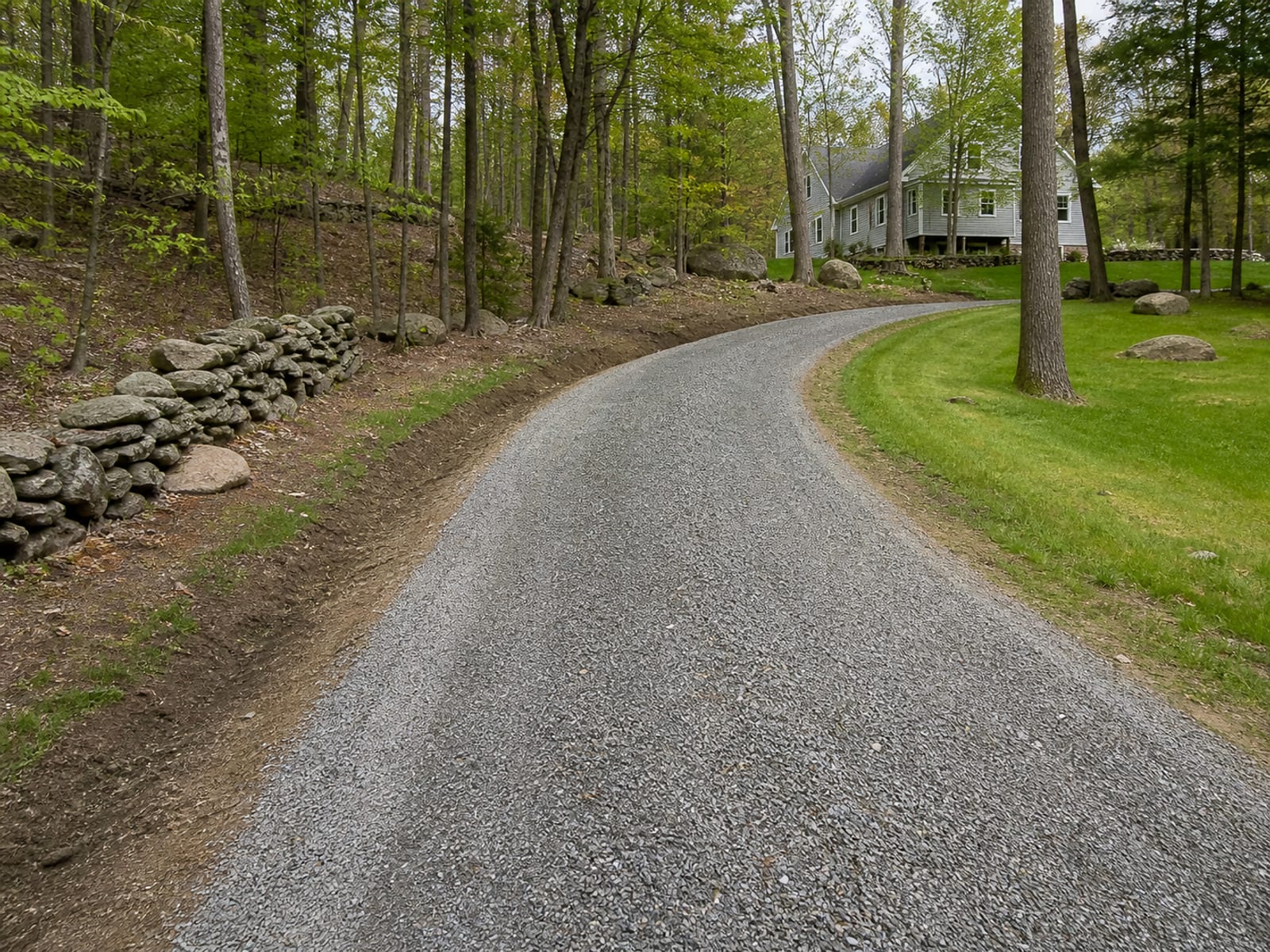
A crown is the slight rise along the center of the drive that makes water run off the sides instead of along the length. Federal gravel road guidance illustrates a 4 percent crown for a reshaped gravel road, which is enough to shed water and gentle enough that nobody notices driving on it.
Crowns disappear on their own. Traffic runs in the same two wheel tracks, material migrates outward and downward, and over a few years the profile flattens and then inverts, so the center sits lower than the edges. At that point the drive is a shallow channel, which is precisely what you do not want on a slope.
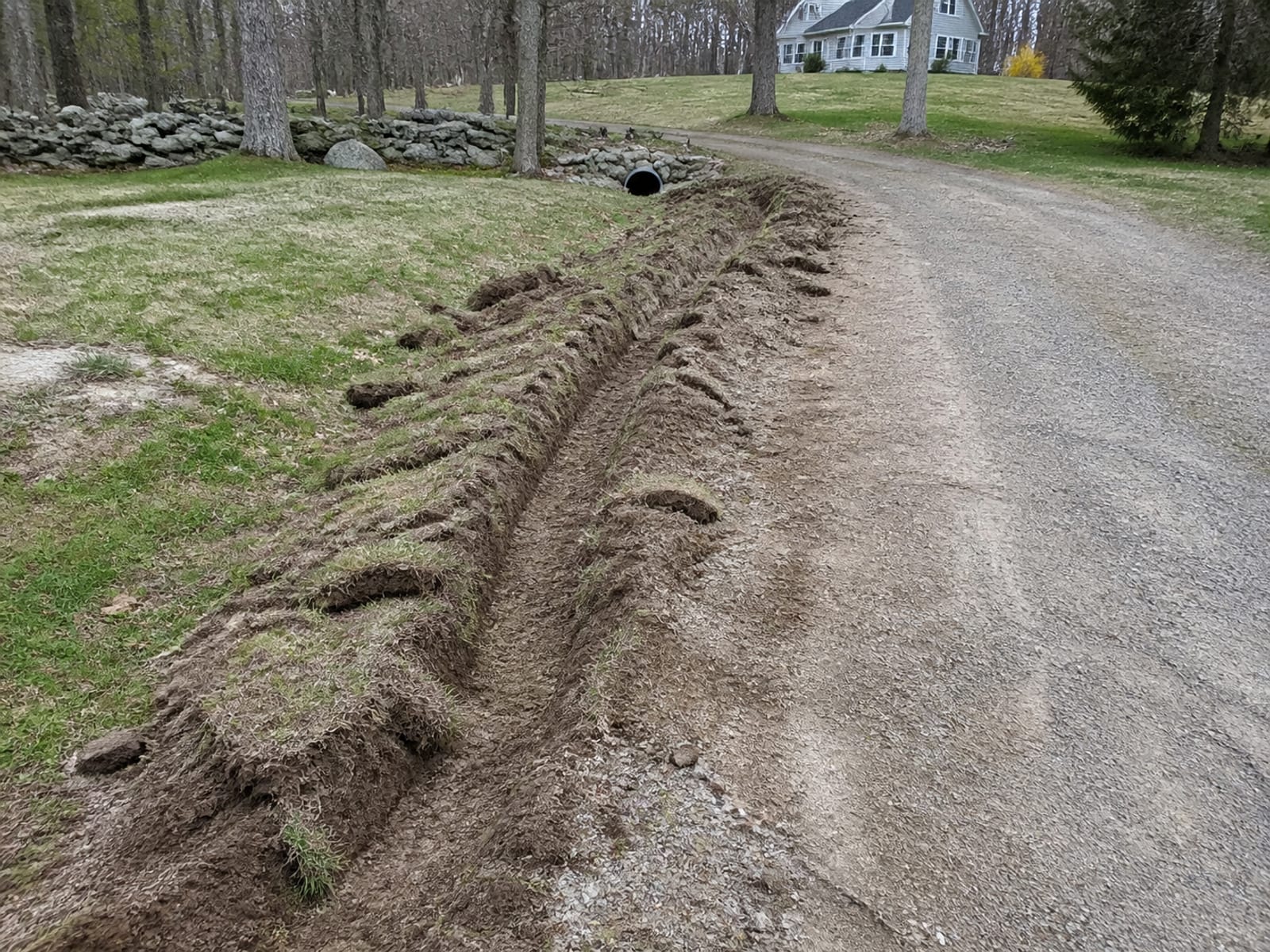
Restoring the crown is a shaping operation rather than a material purchase, and it is often the single highest value thing that can be done to a long rural drive. It only works, though, if the water leaving the crown has somewhere to go. That means a ditch or a shoulder that can take it, and outlets at intervals so the ditch itself does not become a channel that scours. On sloping Bethany ground, the spacing and protection of those outlets matters as much as the crown does.
What Happens When the Weak Section Gets Excavated?
For a section that has genuinely failed, the reconstruction options are well described in Forest Service guidance for unpaved roads, and there are two broad approaches.
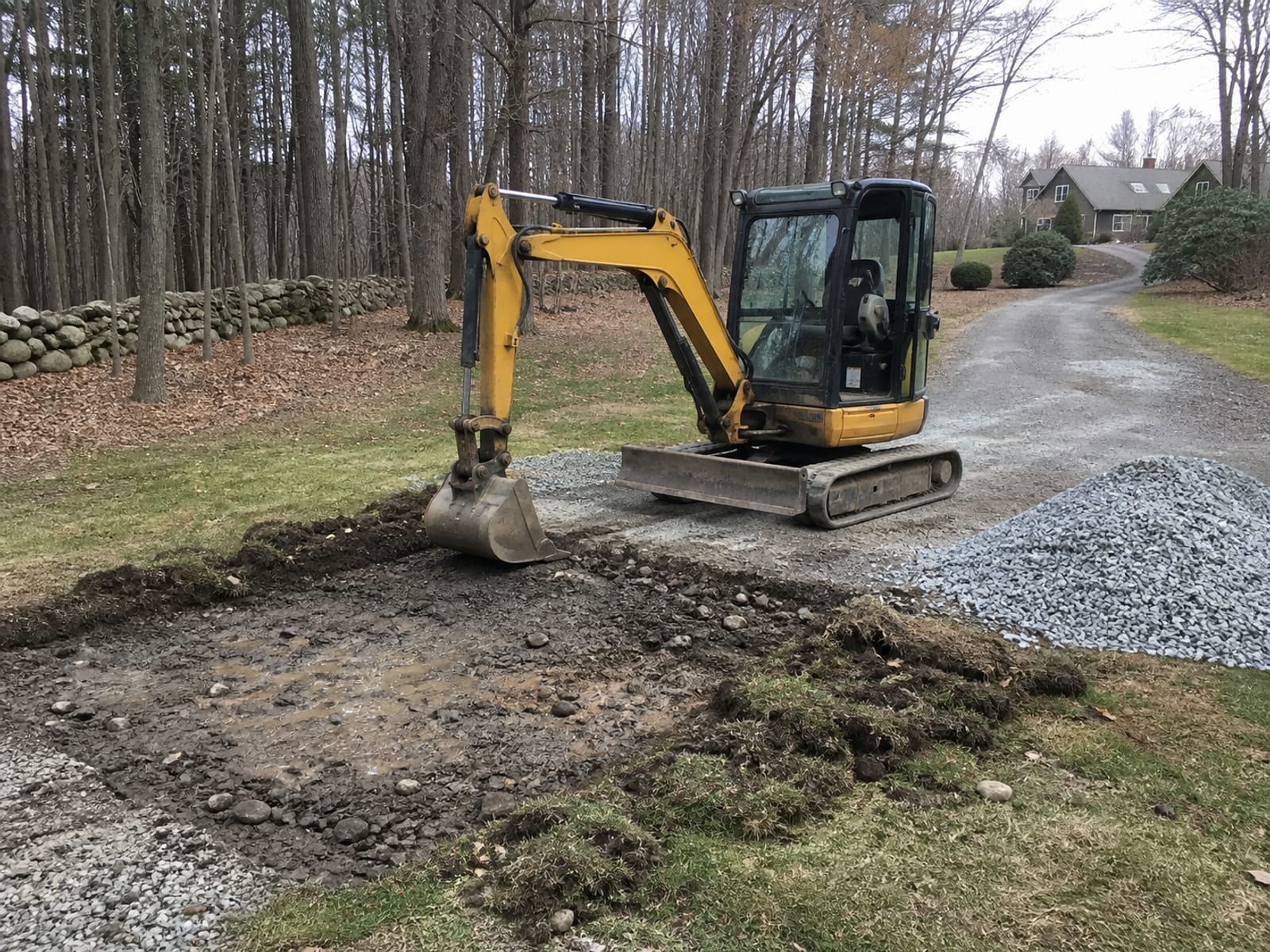
The first is to remove the weak, wet soil and replace it with selected free draining material or gravel. Straightforward, effective, and the depth depends entirely on how deep the weakness goes, which is established in the field rather than assumed.
The second is to use a geosynthetic separator or grid before placing aggregate. A separator keeps the stone and the soft soil apart so pumping cannot occur, and a grid adds confinement so the aggregate layer behaves as a stiffer mat. The same guidance is clear that the material choice should be checked by a materials engineer rather than picked from a catalogue.
Either way, the excavation exposes the actual condition and the actual depth of the problem, which is why a scope written before that is a scope with an allowance in it. Water is the other half: if the section is wet because water arrives there and stays, replacing material without changing that is a repair with a countdown on it.
For screening before anyone digs, the NRCS Web Soil Survey offers interpretations relevant to exactly this work, including unpaved local roads and streets, shallow excavations, slope, depth to bedrock, and frost related properties. NRCS is also clear that soil survey information is not definitive for construction and that onsite testing is needed for road work, so treat it as a first look rather than an answer.
Why Does a Long Driveway in Bethany, CT Cost More Than Twice a Short One?
Because length multiplies more than one variable at a time.
Material quantity scales with length, obviously. Haul does not scale linearly, since a delivery truck that can back straight in on a short drive may need a turnaround, multiple loads, or a smaller vehicle on a long one. Drainage scales with length and slope together, because a longer run collects more water and needs more places to shed it. Access affects everything: whether trucks can reach the failed section at all, whether they can turn without damaging what is already there, and whether the drive has to carry the equipment that is fixing it.
There is also a sequencing question people rarely think about. While the work is happening, the drive is the only way in and out, and on a long rural approach that constrains how much can be open at once, which affects both the schedule and the price.
None of that means a long drive has to be rebuilt end to end. It means a long drive rewards a measured assessment, because knowing which 200 feet are failing turns a very large project into a manageable one.
When Does This Become Private Road Construction in Bethany, CT?
There is a real line here, and it is worth knowing which side of it you are on before you start.
A driveway serves your property. A shared access that serves more than one lot, or a new route built to serve future lots, starts to look like a private road, and that brings design standards, drainage requirements, emergency access considerations, engineering, and often a maintenance agreement between the parties into the picture. A shared private access is not automatically a town road, and a town accepted road is a different thing again with its own standards and process.
Bethany's own zoning rules show how seriously access is treated even for a single rear lot. The traveled driveway surface has to be at least 12 feet wide. The first 20 feet from the road right of way is limited to a 2 percent grade, the next 40 feet to 6 percent, and the remainder to 12 percent. Regrading is limited to the access way limits with a maximum 2:1 horizontal to vertical slope and a maximum 10 foot cut or fill depth, and the design has to provide suitable alignment, clearance for emergency vehicles, and compliant sightlines.
Those are rear lot standards specifically, so they are not universal rules for every existing driveway in town. What they do tell you is the direction of travel: on a new or substantially reconstructed access, width, grade, emergency access, and sightlines are matters the town has opinions about.
Which Bethany Approvals Attach to Driveway Work?
| Trigger | What applies | Who |
|---|---|---|
| Work that alters or excavates a town road, highway, curb, curb cut, driveway, road drainage, or the town right of way | A road excavation and driveway interface permit under the town code. The current form requires the locate call before right of way excavation, one business day notification to the Road Foreman, and public works approval of right of way work | Bethany Road Foreman and the Department of Public Works |
| A driveway connecting to a town highway | Plans submitted and approved before the driveway is constructed or established, with the design not interfering with public drainage | Bethany Board of Selectmen |
| A new or relocated driveway leading onto a state highway | A state permit from the Transportation Commissioner before the work | Connecticut Department of Transportation |
| Work affecting a wetland, watercourse, or the town's regulated upland review area | Municipal wetlands approval before the activity. Ask before plans are filed rather than after | Bethany Inland Wetlands Commission |
| Excavation, grading, filling, stockpiling, or site changes beyond an exempt scope | Zoning or land use approval as the town determines. The regulations identify administrative permitting for certain driveway connected excavation, filling, grading, stockpiling, or screening activity | Bethany Land Use and Planning and Zoning |
| Site disturbance of one acre or more | Municipal review and erosion and sediment controls, with state registration depending on the category | Bethany land use authority and CT DEEP |
| Any mechanized digging | A Call Before You Dig request at least two full working days ahead, excluding the day of notice, weekends, and holidays | CBYD, at 811, under PURA oversight |
Two notes worth carrying into a first phone call. The town's own road excavation application asks for the excavation depth, the fill material, the compaction procedure, the estimated cost, and the start and completion dates, which is a useful signal that the scope is expected to be defined before the work rather than discovered during it. And the locate does not cover private facilities, so septic components, irrigation, propane, a pool line, or a secondary electric run to an outbuilding all need identifying separately.
How Does the Job Run From Inspection to Finished Crown?
1. Inspect after rain and map the water. Where water enters the drive, where it travels, where it leaves, and which sections are soft. This is the one step that cannot be done from a photograph in July. 2. Review the parcel constraints, locates, and approvals. The right of way position, any wetland or watercourse question, whether the work touches a town or state road, and the locate request with its notice period. 3. Establish access and staging. Where deliveries can reach, where material can be stockpiled, how the property stays usable, and what protects the sections that are not being worked on. 4. Excavate the failed sections or reshape the sound ones. Selective rather than uniform, based on what the inspection found. 5. Build the drainage and the load bearing layers. Ditching, culverts, and outlets first where they are part of the fix, then the replacement material placed and compacted rather than tipped and spread. 6. Compact, shape the crown, and finish the edges. With the crown restored along the full length, not only where the work happened. 7. Maintain the outlets and the shape. Keeping ditches and culvert ends clear after storms is what makes the repair last, and it is genuinely owner work.
What Should You Ask a Driveway Contractor in Bethany, CT?
Four questions separate a considered scope from a delivery of stone.
What is the failure mechanism here? If the answer is that it needs more gravel, ask what is happening underneath. A contractor who has walked the drive after rain and dug a hand hole in a soft spot will have a specific answer.
What material is being removed and what is replacing it, and to what depth? Including what happens if the excavation shows the weakness is deeper than assumed.
How does water leave the drive? Crown, ditch, culvert, outlets, and their spacing. If drainage is not in the answer, the fix is temporary.
Which approvals apply and who is obtaining them? The right of way permit if the work reaches the road, the Board of Selectmen plan approval where a driveway connects to a town highway, the state permit for a state highway, the wetlands determination where relevant, and the locate call.
Which Mistakes Guarantee You Will Buy Stone Again Next Year?
- Adding stone over a weak subgrade. The new material joins the old material in the soil.
- Leaving the surface flat, or draining toward the road or a neighboring property. A flat drive is a channel, and a drive that discharges onto the town road or the neighbor is a different kind of problem.
- Treating a culvert or an outlet change as minor yard work. Both can affect the public drainage and both can carry an approval requirement.
- Assuming the locate covers your own lines. It covers participating public utilities, and rural drives cross plenty of private ones.
- Starting roadway interface work before town approval. The road end of the drive is the part with the most rules attached.
When Can the Work Actually Be Done?
There is no local seasonal ban, so the constraint is ground condition and water.
The inspection is best done wet, because a dry August walk tells you very little about where water goes. The construction is best done when the ground can be worked and compacted, which generally rules out saturated conditions and frozen ground, and makes the thaw period the least useful window of the year on a soft rural drive.
There is also a practical sequencing point: while the drive is being rebuilt it is still your only access, and emergency vehicles need to reach the house throughout. That is a conversation to have when the schedule is set rather than on the morning the first section is opened.
Four Questions About a Failing Gravel Drive
1. Where does the stone on a failing gravel drive actually go?
2. What does a crown do?
3. What does Bethany's zoning require for the traveled surface width of a rear lot driveway?
4. Your drive connects to a town highway and you are rebuilding the entrance. What is required?
Pick an answer to begin.
Frequently Asked Questions About driveway excavation bethany ct
Does my gravel driveway need more stone or excavation? It depends on whether the ground beneath is still doing its job. Dig a small hand hole in one of the soft spots. If you find clean stone sitting on firm soil, the problem is likely shape and drainage, and reshaping with a restored crown may be enough. If you find stone mixed into wet soil, that section has pumped and adding more material on top will produce the same result again. Most long drives are a mix, which is why a measured walk beats a blanket decision.
Why does a long driveway keep washing out? Because length gives water more opportunity to concentrate, and because a flattened crown turns the drive itself into the channel. On sloping ground the water gains energy as it travels, so a long run without ditching and regularly spaced outlets will scour in the same places every year. The fix is shape and drainage first, with material second, rather than the other way around.
What does driveway excavation cost in Bethany, CT? No reliable local published range exists, so a figure here would be made up. The measured variables are the length and width, whether reshaping is enough or weak material has to come out, the aggregate quantity and how easily it can be delivered, the drainage, culverts, and outlets, whether rock or shallow bedrock turns up, whether material is retained or exported, the utility precautions, the approvals and any engineering, and whether trucks and compactors can reach the failed sections at all.
Do I need a Bethany permit to change my driveway entrance or culvert? Very likely. The town code requires a permit for work that alters or excavates a town road, highway, curb, curb cut, driveway, road drainage, or the right of way, and a driveway connecting to a town highway may not be constructed or established until plans are submitted and approved by the Board of Selectmen. If the frontage is a state highway, a state permit is required before a new or relocated driveway leads onto it. Confirm before anything is scheduled.
Do I need wetland approval for driveway drainage work? You may, and the determination is the town's rather than yours. Where a proposed activity is likely to affect a wetland or watercourse, or falls within the town's regulated upland review area, municipal wetlands approval comes first. Drainage work is a common trigger, because moving water is exactly what the rules are concerned with. Ask before plans are filed rather than after.
Does 811 locate every underground line on my property? No. The request locates participating public utility facilities. Private lines are not covered, and rural driveways cross a lot of them: septic components, irrigation, propane, a pool line, a secondary electric run to a barn or a gate. Those need identifying separately from your own records and observation. The notice period is at least two full working days, excluding the day of notice, weekends, and holidays.
When can driveway excavation be done in Bethany? Most of the year, with two practical limits. The material has to be workable and compactable, which rules out saturated ground and frozen ground, and makes the spring thaw the least suitable period on a soft drive. The other limit is access: the drive is your only way in and out while it is being rebuilt, so the sequencing has to keep the property reachable, including for emergency vehicles.
Final Thoughts
The reason the stone keeps disappearing is almost never the stone. It is water travelling along a drive that has lost its shape, and soft ground under the sections that fail every year. Fix those two and the material you buy stays where you put it, which is a much better outcome than buying less material more often.
The practical starting point costs nothing: walk the drive during a heavy rain and mark where water enters, where it runs, and where it leaves. Then dig a hand hole in each soft spot and look at whether the stone is sitting on firm ground or mixed into it. Those two pieces of information turn a vague and expensive problem into a specific and much smaller one.
If your Bethany, CT driveway keeps failing in the same places, Prestige Property Maintenance can walk it with you, ideally when it is wet, identify which sections actually need rebuilding, and put a scope in writing that covers the drainage as well as the surface. We handle driveway and roadway excavation, grading, drainage solutions, and erosion and sediment control with one crew working out of Oxford, so the shape, the water, and the base are designed together. See how we work across Bethany, call (203) 258-3395, or contact us for a site specific assessment.
Gravel Drive Terms Worth Knowing
Tap a term to see what it means.
Subgrade. The native ground under the drive. Everything above it depends on its strength and how wet it stays.
Related Articles
Building a Retaining Wall in Bethany, CT That Lasts
Worried your Bethany retaining wall will lean after a few winters? Retaining wall construction in Bethany, CT depends on frost depth and drainage.
Bethany, CT Drainage Solutions for a Soft Lawn or Damp Basement
Not every wet yard needs the same fix. Drainage solutions in Bethany, CT depend on whether water comes from your roof, a neighbor's slope, or groundwater.
Grading in Bethany, CT: Taming a Sloped, Wooded Yard
No flat ground and runoff carving channels every spring? Here is what grading in Bethany, CT actually involves on a wooded, sloped property like yours.