

Erosion and Sediment Control Bethany, CT: Stopping a Washout
Kash CochranePublished
- erosion control
- bethany ct
- slope stabilization
- wetlands
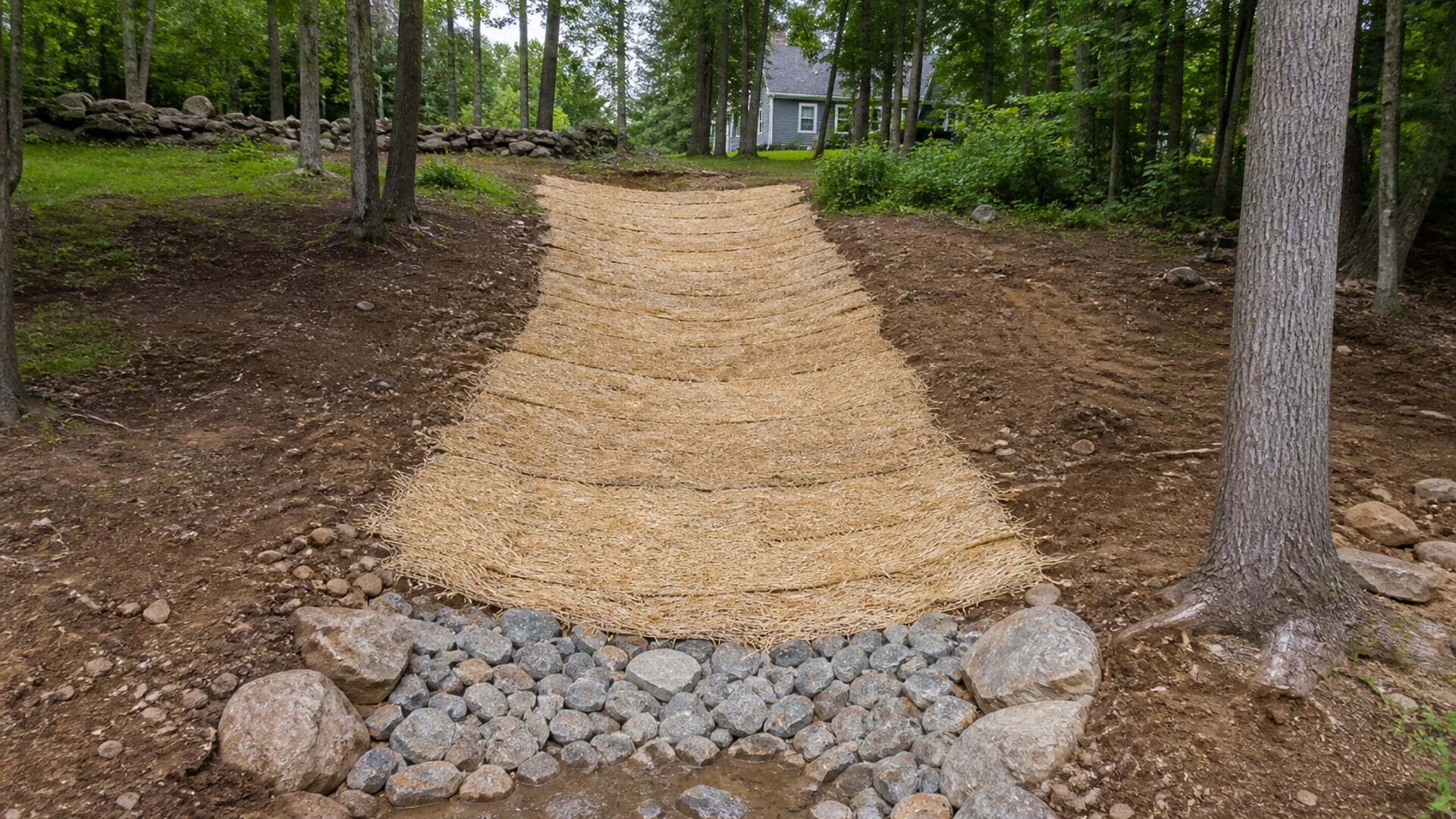
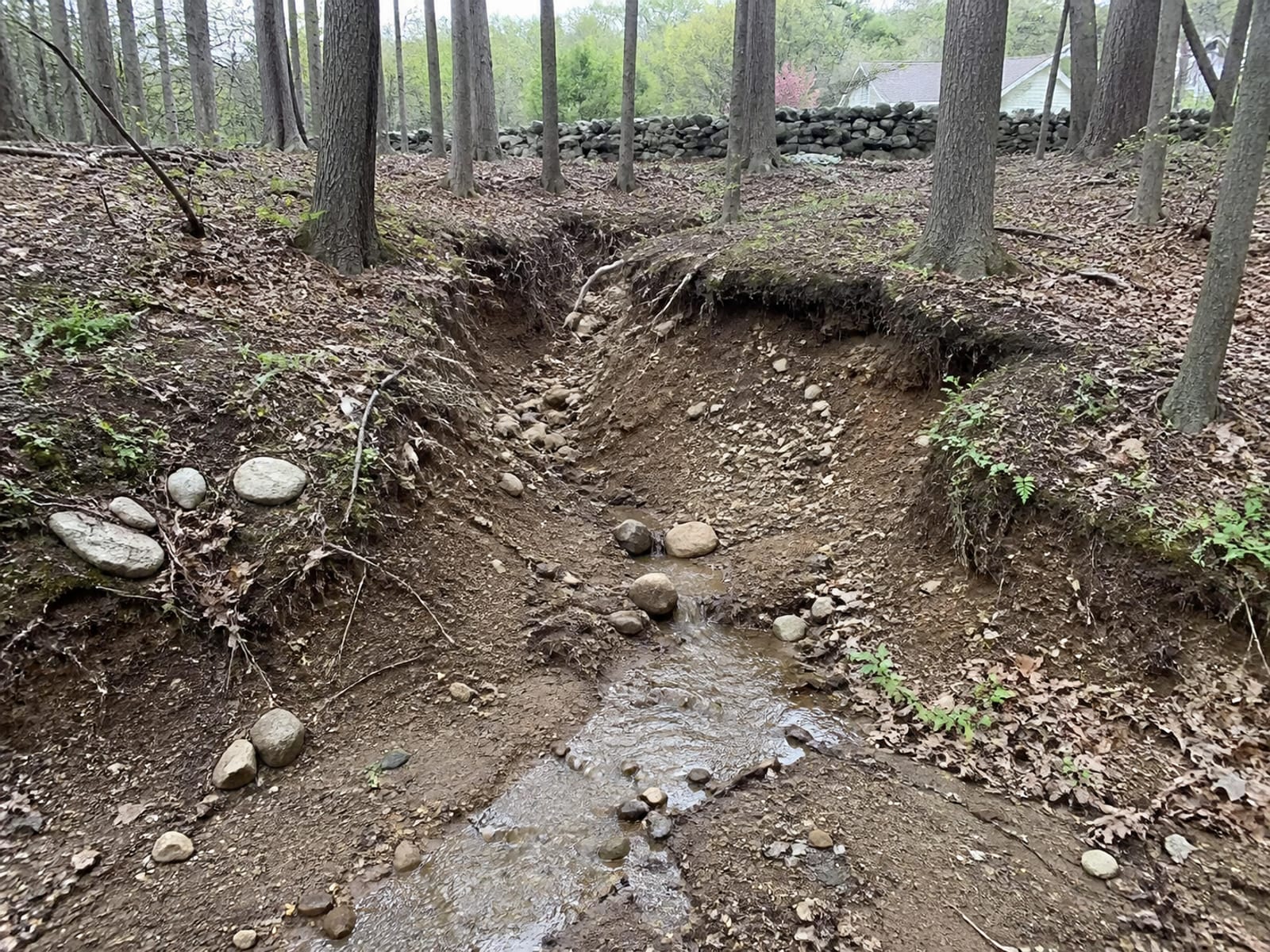
You can see where it is going. A scar has opened on the slope, the last storm deepened it, and the muddy water at the bottom is heading toward the brook, the wet area at the back, or the ditch along the road. Somebody suggested straw. Somebody else mentioned that the town may want a plan before anything happens, which was not what you wanted to hear about a hole in your own hillside. Both are partly right, and the reason this is more involved than a bale of straw is that a washout has two separate problems inside it, and Bethany sits in a public water supply watershed where soil leaving a property is a regulatory matter as well as a maintenance one.
Key Takeaways
Erosion control and sediment control are different jobs
one keeps soil from detaching and moving in the first place, the other keeps whatever does move from leaving the site, and nearly every real repair needs both in sequence.
The repair starts upslope and ends at a stable outlet
what is concentrating the water above the scar is the actual problem, and where the water is sent afterward decides whether the fix lasts.
Bethany's half acre rule is stated without exemptions
the zoning regulations require an approved erosion and sedimentation control plan, or a determination that one is not required, before a zoning or building permit is issued where cumulative land disturbance is more than one half acre, certified by the Planning and Zoning Commission or its designated agent, and the published regulation states there are no exemptions from that requirement.
Engineered measures are engineered, not selected
Connecticut's guidance is that measures requiring engineered design have to be evaluated case by case by a Connecticut licensed professional engineer.
Erosion and Sediment Control Are Two Different Jobs
The phrase gets used as one thing and it is two, which matters because they are solved differently and only one of them is permanent.
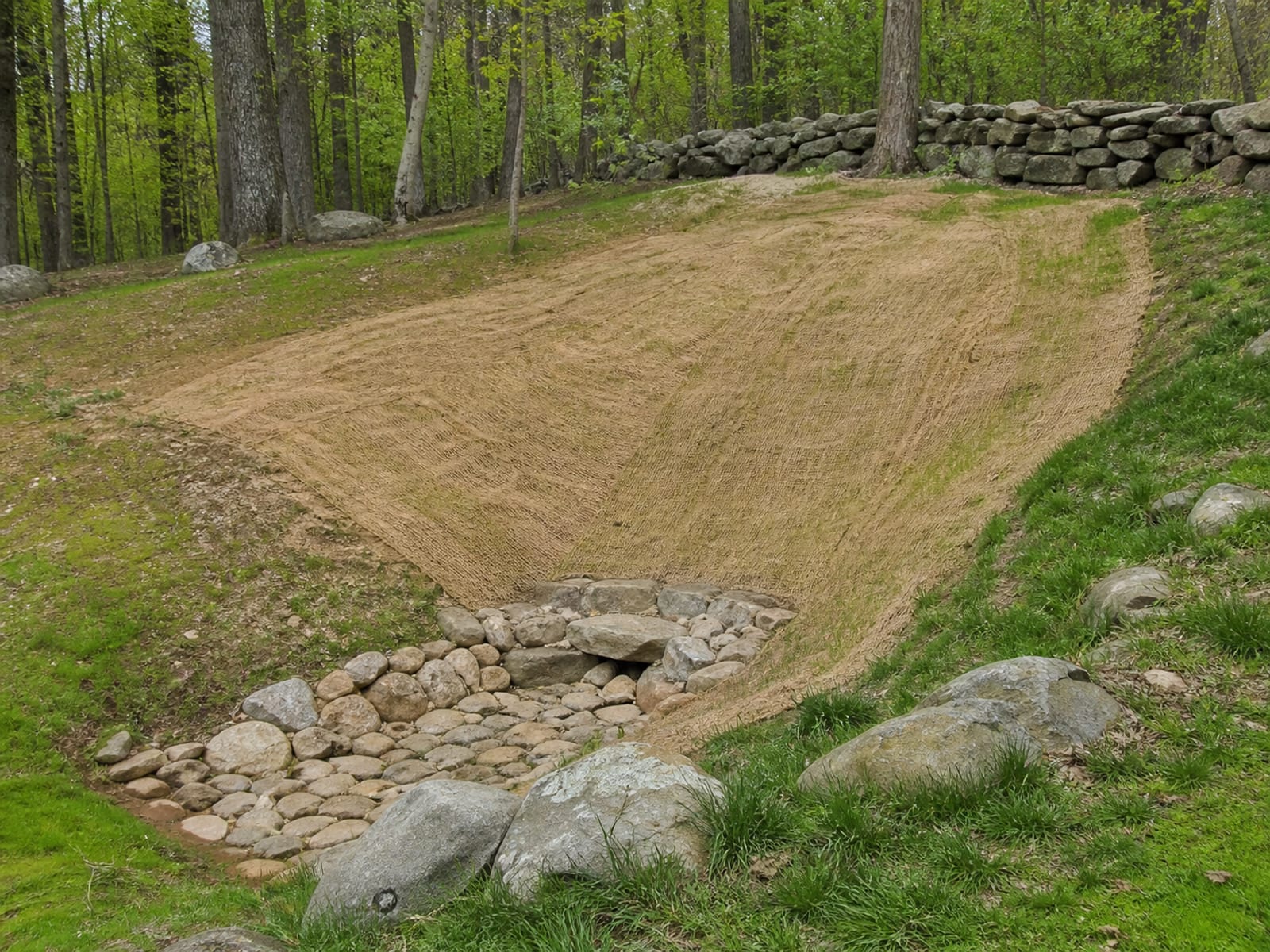
Erosion control deals with detachment. Soil moves because water hits it, gathers speed, and carries it away, so erosion control reduces how concentrated and how fast the water is, protects bare soil while it is exposed, and establishes a surface that holds. That is the actual repair.
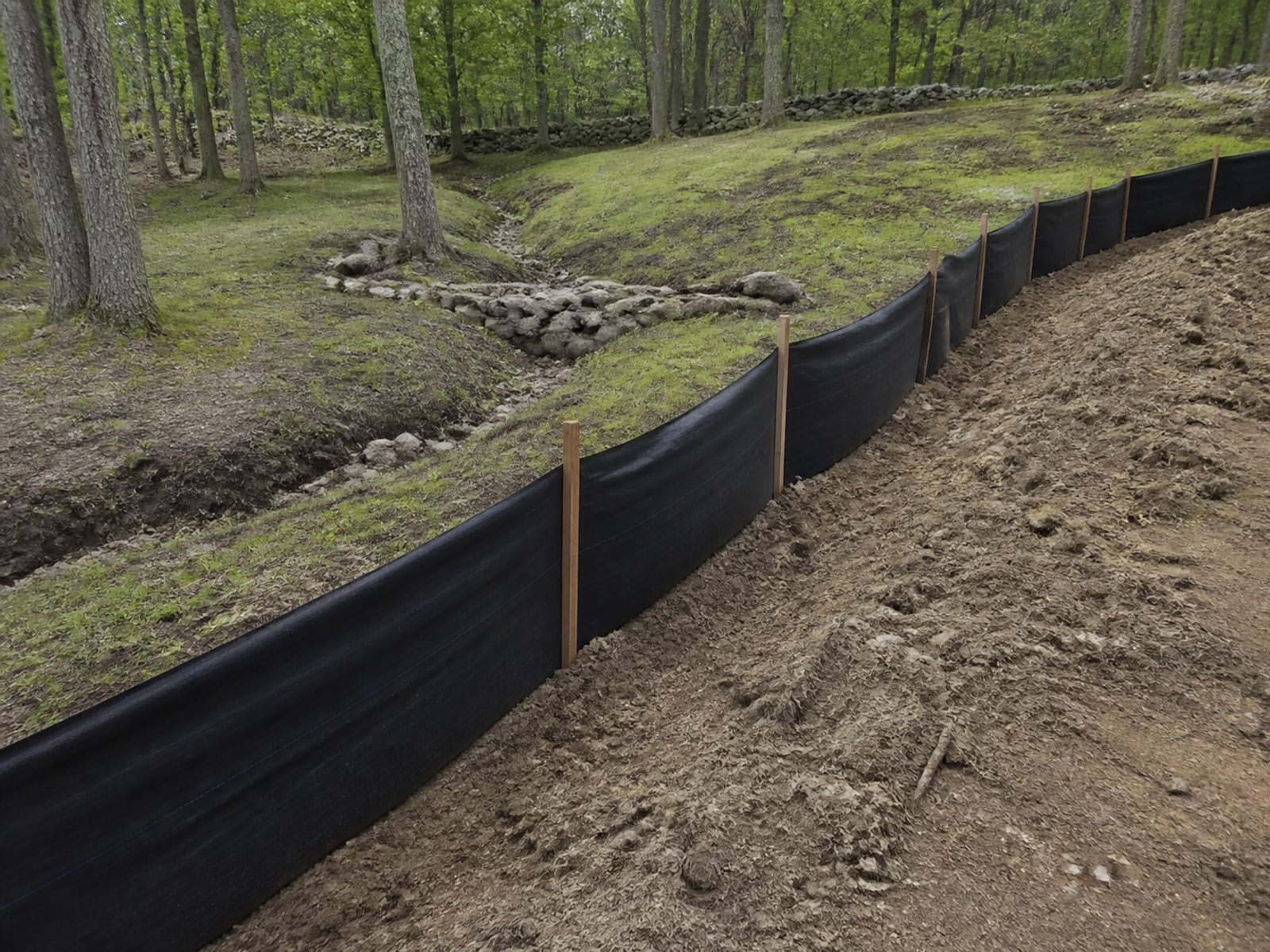
Sediment control deals with what has already detached. Silt fence, inlet protection, check dams, and similar measures keep soil that is moving from reaching a drain, a stream, a wetland, a road, or a neighbor while the source is being fixed. That is protection during the work.
The reason this distinction matters practically: a great many washouts get treated with sediment control alone. A silt fence goes in at the bottom of the slope, the visible mud stops leaving, and everybody moves on. The following spring the scar is deeper, because nothing upslope changed. Temporary control that has become permanent is not a repair, it is a filter with a maintenance obligation attached.
Connecticut's guidance treats the whole thing as a planned, site specific process rather than a product you buy, and that framing is the useful one.
The Repair Starts Above the Scar, Not At It
Where erosion is happening is not where erosion is caused. The gully is where concentrated water passes, so the fix begins at whatever is doing the concentrating.
The list of usual suspects is short and most of it is visible from where you are standing. Roof discharge landing in one place. A driveway or other hard surface shedding along one edge. A compacted path or track that has become the low line. A swale that has silted up and now overtops at one point. A culvert or a pipe outlet discharging without protection. A neighboring property routing water to your boundary.
Then follow the water down to where it leaves, and look hard at that point. An outlet has to be stable enough to take what arrives, it has to be somewhere you are permitted to send water, and it must not simply move the erosion twenty feet downhill. If the only plausible discharge point is near a watercourse, a wetland, or off the property, that is a design conversation to have at the start.
The other thing worth establishing early is whether you are looking at surface loss or slope movement. Rills and gullies in an otherwise sound slope are one problem. Sloughing, cracking, bulging, or an undermined edge is a different one, and a repair designed for the first will not address the second.
Bethany's Half Acre Rule Has No Listed Exemptions
This is the local fact worth knowing before you plan anything substantial.
Bethany's published zoning regulations require an approved erosion and sedimentation control plan, or a determination that one is not required, before a zoning or building permit is issued where cumulative land disturbance is more than one half acre. The Planning and Zoning Commission or its designated agent certifies the plan. And the published regulation states that there are no exemptions from that requirement.
Two words in there deserve attention. Cumulative means the total disturbed across the project rather than the largest single area, which is easy to underestimate on a repair that ends up touching several places on a slope. And no exemptions is unusual language and worth taking at face value rather than assuming a residential carve out exists.
The Inland Wetlands Commission is the other path. It administers the town's Inland Wetlands and Watercourses Regulations and issues, conditions, modifies, or denies permits for regulated activities. Filling, removal of material, diverting or obstructing the flow of water, construction, and other site work can all be regulated activities depending on where they happen, and the regulated area determination is parcel specific. Screening the proposal with Land Use before work begins is a phone call. Discovering the answer afterward is not.
For a larger project, private non governmental construction disturbing at least one acre and less than five falls into the state's locally approvable construction stormwater category, which means municipal review with a local plan rather than a separate state application. Confirm the current category before filing rather than assuming.
Four Approaches Solve Four Different Problems
| Approach | Best for | What it does not do |
|---|---|---|
| Erosion control | Exposed soil and surface loss where the underlying slope is sound | Resolve an uncontrolled water source, or hold a slope that is structurally unstable |
| Sediment control | Temporary protection of drains, water, roads, and neighboring land while the source area is corrected | Serve as a permanent repair. It is protection during the work, not the work |
| Slope stabilization | A slope that is moving, sloughing, cracking, or losing material at a concentrated outfall | Substitute for correcting the water. It may also need engineered design and review |
| Runoff control | A concentrated water source above or passing through the damaged area | Help if the outlet it discharges to creates new erosion or affects a regulated area |
Erosion control in Bethany, CT protects and stabilizes the source area
The core of most residential repairs. Reduce the concentration and velocity of water reaching the exposed area, protect the bare soil while it is vulnerable, and establish a permanent surface that holds. On a wooded upland slope that often means a combination of interception above, shaping through, and cover on the disturbed ground.
Sediment control in Bethany, CT protects what is downslope during the work
Necessary and temporary. Perimeter measures, inlet protection, and check dams keep the disturbance from reaching the brook, the wetland, the road, or the property line while the real fix is being built. They get maintained during the work and removed when the site is stabilized, not left as the answer.
Slope stabilization in Bethany, CT addresses ground that cannot hold its shape
When the face itself is failing rather than simply eroding, the question moves from cover to structure. Regrading to a stable angle, reinforced slope treatments, retaining elements, and drainage behind them are all possibilities, and this is exactly the territory where Connecticut's guidance points to case by case evaluation by a licensed professional engineer rather than a standard detail.
Runoff control in Bethany, CT intercepts the water before it concentrates
Often the cheapest permanent fix available, because it deals with the cause. Interception above the problem area, distribution so flow stays spread rather than gathered, conveyance that can carry what it receives, and a discharge point that is stable and lawful. Where a repair keeps failing, this is usually the part that was skipped.
Water Leaving the Property Is a Watershed Question Here
Bethany's role in a public water supply watershed changes the weight of an ordinary washout. Sediment reaching a stream is not only a nuisance to a neighbor, it is material entering a system the town treats as a core concern, and that is reflected in how seriously the local rules take erosion, siltation, and water quality.
Practically, that shows up in two ways. First, the outlet question is less flexible here than somewhere with no receiving water nearby, and a discharge that would be unremarkable elsewhere may need review. Second, the threshold for wanting a determination rather than a judgment call is lower. If the water from your slope reaches a brook, a wetland, a pond, or a road ditch that leads to one, that is worth raising with Land Use before the work rather than describing afterward.
None of that makes the repair harder to build. It makes the sequence matter: ask first, then design, then dig.
The Work Runs From Triage to Post Storm Verification
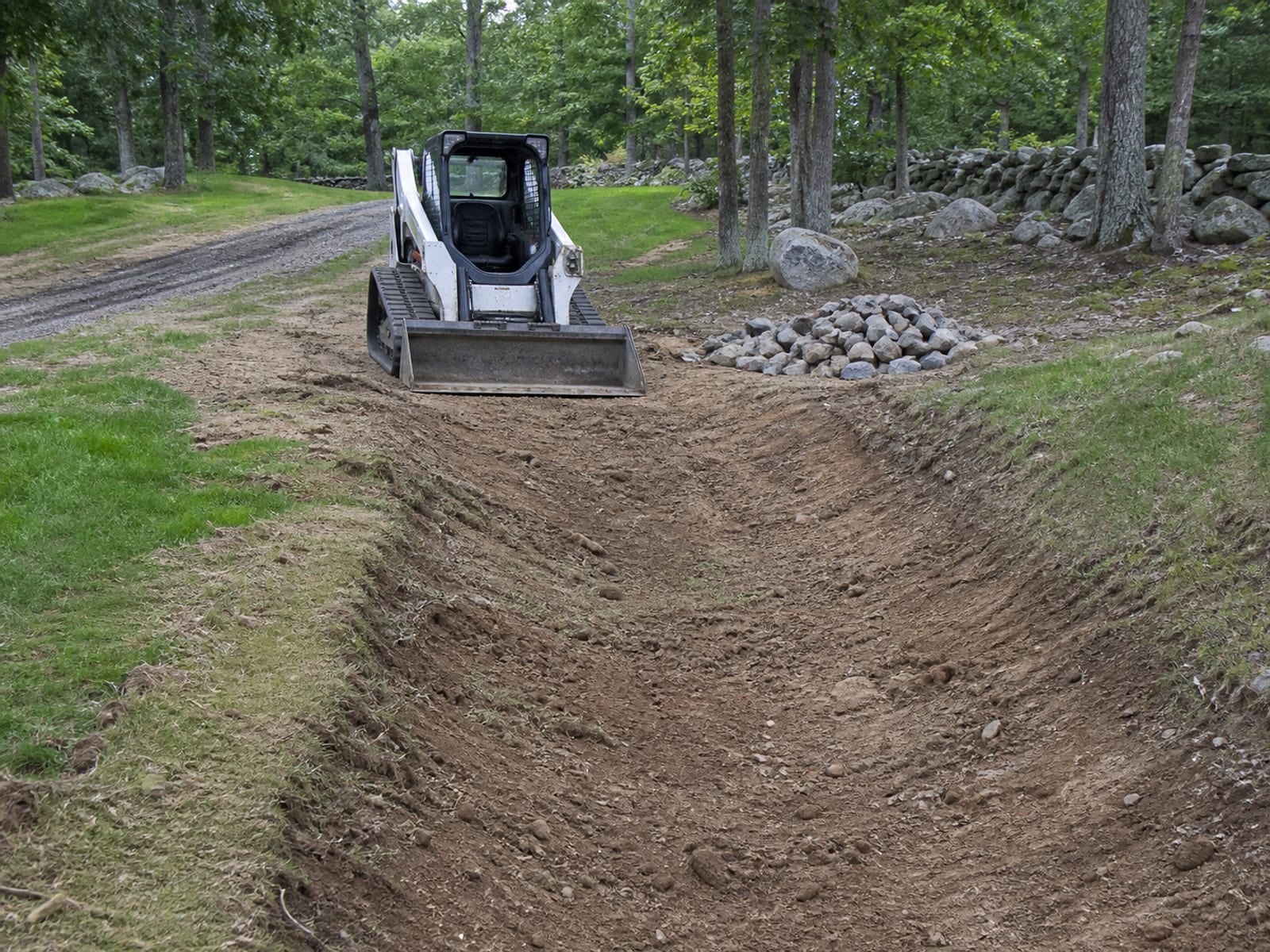
1. Triage. Keep people away from an undermined edge or an actively moving area, and put temporary protection between the disturbance and anything downslope that matters. This is the part that happens today. 2. Assess the water path and the grade. Walk it in rain if at all possible. Where water starts, where it concentrates, where it exits, and whether the slope itself is stable or moving. 3. Plan and phase the work. What gets disturbed, in what order, with which controls in place at each stage, and where the permanent outlet is. This is also where the approval question is settled rather than assumed. 4. Do the earthwork and install the drainage under control. Interception and conveyance built before the surface is finished, outlets protected before water is sent to them, and only as much ground open at a time as can be protected. 5. Stabilize and maintain. Permanent cover established on the disturbed ground, temporary measures maintained until it is holding, and only then removed. 6. Verify after a real storm. Walk it again during or just after significant rain and look for concentrated flow, undercutting, or a new low point. Repairs that fail usually announce themselves at the first storm, and that is the cheapest moment to correct them.
A Site Specific Plan Shows Things a Product Cannot
Where a plan is required, what it has to contain is a good description of what the work genuinely involves.
| Item | When it applies | Who |
|---|---|---|
| Certified erosion and sedimentation control plan, or a determination that one is not required | Before a zoning or building permit is issued where cumulative land disturbance exceeds one half acre. The published regulation states there are no exemptions | Bethany Planning and Zoning Commission or its designated agent, through Land Use |
| Plan contents | Existing and proposed topography, soils, wetlands, watercourses, water bodies, disturbed areas, and the location and design of the erosion and sediment controls, with stormwater facility sizing calculations where applicable | Prepared for the certifying authority |
| Inland wetlands permit or determination | Filling, removal of material, diversion or obstruction of water flow, construction, or other site work that may be a regulated activity. The regulated area determination is parcel specific | Bethany Inland Wetlands Commission |
| Locally approvable construction stormwater category | Private non governmental construction disturbing at least one acre and less than five acres, with municipal review and a local plan | Bethany land use process, under the CT DEEP program |
| Engineered design | Any measure that requires it. Connecticut guidance calls for case by case evaluation by a Connecticut licensed professional engineer | A licensed professional engineer |
| Call Before You Dig | Any powered excavation, at least two full days ahead excluding weekends and holidays, and no more than 30 days ahead, subject to the emergency exception | CBYD, at 811 |
Read the plan contents row again and notice what it asks for: topography, soils, wetlands, watercourses, disturbed areas, and the design and location of the controls. That is a description of the water path from top to bottom. It is also the reason a quote built from a photograph of the gully will not survive contact with the site.
The Cost Is Set by the Water Path, Not the Materials
No authoritative Bethany specific residential price range for erosion control, sediment control, slope stabilization, or runoff control was found, and no general duration range exists either. What determines both is knowable, though, and it is mostly upstream of any material choice.
- The source and volume of runoff, and how far above the damage the interception has to start.
- The grade and the outlet, including whether a stable, lawful discharge point exists or has to be built.
- The soil and the slope condition, meaning surface loss versus movement, since the second brings design work.
- Access, on a long or steep approach where equipment and material have to reach the work.
- The regulated area status, and whether wetlands review, a certified plan, or engineering is involved.
- The total disturbed area, since crossing one half acre cumulatively changes the approval position.
- Utility conflicts, and the locate and protection they require.
- The permanent stabilization method, which is a real line item rather than the tidying up at the end.
Five Mistakes Turn a Washout Into a Larger Repair
- Treating a temporary sediment measure as the permanent fix. It filters what is leaving. It does not stop what is causing it.
- Sending collected runoff to an unprotected downslope point. The erosion relocates, often onto ground that is not yours.
- Disturbing more ground than the project can protect and stabilize. Every extra open area is exposed until the whole job is finished.
- Starting powered excavation without a current locate ticket and markings. The requirement applies to repair work exactly as it does to construction.
- Deciding from a visual inspection that no wetland or watercourse review is needed. The determination belongs to the town, and dry looking ground proves very little in Connecticut.
Some Things Cannot Wait for the Ground to Dry
There is a reasonable instinct to wait for better conditions, and for a modest surface problem it is often the right call. There are situations where it is not.
Do not wait if soil is actively moving toward a waterbody, a road, a structure, or a steep edge, or if anyone is exposed to an undermined area. Those need immediate protection even if the permanent repair follows later, and a contractor or the town can help establish what interim measures are appropriate and what sequence the real fix should follow.
For everything else, timing follows condition rather than the calendar. Working saturated ground makes a repair harder to build and harder to stabilize, and permanent cover has its own seasonal window, which means a late season repair may carry temporary protection through until conditions allow the permanent surface to establish. That is normal and worth agreeing in advance rather than treating as an unfinished job.
Four Questions About a Moving Slope
1. What is the difference between erosion control and sediment control?
2. Where does a washout repair actually begin?
3. What does Bethany's regulation say about exemptions from the erosion and sedimentation control plan requirement over one half acre of cumulative disturbance?
4. Who evaluates measures that require engineered design?
Pick an answer to begin.
Frequently Asked Questions About erosion and sediment control bethany ct
What is the typical price range for erosion control in Bethany? No authoritative Bethany specific residential range was found, so a figure here would be made up. The estimate is driven by where the water comes from and how much of it there is, the grade and whether a stable lawful outlet exists, whether the problem is surface loss or slope movement, access on the property, the regulated area status and any plan or engineering required, the total disturbed area, utility conflicts, and the permanent stabilization method. Ask for those separated in writing rather than a single number for a repair.
Is sediment control the same as erosion control? No. Erosion control addresses soil detaching and moving at the source. Sediment control limits where detached soil goes while the work is happening. Most projects need both, in sequence: sediment measures protect what is downslope while the erosion source is corrected, then come out once the ground is stabilized. Leaving sediment control in place as a permanent solution is the single most common way a washout comes back.
Is slope stabilization better than runoff control? Neither is better in the abstract, and the assessment decides. Runoff control is essential where water concentration is driving the damage, which is most residential washouts. Slope stabilization becomes necessary when the slope itself cannot hold its shape regardless of the water. Plenty of sites need both, and doing the stabilization without correcting the water tends to produce a well built structure with a countdown on it.
Do I need a Bethany permit for erosion control work? It depends on the scope and the location, and there are two paths worth checking. Bethany's regulations require a certified erosion and sedimentation control plan, or a determination that one is not required, where cumulative land disturbance exceeds one half acre, and the published regulation states there are no exemptions from that. Separately, regulated activities are within the Inland Wetlands Commission's authority. Confirm the parcel and your actual scope with Land Use before work.
Do I need to call 811 before a drainage or slope repair? Yes, for any powered excavation, subject to the emergency exception. Obtain the ticket at least two full days ahead, excluding weekends and holidays, and no more than 30 days before digging, then verify the markings. The locate covers participating utility facilities, so private lines on the property need to be identified separately from your own records and observation.
Can I wait until the ground dries out? Not if soil is actively moving toward a waterbody, a road, a structure, or a steep edge, or if anyone is exposed to an undermined area. Those situations need immediate protection whether or not the permanent repair can proceed. For a stable surface problem, waiting for workable conditions often produces a better result. No universal local wait time rule exists, so the judgment belongs to a professional or the town rather than to a calendar.
How long will the repair take? No general residential duration range exists for this work. The schedule follows the scope, whether an approval or engineering is needed, the access, the weather, the soil condition, material availability, and the stabilization method. Note also that where a state application is involved, its processing window is a separate thing entirely from how long the field work takes, and the two should not be confused when planning.
Final Thoughts
A washout is a water problem wearing a soil problem's clothes. The gully is the evidence, the cause is above it, and the durability of any repair is decided at the outlet below it. Work in that order, from the contributing area down through the damaged ground to a stable discharge point, and the fix holds. Start at the scar and it does not.
The Bethany specific parts belong in your first phone call rather than your last. The half acre cumulative disturbance threshold is published without exemptions, the Inland Wetlands Commission decides what counts as a regulated activity, and engineered measures are evaluated case by case by a licensed engineer. All three are easy to satisfy up front and awkward to satisfy retrospectively.
If soil is moving on a Bethany, CT property, Prestige Property Maintenance can walk it with you, ideally in wet weather, trace the water from its source to where it leaves, and put a scope in writing that names the outlet and the permanent stabilization. We handle erosion and sediment control, grading, drainage solutions, and retaining wall construction with one crew working out of Oxford, so the water and the ground it is moving are one job rather than two. See how we work across Bethany, call (203) 258-3395, or contact us before the next storm makes it bigger.
Erosion and Sediment Terms
Tap a term to see what it means.
Erosion. The detachment and movement of soil by water. It is caused upslope of wherever the damage is visible.
Related Articles
Site Preparation in Bethany, CT: A Wooded Lot's Real Order
Site preparation in Bethany, CT follows a set sequence, from erosion controls to footing inspection. See what has to happen before you can build.
Building a Retaining Wall in Bethany, CT That Lasts
Worried your Bethany retaining wall will lean after a few winters? Retaining wall construction in Bethany, CT depends on frost depth and drainage.
Erosion and Sediment Control in Derby, CT: Where to Start
Erosion and sediment control in Derby, CT means two different jobs, holding soil in place and catching what already moved. See how they fit together.