

Drainage Solutions in Derby, CT: Options Compared
Kash CochranePublished
- drainage solutions
- derby ct
- french drain
- standing water
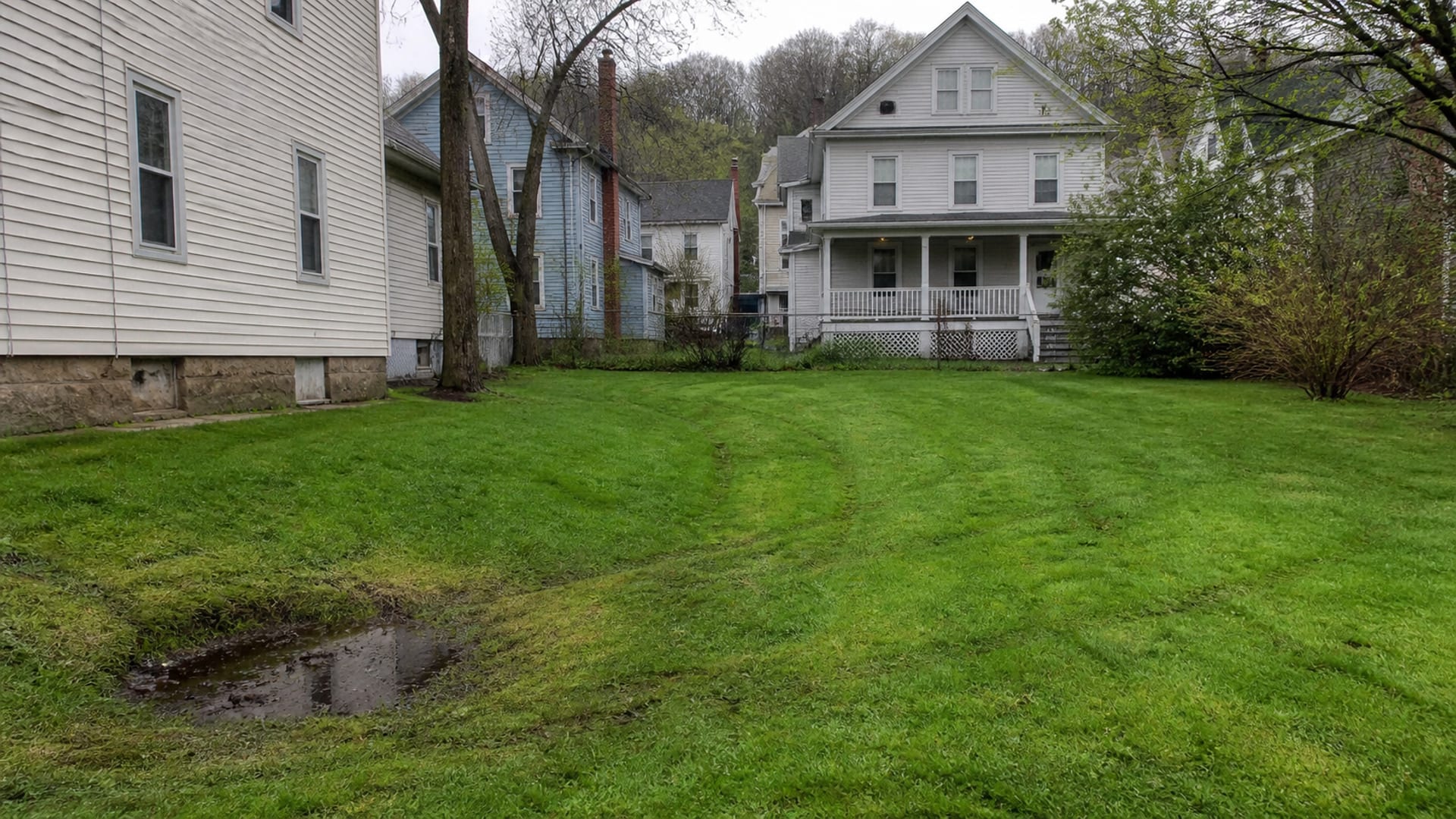
The low spot in the yard is still holding water four days after the last storm, and you have started checking it every time rain shows up in the forecast. Derby sits right where the Housatonic and the Naugatuck come together, in New Haven County, and the city's own natural resources mapping identifies alluvial and floodplain soils, poorly drained and very poorly drained ground, and mapped flood zones along both rivers. That is not a small detail when you are trying to work out where your water is supposed to go. Most drainage advice online jumps straight to installing a French drain, as though every wet yard has the same cause. It does not. Standing water is a symptom, and the fix that actually works depends on where the water starts, how much fall your property has, and whether there is a lawful place to send it. What follows walks through the likely causes, the options that match each one, and the questions that separate a real investigation from a guess.
Key Takeaways
Diagnosis comes before the dig
standing water needs a source and elevation check first. A French drain is one option, not the automatic answer, and installing one without a verified outlet moves the problem rather than solving it.
Derby's river valley ground changes the math
alluvial and floodplain soils, poorly drained areas, and mapped flood zones mean a homeowner cannot assume a trench will have adequate fall, suitable infiltration, or an allowable discharge point.
Call Before You Dig is not optional
Connecticut requires an 811 notification at least two full days, excluding weekends and holidays, before excavating with powered equipment.
Standing Water Is a Symptom, and It Has Several Possible Causes
Before anyone prices a system, the water has to be traced back to where it begins. A useful site investigation separates roof runoff, uphill surface flow, shallow groundwater, a simple low spot, a failed or undersized existing drain, and water actually reaching a foundation wall. These are different problems with different fixes, and the same trench will not address all of them. Getting this wrong is the single most common reason a homeowner pays for drainage work twice.
Roof runoff and downspouts
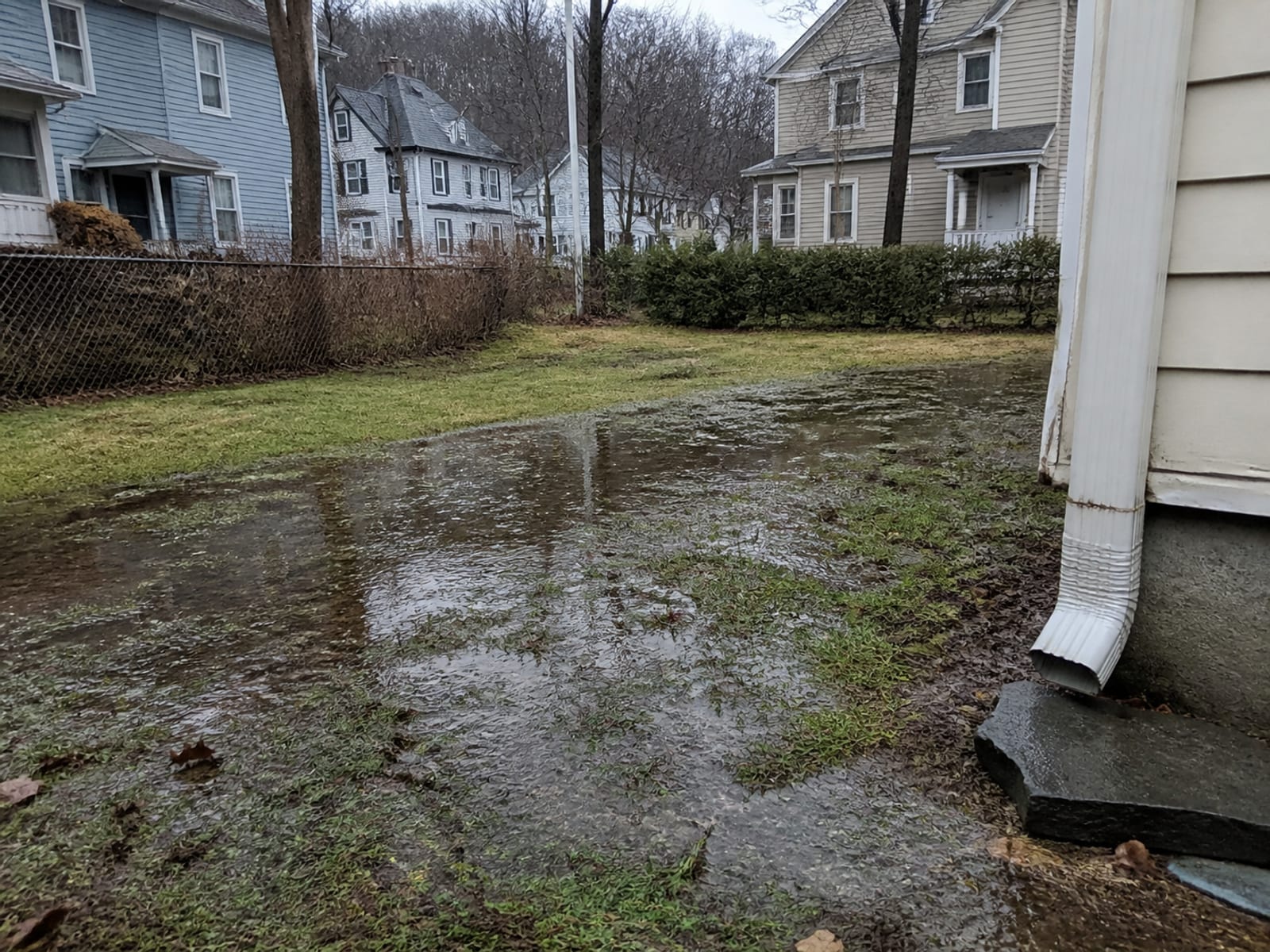
A surprising share of yard water problems start at the roof. A house sheds a large volume of water in a heavy rain, and if downspouts discharge at the foundation or a few feet from it, that water saturates the ground closest to the building. Cracked leaders, disconnected extensions, and clogged gutters concentrate it further. This is the cheapest thing to rule out and the first thing worth checking, because it is often the whole answer.
Surface slope, hardscape, and yard low points
Water follows grade. On a compact Derby lot with a driveway, a walkway, and a patio, a good deal of the ground is impervious, and the remaining lawn has to absorb or shed everything that lands on it. If the yard pitches back toward the house, or a patio was set slightly high, water collects against the building instead of running away from it. A low spot in the middle of the lawn is a different case again: the water may have nowhere lower to go.
Shallow groundwater and soil that will not drain
Some ground stays wet because the water table is close to the surface or because the soil itself moves water slowly. Derby's mapped alluvial and floodplain soils near the rivers, along with areas identified as poorly drained and very poorly drained, make this a live possibility rather than a rare one. The USDA Web Soil Survey is a reasonable screening tool for a parcel, but it is a screen, not a substitute for test pits and field observation on a small urban lot.
An existing drain with no outlet or a blocked one
Plenty of Derby properties already have drainage in the ground, installed by a previous owner and long since forgotten. Pipe crushes, outlets silt up, and cleanouts get buried under a lawn. A system that once worked can stop working entirely without anything visible changing at the surface. Finding and testing what is already there sometimes costs less than installing something new.
Water in the yard versus water at the foundation
These sound similar and are not. A wet lawn is a nuisance and a maintenance problem. Water standing against a foundation wall, or showing up inside the basement, is a building problem, and addressing it usually means deeper excavation along the structure and a look at whether the exterior of the wall is doing its job. Treating the second as though it were the first is how homeowners end up with a tidy new trench and a basement that still gets wet.
What Actually Changes the Scope on a Derby Property
Two jobs described the same way, "drainage," can be very different pieces of work. Scope is set by physical conditions on the parcel and by which approvals apply, and both need to be established before anyone can say what the work involves. The factors below are the ones that move a project from a half day of grading to a multi day excavation. Working through them early is what makes an estimate meaningful rather than a guess.
Collection point, pipe length, depth, and outlet elevation
Gravity drainage only works if the destination is genuinely lower than the collection point. A level survey settles that question. Where the fall is marginal, the pipe has to run further, sit deeper, or take a different route, and each of those changes the amount of excavation, stone, and restoration involved.
Soil conditions, wet ground, and material handling
Saturated ground behaves differently from dry ground. It holds trench walls poorly, it compacts differently on backfill, and it can require dewatering before pipe can be laid. Unsuitable material or rock encountered partway through a run changes both the method and the volume of spoil that has to be handled.
Access, staging, and restoration on a compact lot
Derby is a built up city of roughly five square miles, and lots are correspondingly tight. Whether a machine can reach the work area, where pipe and washed stone get stockpiled, and how much lawn, pavement, or planting has to be put back afterward all belong in the scope conversation rather than being discovered on day one.
Utility locations and the Connecticut 811 requirement
Every powered dig starts with a Call Before You Dig notification. Connecticut requires it at least two full days ahead, excluding Saturdays, Sundays, and holidays, and no more than 30 days ahead, with a narrow exception for emergencies. Public utility marks do not cover private lines, so irrigation, landscape lighting, propane, septic components, and existing site drainage still have to be located by other means.
Wetlands, watercourse, floodplain, and local review
Work near regulated wetlands or watercourses, or within mapped flood areas, may need review by the Derby Inland Wetlands Agency before anything is disturbed. Depending on the scope, a zoning permit or a building permit may also apply. These are questions to answer at the planning stage, not after a machine is on site.
The Options, and the Problem Each One Actually Solves
Matching the fix to the cause is the whole exercise. Each of the approaches below is a legitimate solution to a specific problem and a poor solution to the others. A contractor who leads with one of them before walking the property is selling a product rather than diagnosing a site. The comparison below is meant to help you follow the reasoning when someone explains their recommendation.
| Option | What it actually addresses | Where it falls short |
|---|---|---|
| Downspout extensions and surface grading | Roof discharge and shallow sheet flow near the house | Moves surface water only, and must not push runoff toward a neighbor, a public way, a wetland, or a watercourse |
| Swale, shallow collection area, or surface inlet | Broad overland water and a defined low spot | Needs enough fall, erosion control, and a safe receiving area. Does not correct groundwater or a foundation defect |
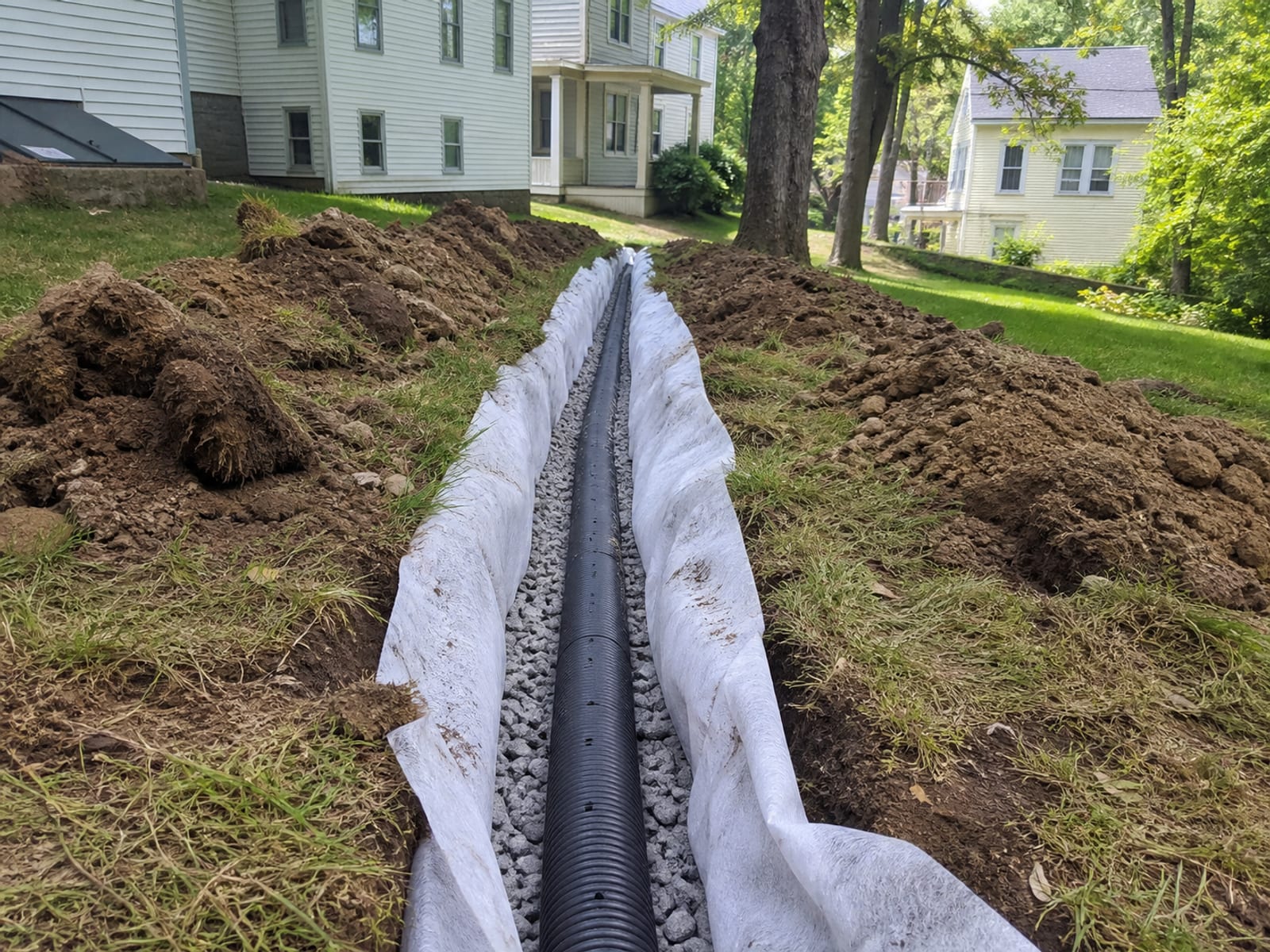
| French drain, perforated pipe in a washed stone envelope | Intercepting subsurface water, or collecting at a designed low point | Needs confirmed pipe elevation, cleanouts, stable trench conditions, and a lawful discharge. Not automatically foundation waterproofing |
| Foundation drainage and waterproofing | Verified water at or against the basement wall or footing | Deeper excavation close to the structure and utilities. Building and land use review may apply |
| Dry well, rain garden, or other infiltration feature | Runoff on parcels where soils and setbacks genuinely support infiltration | Requires site specific soil, water table, overflow, and wetland review. Cannot be sized from a generic rule |
Yard drainage in Derby, CT: grading, swales, and downspout management
Best for surface runoff and roof water. Extending downspouts, correcting the grade so ground falls away from the building, and shaping a shallow swale to carry overland flow are the least invasive place to start. The limit is that this moves surface water only, and it must not push runoff toward a neighbor, a public way, a wetland, or a watercourse.
A French drain in Derby, CT: subsurface collection
Best for water verified to be moving below grade, or collecting at a designed low point. A perforated pipe in a washed stone envelope, with a separation layer where the soil calls for it, intercepts subsurface water and carries it away. It needs confirmed pipe elevation, accessible cleanouts, stable trench conditions, and a lawful discharge. A French drain is not automatically foundation waterproofing, and it is not a fix for a problem that starts at the gutter.
Surface inlets and solid pipe conveyance
Best for a defined low spot that has somewhere lawful to drain. An inlet catches ponded water and solid pipe carries it to an approved outlet. The constraint is the same as always: enough fall, and a destination that does not create a new problem for someone else.
Foundation drainage and waterproofing
Best where investigation shows water at or against the basement wall or footing. This addresses the exterior side of the structure and usually means deeper excavation close to the building, with the utility and structural care that implies. Local building and land use review may apply.
Dry wells, rain gardens, and other infiltration features
Best where soils, setbacks, and the water table genuinely support putting water into the ground on the parcel rather than piping it away. Guidance from university extension programs on rain gardens is a reasonable starting point for the concept, but sizing has to come from site specific soil and water table evidence, plus an overflow path. On river influenced ground this is exactly the kind of feature that warrants early wetlands and floodplain review.
What a Careful Drainage Contractor Serving Derby, CT Does, in Order
The sequence matters as much as the components. A good process front loads the questions that could stop the job, so that nothing gets excavated until the destination for the water is settled and the approvals are confirmed. What follows is the order the work should run in, and each step produces something you should be able to see or be told about.
| Step | What happens, and what it produces |
|---|---|
| Walk the property | Map roof leaders, pavement, slope breaks, low points, utility entrances, basement symptoms, and possible outlets. Observe during or after rain where it is safe. A level survey settles whether gravity drainage is feasible. |
| Confirm the constraints | Submit the 811 locate, identify private lines separately, and check wetlands, watercourse, floodplain, zoning, and erosion control implications. Document approvals before mobilizing. |
| Protect and set up the site | Mark the work zone after utility marks are down. Plan access, material delivery, spoil storage, and protection of lawn, pavement, and walls. Install sediment controls before major disturbance. |
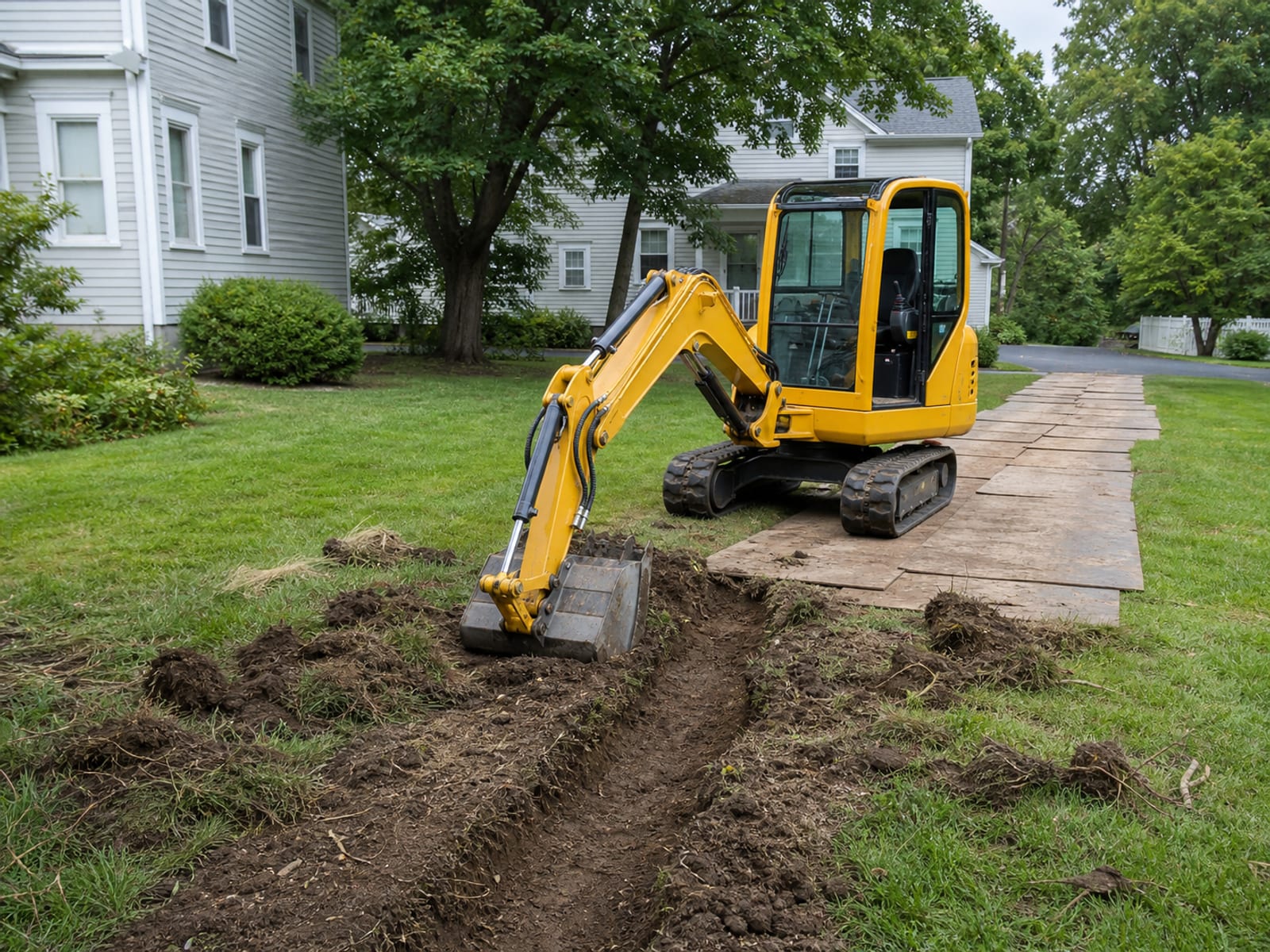
| Excavate and build the system | Dig to the designed line and grade, hand exposing around known utilities. Assemble the trench, stone, pipe, and any filter layer, with accessible cleanouts. |
| Build and test the outlet | Connect only to an approved outlet or designed infiltration feature. Check alignment, connections, and route before backfill, then test with controlled water where conditions allow. |
| Backfill, restore, and document | Protect the pipe, restore grade and surface, and photograph cleanouts, route, and outlet before they are covered. Keep the as built sketch. |
Walk the property, in dry weather and after rain
Roof leaders, pavement, slope breaks, low points, utility entrances, basement symptoms, existing drains, and possible outlets all get mapped. Observing during or shortly after rain, where it is safe to do so, shows the water path rather than inferring it. A level survey then establishes whether gravity drainage is even feasible.
Confirm the constraints before anything is dug
The 811 locate goes in. Private lines get identified separately. The parcel gets reviewed against wetlands, watercourse, floodplain, zoning, and erosion control implications, and any required approvals are documented before mobilization rather than after. If the discharge route is still uncertain at this point, the honest move is to stop and resolve it, not to open a trench and hope.
Protect the site, then excavate and build the system
Work zones get marked after utility marks are down. Access, material delivery, spoil storage, and protection of lawn, pavement, and walls are planned. Where the work is erosion sensitive, sediment and runoff controls go in before major disturbance and stay maintained through restoration. Excavation follows the designed line and grade, with hand exposure around known utilities and structures.
Build and test the outlet, then restore
The system connects only to an approved outlet or a designed infiltration feature. Before backfill, alignment, connections, cleanouts, and the route to the outlet get checked visually, and where conditions allow the system is tested with controlled water to confirm it does not back up or create a nuisance somewhere else. Backfill protects the pipe and restores the intended grade, and topsoil, seed, planting, or hardscape goes back per the agreed scope.
What you should have when the crew leaves
Photographs of the cleanouts, the route, and the outlet before they were covered, plus a simple as built sketch. That record is what makes future landscaping, fencing, or utility work possible without cutting your own drain in half.
Why Derby Properties Run Into This More Than Some of Their Neighbors
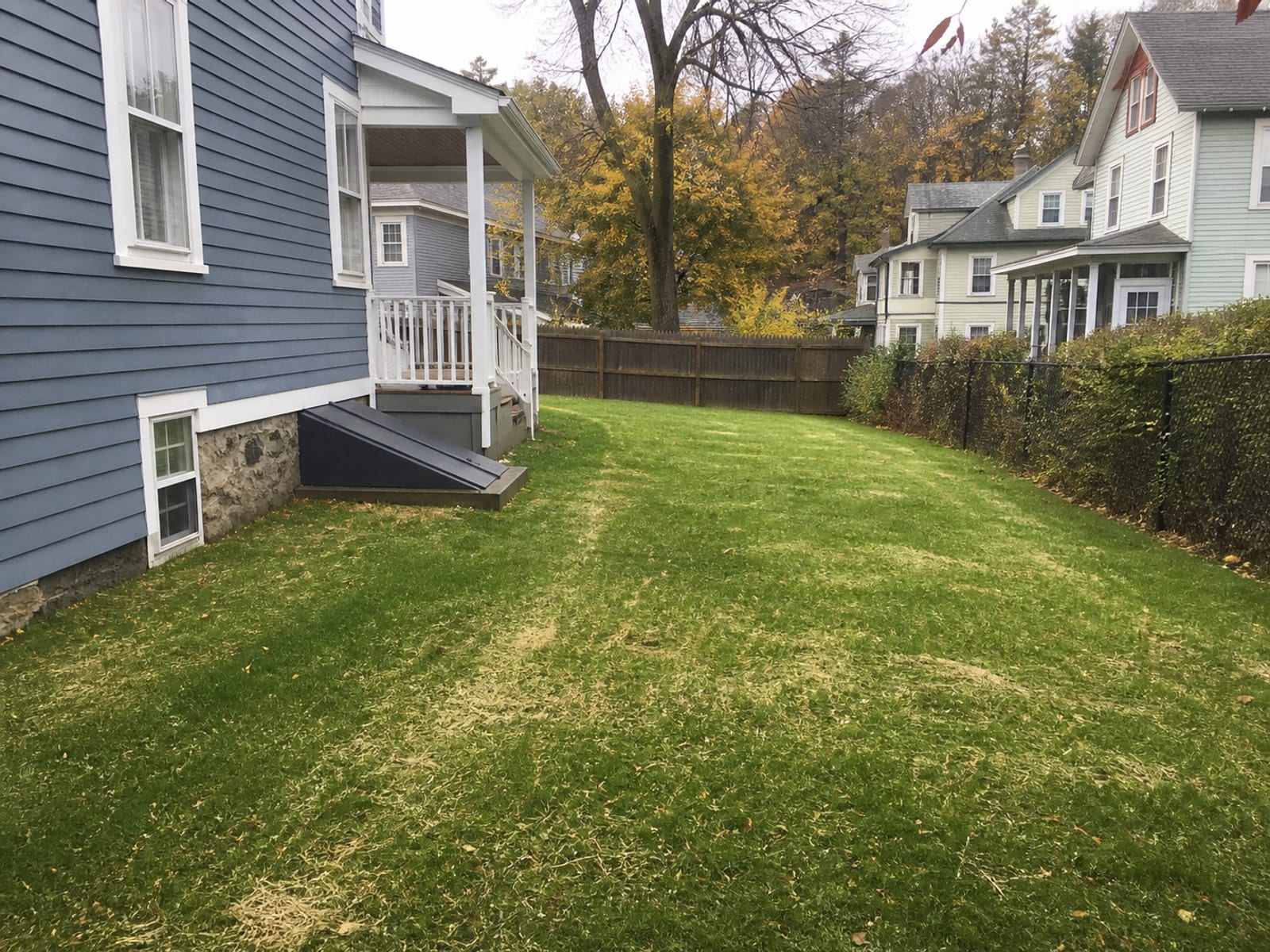
Derby is Connecticut's smallest city by land area, about five square miles, and it is densely built. It sits at the confluence of the Housatonic and the Naugatuck, and the city's natural resources mapping identifies alluvial and floodplain soils, poorly drained and very poorly drained ground, floodway, and both 100 year and 500 year flood zones along the rivers. The housing stock skews older, with a median year built in the mid 1960s, which means a good deal of the existing site drainage predates current practice and may never have been documented.
Put those together and the practical consequence is this: on a compact, developed parcel near river influenced low ground, you cannot assume a standard trench drain will have adequate fall, suitable infiltration, or an allowable outlet. Upland Derby neighborhoods away from the rivers are a different situation again, but they still need their own elevation and soil checks rather than a rule of thumb. This is also why work near the rivers warrants an early conversation about wetlands, watercourse, floodplain, and discharge constraints, well before anyone quotes a trench.
Connecticut's building code materials list a frost line depth of 42 inches and a winter design temperature of 7 degrees Fahrenheit. That figure does not set the depth of a yard drain pipe, but it is a real local condition to account for where drainage meets foundations, hardscape, and seasonal ground movement.
Mistakes That Cost Derby Homeowners the Most
Some of these are expensive, and some are simply dangerous. All of them are avoidable at the planning stage. Recognizing them is useful even if you never pick up a shovel yourself, because they are also the things worth asking a contractor about directly. If the answers are vague, that is information.
- Treating a French drain as the default: it is the right answer for a specific problem, and the wrong answer for roof runoff, a surface low spot, or a foundation defect.
- Digging before the utility marks are down: powered excavation without an 811 locate is unsafe and unlawful, and private lines still need separate attention.
- Installing pipe with no verified outlet: a trench that collects water and has nowhere to send it becomes a buried reservoir.
- Moving the problem next door: discharging toward a neighbor, a public way, a wetland, or a watercourse creates a different and worse problem.
- Skipping local review: an unreviewed project in a regulated wetland or watercourse area can put you on the wrong side of Derby's wetlands regulations.
- Letting fine soil migrate into the stone: without the right filter treatment where conditions call for it, an aggregate system silts up and stops flowing.
What You Can Reasonably Handle Yourself, and Where That Line Sits
There is real work a homeowner can do without a machine and without risk, and doing it first sometimes resolves the problem or at least narrows it usefully. Keeping gutters and leaders clear, confirming downspout extensions are intact and actually carrying water away from the building, clearing leaves off accessible surface inlets, and photographing where water runs after a storm all cost nothing but time. Keeping a known drain outlet clear counts too, where that can be done safely.
The line sits at excavation and at anything structural. Trenching, work near foundations or retaining walls, installing pipe, dry wells, or catch basins, substantial grading, dewatering, work in or near wetlands, and any proposed connection or discharge belong with a contractor, and sometimes with a surveyor, engineer, or licensed trade as well. Any powered digging, whoever does it, starts with an 811 locate.
What Drainage Work Costs, and What Moves the Number
There is no honest published price range for this work in Derby, and anyone quoting one before walking your property is guessing. What can be described accurately is what the price is made of. Cost rises and falls with the confirmed length and depth of the collection run, the volume of pipe and stone, the actual excavation conditions, whether machines and material trucks can get in easily, how much utility conflict has to be worked around, whether dewatering is needed, how close the work sits to a structure, whether ledge or unsuitable material turns up, how much spoil leaves the site, what the outlet construction involves, how much restoration is expected, and which inspections, approvals, or engineering apply.
That is why a surface grade correction and a deep exterior foundation excavation can both be called drainage and be nothing alike in scope. Duration works the same way. Mobilization, locate timing, permit review, depth, ledge, wet ground, weather, access, disposal, restoration, and outlet design all move the schedule, which is why a realistic timeline comes after a site visit rather than over the phone. For a figure that means something on your property, the right next step is a site assessment.
Frequently Asked Questions About drainage solutions derby ct
Is a French drain the best solution for standing water in Derby, CT?
Sometimes, and often not. A French drain intercepts water moving below grade or collects it at a designed low point. If your water is coming off the roof, or ponding because the yard pitches the wrong way, grading and downspout work address the actual cause and a trench does not. The diagnosis decides.
What should a drainage contractor serving Derby, CT check before excavating?
Where the water starts and how it behaves after rain, the elevations and whether there is enough fall, the soil evidence, a lawful outlet or overflow path, the 811 utility locate plus any private lines, access and staging, and whether wetlands, watercourse, floodplain, zoning, or building review applies.
Do I need to call 811 for yard drainage work?
Yes, for any excavation with powered equipment. Connecticut requires notification at least two full days ahead, excluding Saturdays, Sundays, and holidays, and no more than 30 days ahead, with a limited emergency exception.
Do Derby wetlands rules apply to a French drain or a regrading project?
They can. If the work is a regulated activity or may affect a regulated wetland or watercourse, the Derby Inland Wetlands Agency should be consulted before trenching, grading, or discharging. Confirm it at the planning stage rather than assuming a small yard drain is exempt.
How long does drainage work take in Derby?
It depends on depth, ground conditions, access, permit timing, and what the outlet involves. A short surface correction and a deep foundation side excavation are different jobs. A realistic timeline comes after someone has walked the site.
Can I install a small drainage fix myself?
You can do the non excavation work safely: gutters, downspout extensions, clearing accessible inlets, and observing where water goes. Once the job involves digging, pipe, structures, or a discharge point, it belongs with a contractor, and the 811 locate is required either way.
Check What You Know Before You Call
1. How far in advance does Connecticut require an 811 Call Before You Dig notification for powered excavation?
2. Your yard floods only after heavy rain, and the water pools right where the downspout discharges. What should be checked first?
3. What single thing has to be confirmed before a collection trench is worth digging?
4. What makes Derby ground different from a typical inland Connecticut lot?
Pick an answer to begin.
Final Thoughts
Standing water in a Derby yard is a solvable problem, but the solution has to start with where the water comes from rather than with a product. Roof runoff, surface grade, shallow groundwater, an old failed drain, and water at a foundation wall are five different situations, and each has a fix that suits it and several that do not. On ground shaped by two rivers, with floodplain soils and a densely built lot pattern, the elevation check and the outlet question are what turn a plan into a system that works.
Getting that diagnosis right the first time is what keeps you from paying for drainage twice, and it is what protects the rest of the property, the foundation, and the parts of the yard you actually use. A drain that was designed around your site conditions goes on working quietly for years, and the as built record means the next project on your property does not damage it.
At Prestige Property Maintenance we handle drainage solutions for property owners in Derby, CT as part of our work across the Naugatuck Valley and western Connecticut. Because we run excavation, grading, and trenching with the same crew, the diagnosis and the fix do not get handed between contractors. If your yard is holding water and you want someone to walk it with you and give you a straight answer about the cause before anyone talks about a trench, call Prestige Property Maintenance at (203) 258-3395 or contact us to arrange a site assessment in Derby, CT. We will tell you where the water is starting, where it can lawfully go, and what the work on your property actually involves.
Drainage Terms You Will Hear on Site
Tap a term to see what it means.
French drain. A perforated pipe laid in a washed stone envelope, with a separation layer where the soil calls for it, used to intercept water moving below grade or collect it at a designed low point.
Related Articles
What to Expect from Drainage Work in Derby, CT, Start to Finish
Hired someone for drainage work in Derby, CT and wondering how torn up the yard gets? Here is the real sequence, from utility mark-out to grading.
What to Expect from an Excavation Company in Derby, CT
A machine on your small Derby lot does not have to be stressful. Learn what to expect from an excavation company, step by step, before you hire one.
Land Clearing in Derby, CT: What Is Under the Brush?
An overgrown Derby parcel hides more than brush. Learn how land clearing in Derby, CT reveals ground conditions, limits, and drainage before you build.