

Grading in Bethany, CT: Taming a Sloped, Wooded Yard
Kash CochranePublished
- grading
- bethany ct
- erosion control
- drainage
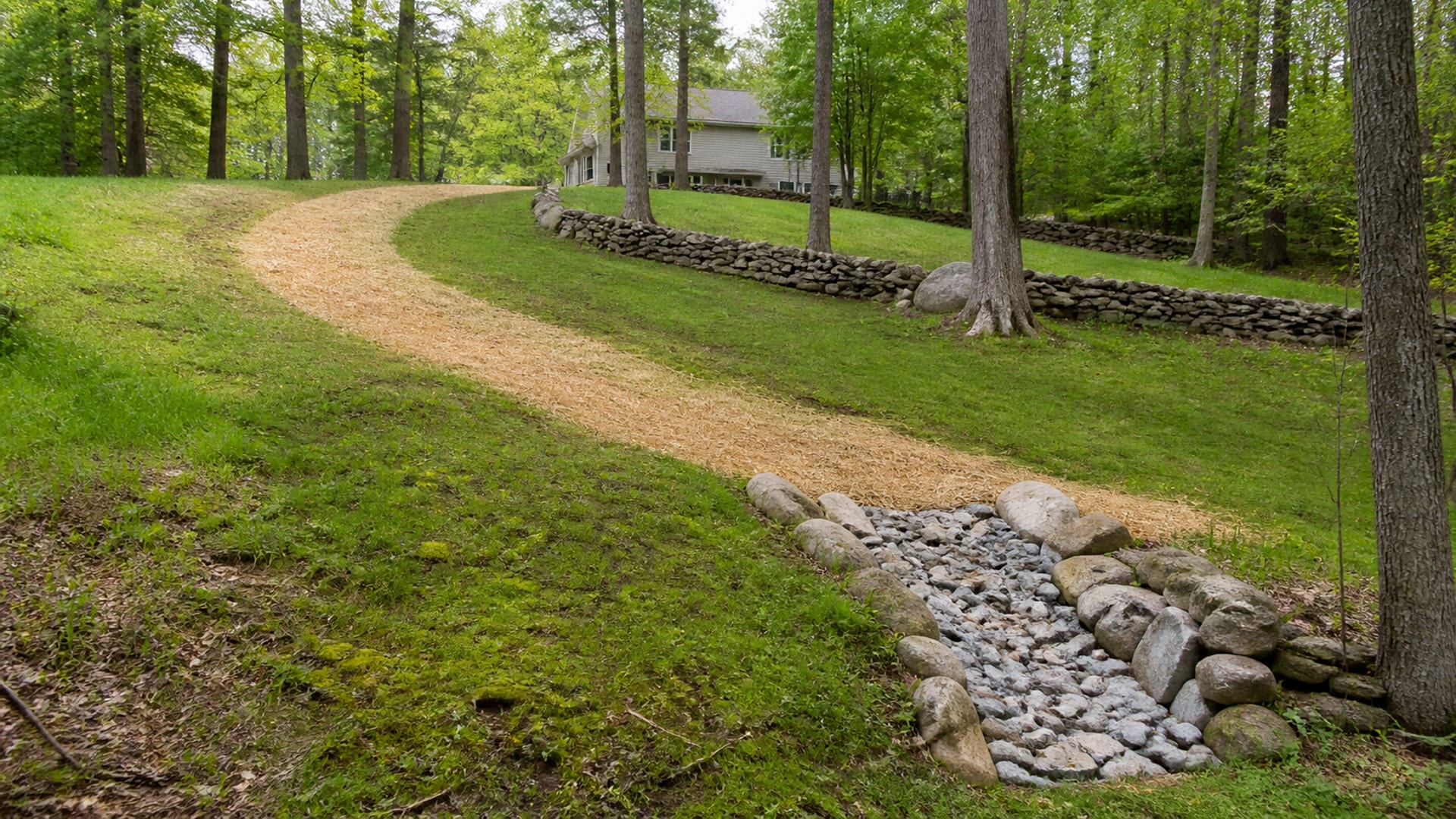
Snow goes, ground softens, the first real rain of the season comes through, and by the next morning there are channels cut across the yard again in exactly the places they were last year, a little deeper. Mulch is down the hill. Roots are showing. There is nowhere on the property that is genuinely flat enough to put a table, let alone a shed or a play area. And the fix that suggests itself, which is to bring in a machine and level some of it, is the fix that most often makes the problem worse on a lot like this. Level is not the goal on a sloping wooded parcel in Bethany. A controlled path for the water is the goal, and level is one of several possible outcomes of getting that right.
Key Takeaways
Grading on a slope is water routing first and dirt moving second
the finished elevations have to give the water a deliberate path and a safe place to arrive, or the channels simply reform somewhere else on the same lot.
Filling the channel without finding its source is the most common wasted spend
a rill is where concentrated water passes, not where it comes from, so the uphill contributing area is what has to change.
Bethany has a dedicated permit application for this work
the town publishes an Earth Removal, Excavation, Filling, Stockpiling and Grading permit application under Section 8 of its zoning regulations, with administrative and Planning and Zoning Commission approval tracks.
Where the water lands is somebody else's property if you get it wrong
sending concentrated runoff to an adjoining lot, a wetland, a watercourse, or the public way is a design decision with legal weight, not a detail.
The state advises against disturbing large or critical areas during frozen ground and spring thaw
Connecticut's erosion and sediment guidance points to December through February and March through mid April as periods to schedule around where the work allows it.
Get a Yard That Sheds Water Instead of Channeling It
The difference between a yard that works and one that erodes is not how flat it is. It is whether water arrives, crosses, and leaves in a way somebody planned.
Sheet flow, meaning water moving in a thin even layer across a vegetated surface, does almost no damage. Concentrated flow, meaning the same volume gathered into a narrow path, moves soil. Every channel in your yard is a place where sheet flow became concentrated flow, usually because something upslope collected it: a driveway edge, a roof valley and downspout, a compacted path, a gap in a stone wall, a neighbor's culvert.
That is why grading work on a wooded Bethany slope is planned backward from the outlet. Where can the water safely go, what does it have to be doing when it gets there, and what shape does the ground upstream need to take so it arrives that way. Answer those three and the earthwork is straightforward. Skip them and you have moved dirt.
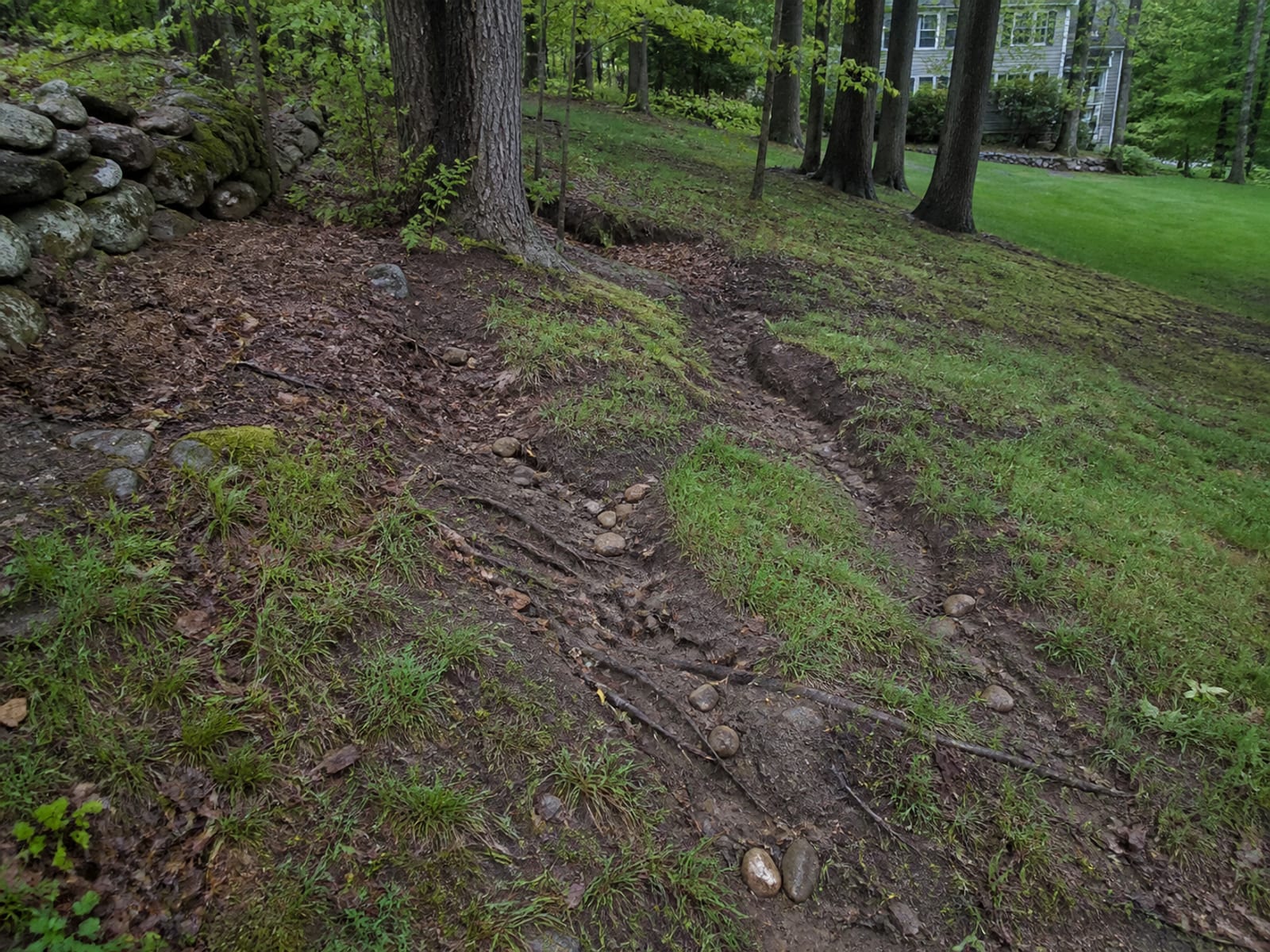
Find the Source Before You Touch the Channel
Walk the property during a heavy rain, not after. That single habit is worth more than any tool, and it is the one thing an owner can do that a contractor visiting on a dry Tuesday cannot.
| What you see | The question it raises | Reasonable to handle yourself | When it becomes professional or town work |
|---|---|---|---|
| A rill or channel cutting the same line each year | What is collecting the water upslope of where the channel starts | Photograph it, trace the line uphill, clear debris | Reshaping the contributing area, or building a swale with a designed outlet |
| Water running toward the foundation | Whether the ground within the first several feet of the wall falls away or back | Extending a downspout, clearing a blocked leader | Regrading against the structure, or any drainage component near the wall |
| A low area that holds water for days | Whether it has an outlet at all, and whether the soil drains | Watching it through a few storms and noting how long it holds | Filling it, which without an outlet just relocates the pond |
| A driveway edge shedding water into the yard | Whether the drive is the real contributing area | Noting where it leaves the drive | Any change to the driveway interface, which can involve a separate town permit |
| Exposed roots and washed mulch on a slope | How fast water is moving across the surface | Mulch and planting on gentle areas | Slope stabilization, terracing, or retaining evaluation |
| Wet ground that never fully dries | Whether it is drainage or a wetland soil | Nothing. Observe and record | A wetlands determination from the town, before any soil is moved |
The other half of the investigation is what is under the surface. The NRCS soil survey is a reasonable planning aid for a general read on your parcel, and NRCS itself is clear that onsite investigation is needed for engineering applications. On rolling wooded ground with ledge in the picture, what the soil map suggests and what a test pit shows can be two different conversations.
Pick the Scope That Matches Your Slope, Not the One That Sounds Cheapest
Four different jobs get called grading, and on a sloped parcel they are not interchangeable.
Yard grading in Bethany, CT for runoff around the lawn
The smallest scope. Shallow swales, downspout discharge moved away from the house, a lawn area reshaped so it falls consistently in one direction, low spots tied into a path that leads somewhere. It suits a property where the water problem is surface water and the volume is modest. The point at which it stops being enough is fairly clear: water at the foundation, ponding that persists for days, or flow concentrated enough to cut, all point toward drainage components rather than surface shaping alone.
Land grading in Bethany, CT for whole site cut, fill, and drainage
The larger scope, and the one that comes with survey work, a designed cut and fill balance, limits of disturbance, staging, and erosion controls tied to a construction sequence. This is what a new building area, a reworked access, or a substantial reshaping of usable ground actually requires. It is also the scope most likely to cross the acre threshold that pulls state stormwater requirements into the picture.
Slope grading in Bethany, CT for erosion and a stable flow path
The specialist case, and the common one here. Bethany's own planning objectives name protecting steep slopes, ridge lines, significant ledge, and waterways, which tells you what the town is watching for. On a steep section the risks stack: concentrated flow gains energy quickly, exposed soil on a grade is far harder to stabilize, ledge can appear where the design assumed soil, and a machine's own travel becomes a stability question. Retaining work is often part of the answer rather than an upsell, because there is a limit to how much slope you can remove by moving soil alone.
Lot leveling in Bethany, CT for usable space that still drains
People say leveling when they mean usable, and that is a fair request. What has to survive the translation is positive drainage. A genuinely flat pad on a hillside is a place for water to sit unless it is built with a fall across it and a route out. Modest reshaping, terracing with retaining elements, or a larger site rework are the three ways to get there, and which one fits depends on how much elevation you are trying to take out and what is under the ground.
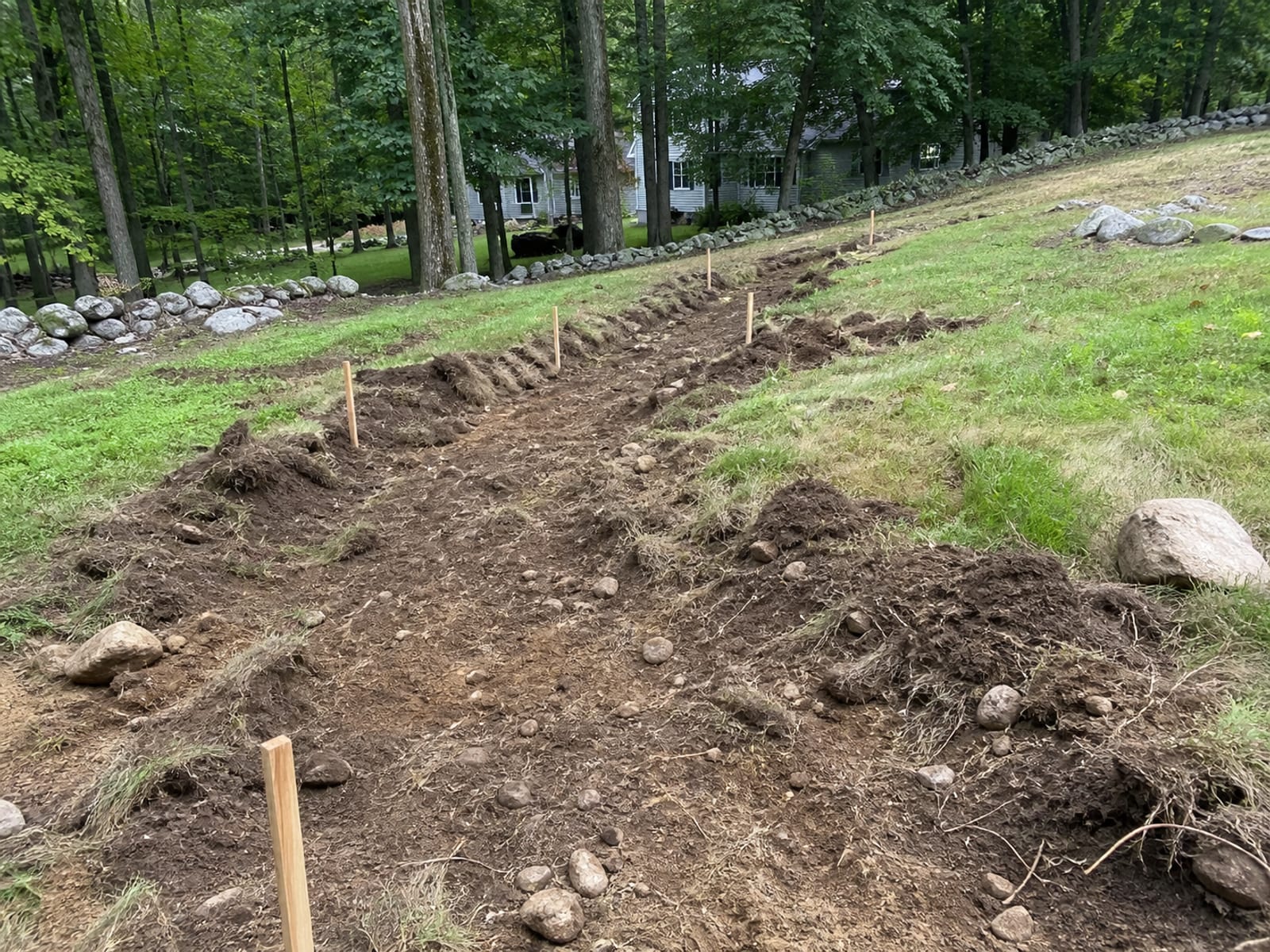
Send the Water Somewhere It Will Not Become the Next Problem
This is the part of a grading plan that people skip and later regret, and it has three separate dimensions.
The physical one: an outlet has to be stable before water is directed to it. A new swale discharging onto an unprotected bank simply moves the erosion downhill, which is why outlet protection is part of the work rather than an option.
The legal one: concentrating runoff onto an adjoining property is not something a grading plan gets to do casually. Neither is discharging into a wetland, a watercourse, or a public right of way without the relevant review. If your only plausible outlet is off the property, that is a design conversation to have at the start, not a discovery at the end.
The regulatory one: Connecticut's guidance on municipal wetlands permitting lists grading, filling, excavating, piping, culverting, and clearing among the activities that may need review when they are in or may affect a wetland or watercourse. The municipal agency, in Bethany the Inland Wetlands Commission through the Land Use Department, decides whether an activity is regulated. An owner cannot declare their own exemption. Bethany's wetlands charter names erosion, turbidity, siltation, flood, pollution, and potable water protection among what it is there to protect, which is a fair summary of what a badly aimed outlet can affect.
Clear Bethany's Earth Permit Path Before a Machine Is Booked
Bethany does not leave this to inference. The town publishes an Earth Removal, Excavation, Filling, Stockpiling and Grading permit application under Section 8 of its zoning regulations, and the application itself distinguishes an administrative approval track from a Planning and Zoning Commission track. Which track your project takes depends on its scope, and Land Use confirms it. Do not assume a threshold, and do not assume a fee.
| Item | When it can apply | Who administers it |
|---|---|---|
| Earth removal, excavation, filling, stockpiling, and grading permit | Before earthwork. The application provides administrative and commission approval tracks | Bethany Planning and Zoning Commission, through the Land Use Department |
| Inland wetlands review or permit | Work in or that may affect a wetland or watercourse, including grading, filling, excavating, piping, culverting, or clearing | Bethany Inland Wetlands Commission, through Land Use |
| Site plan or zoning review | Where the scope or associated use triggers zoning standards. Bethany's zoning materials call for erosion and sedimentation control plus drainage and runoff control plans with site development plan applications | Bethany Planning and Zoning Commission |
| Local erosion and sediment control plan under the state stormwater program | Private construction disturbing at least one acre and less than five acres, which is locally approvable with municipal review | Bethany land use process, under the CT DEEP program |
| Building permit | Only where the scope includes regulated building, structural, plumbing, mechanical, or electrical work. Pure grading is not automatically a building permit item | Bethany Building Department |
| Driveway interface or road excavation permit | Where grading changes a driveway connection or work happens in a town right of way. Bethany's own form directs a call before digging for excavation in a right of way | Bethany Land Use and the public works process |
| Call Before You Dig, 811 | Any non emergency excavation with power operated equipment. Notice at least two full days ahead excluding weekends and holidays, and no more than 30 days ahead | CBYD, overseen by Connecticut PURA |
One more note on the locate. A CBYD ticket covers participating utility facilities. It does not establish where your own private lines run, and on a rural parcel that list is usually long: the well line, the septic tank and field, a feed to a barn or a post light, an old drain of unknown vintage. Those get identified separately.
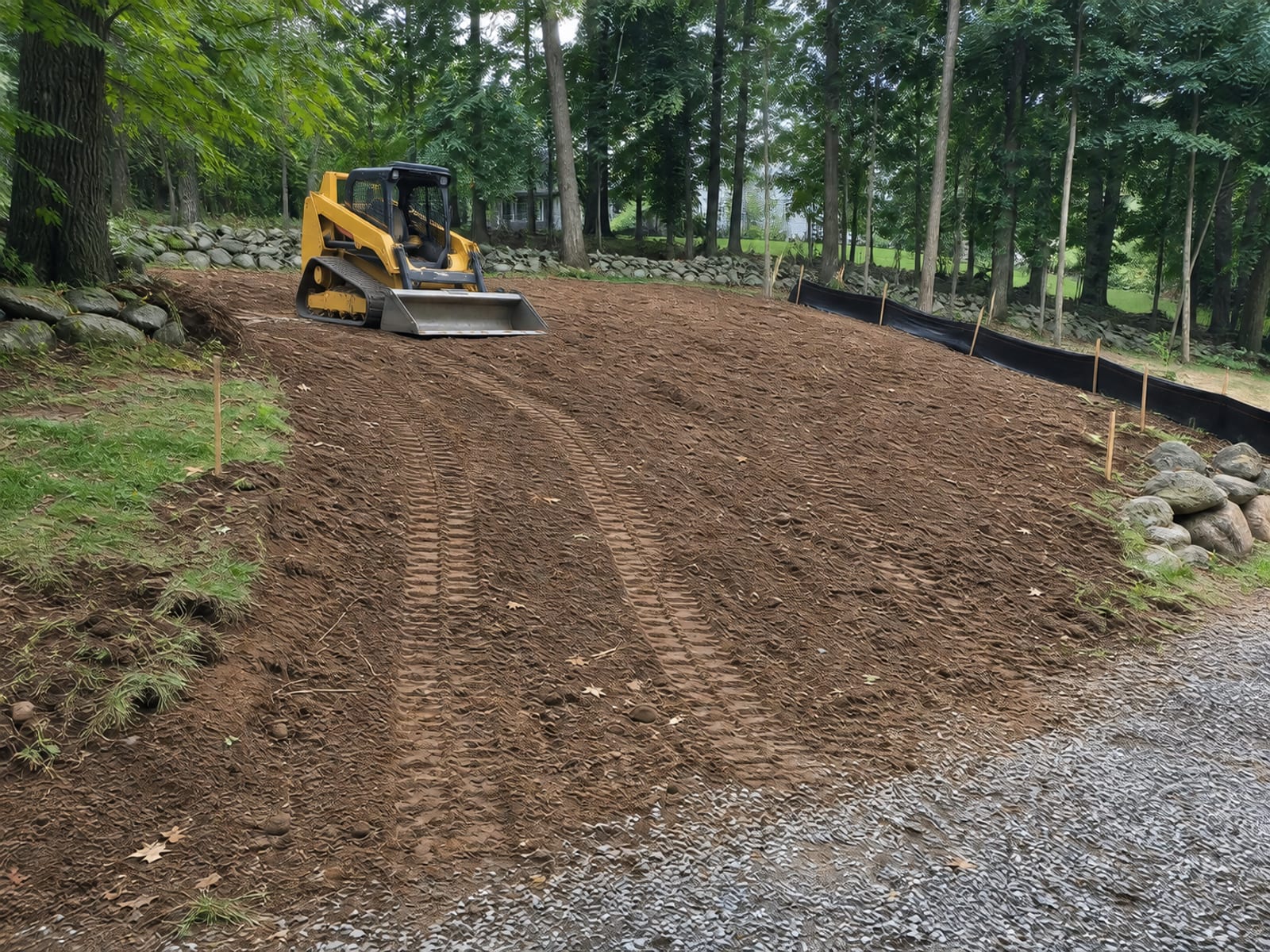
Get the Sequence Right and the Grade Holds Through the First Storm
1. Diagnose and document the water path. Observe after rain where possible. Record entry points, discharge points, channels, low areas, downspouts, driveway runoff, existing drainage structures, utilities, wetland indicators, access width, and anything that must not be disturbed. 2. Survey and lay it out. Existing and proposed elevations, drainage direction, the limits of disturbance, the stockpile location, the access route, protected vegetation, and the intended outlet. A project that needs municipal review needs plan detail at the level the application asks for. 3. Clear approvals and pull the locate. The applicable Bethany earthwork approval, the wetlands determination or permit, any stormwater materials for the disturbed area, and a valid CBYD ticket before any power excavation. 4. Install controls before moving soil. Erosion and sediment measures tied to the construction sequence, a stabilized entrance where needed, inlet and work limit protection, and topsoil and fill locations that do not let sediment leave the property. 5. Strip, stockpile, cut, and fill. Salvageable topsoil set aside separately if the scope calls for it. Fill placed in controlled lifts to the design. Unverified material kept out of places where it would create unstable ground or a drainage problem. 6. Build the drainage before the final surface shaping. Swales, pipe, structures, outlet protection, and infiltration elements in the approved sequence, with outlets stabilized before water is directed to them. 7. Finish grade, stabilize, and test in rain. Verify the flow path, replace topsoil where called for, get permanent stabilization down promptly, then inspect after a storm and correct any concentrated flow before the temporary controls come out.
Understand What Moves the Price Before You Compare Quotes
No dependable Bethany specific price range for grading, drainage, ledge removal, imported fill, hauling, or restoration was found in any town, state, or other authoritative source, and dropping in a national average would be pretending to know something nobody has established for this town. The drivers are knowable, though, and they are what two honest quotes will differ on.
- Access. Gate width, turning room, slope, soft ground, and the distance from staging to the work.
- Volume. Cut, fill, imported material, export, hauling, and whether what is on site can be reused after evaluation.
- What is in the ground. Ledge, boulders, unsuitable soils, wet conditions, groundwater, and how much testing or engineering the uncertainty warrants.
- Drainage scope. Pipe, structures, outlet protection, and the restoration behind them.
- Approvals. Wetlands, zoning, stormwater, building, driveway, or health reviews, plus the plans or professional services they require.
- Exposure and season. How much soil is open at once, how steep it is, and what erosion control that combination needs.
- Restoration. Topsoil, seed, sod, planting, stone, or hardscape put back.
An estimate that separates those is one you can question intelligently. A single figure for "regrade the yard" is one that will move.
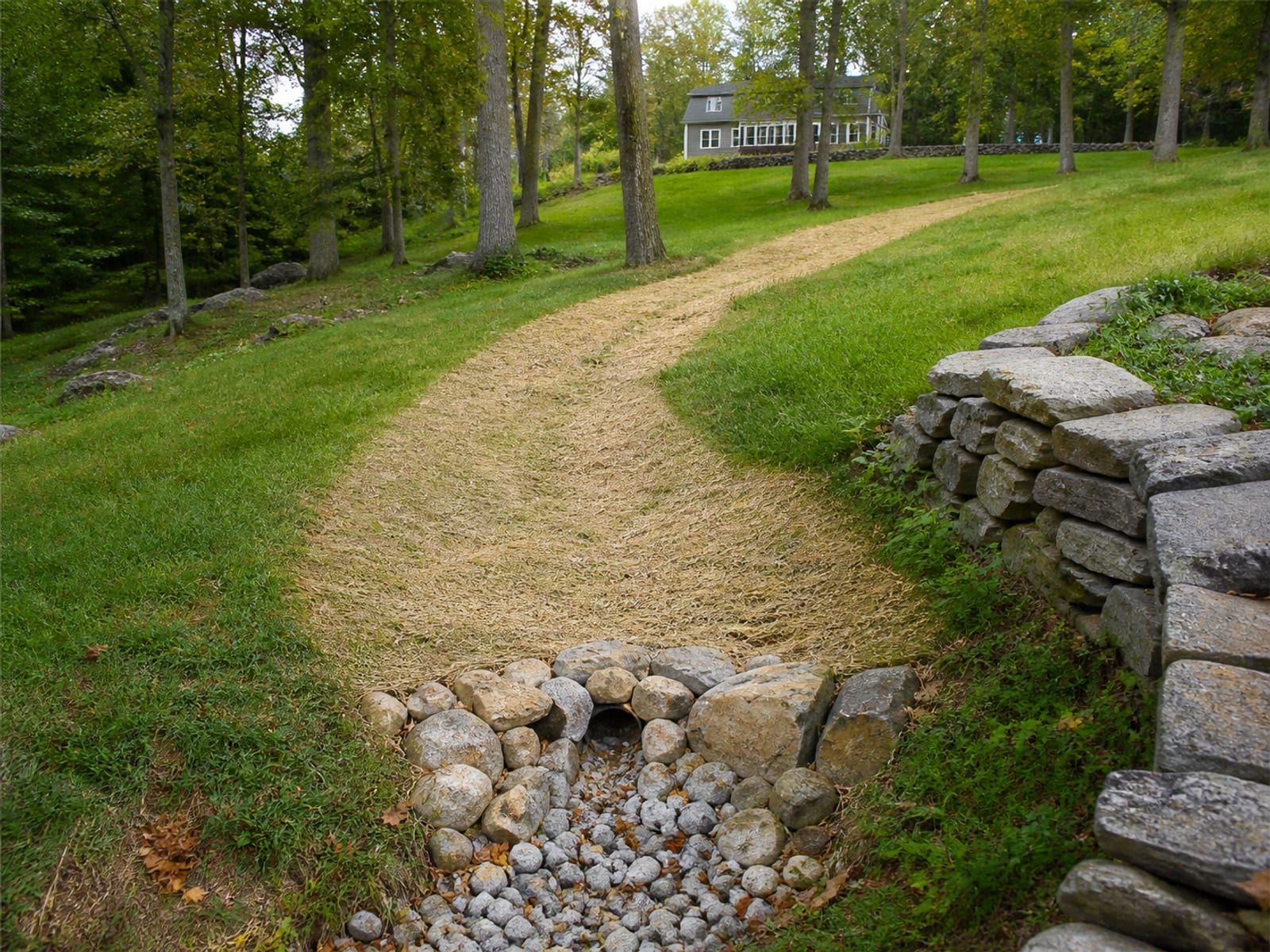
Avoid the Five Failures That Bring the Channels Back
- Filling the low spot before finding the uphill source. The water still arrives. It just finds a new line, often closer to something you care about.
- Directing flow to an outlet that is not protected or not approved. The erosion relocates downhill, sometimes onto ground that is not yours.
- Moving soil before the wetlands, zoning, stormwater, driveway, and utility questions are settled. Every one of those can stop a job that has already started.
- Leaving stockpiles and finished slopes open. Connecticut's guidance favors phasing disturbance, keeping the active exposed area small, and stabilizing completed areas promptly, for exactly this reason.
- Working through frozen ground or spring thaw when the schedule allowed otherwise. Compaction, drainage, and stabilization are all less reliable, and the finished work is what suffers.
Time the Work So the Stabilization Actually Takes
There is no Bethany seasonal grading ban, and no municipal start date to work around. What exists is state guidance worth following. Connecticut's erosion and sediment control guidance advises scheduling, where possible, to avoid disturbing large or critical areas during frozen ground conditions from December through February and during spring thaw from March through mid April, and it calls for final grading and stabilization to be completed as soon as possible.
The practical translation for a sloped Bethany yard: a big earthwork scope is better held for a window where the finished surface can actually be stabilized, and a small correction can often be done sooner. Where timing cannot be chosen, the plan carries more temporary protection rather than less. The 42 inch frost line in Connecticut's residential code criteria comes up in a lot of these conversations, but it is a foundation design figure and not a depth requirement for ordinary yard grading.
Keep the Part That Is Genuinely Yours
Photograph runoff during storms, which is the single most useful record anyone can hand a contractor. Keep gutters clear and downspout extensions working, because roof water is a contributing area you control for free. Mark where water enters and leaves the yard. Protect the vegetation you want kept. Ask the town for a wetlands answer before anything is planned around a wet area. Call 811 before any covered digging.
Beyond that, get help. Changing grades near a foundation, anything that requires the earthwork approval, trenching, moving material at scale, drainage piping and discharge design, steep slopes, suspected ledge, wet ground, anything near a wetland or watercourse, and any altered driveway interface all belong with a contractor, and sometimes with a surveyor, engineer, or soil scientist as well. That is a risk position, not a claim that every shovel needs a professional.
Five Questions About Water on a Sloped Lot
1. What does a channel cut across a yard actually tell you?
2. What has to be true of a new drainage outlet before water is sent to it?
3. Which approval does Bethany publish a dedicated application for?
4. What does Connecticut's erosion and sediment guidance advise about scheduling?
5. Your CBYD locate came back clean. What does that establish?
Pick an answer to begin.
Frequently Asked Questions About grading bethany ct
What does grading cost in Bethany, CT? No dependable local range was found in any town, state, or other authoritative source, so publishing one would be inventing a figure. What sets it is access, the volume of cut and fill and whether material can be reused, what turns up in the ground, the drainage scope, the approvals that apply, how much soil is exposed and for how long, and the restoration at the end. A written scope that separates those items is what turns them into a number you can rely on.
Is yard grading or a drainage system better for my Bethany property? It depends on where the water comes from and where it can safely go. Surface shaping handles sheet flow well and is often enough for a modest problem. Concentrated water, roof runoff, or ponding that persists usually needs drainage components as part of the plan, because there is a limit to what a surface grade alone can carry. The honest answer comes from tracing the contributing area rather than from a general preference.
Do I need a permit for land grading in Bethany, CT? Quite possibly. Bethany publishes an Earth Removal, Excavation, Filling, Stockpiling and Grading permit application under Section 8 of its zoning regulations, with administrative and Planning and Zoning Commission tracks. Confirm the required path with the Land Use Department for your specific scope before work starts, and obtain wetlands review where it applies.
Is slope grading safe near a wetland or watercourse? Not until the Bethany Inland Wetlands Commission has determined the applicable review or permit path. State guidance specifically lists grading among the activities that may need municipal wetlands review when they are in or may affect the resource, and the determination of whether an activity is regulated belongs to the municipal agency rather than to the owner or the contractor.
Can I level part of my lot myself? Small non excavation lawn work is a different thing from power excavation, imported fill, drainage piping, or changing where runoff goes. The moment any of those enter the picture, you are into 811 notice for covered digging and, in many cases, the town's earthwork approval path. Talk to Land Use about your scope before you decide, and bear in mind that a flat area without positive drainage is a pond in waiting.
When is the best season for grading in Bethany? Site conditions and approvals control it more than the calendar does. Connecticut guidance advises avoiding disturbance of large or critical areas during frozen ground conditions from December through February and spring thaw from March through mid April where scheduling allows, and calls for final grading and stabilization to be completed as soon as possible. A small correction can often be done outside that ideal window with more temporary protection.
Why did runoff channels come back after I filled them? Because filling a channel treats the symptom. The channel is where concentrated water passes, and unless the contributing area upslope or the outlet downslope changed, the same volume arrives at the same place and cuts again, usually in a slightly different line. A field assessment that traces the contributing flow and designs the grade and the drainage path together is what stops the cycle.
Moving Forward
On a sloped wooded lot the useful mental switch is this: you are not levelling ground, you are giving water a route. Once that is the goal, the decisions get much simpler. Find where the water is collecting. Decide where it can safely leave. Shape what is between those two points so it arrives that way. Protect the outlet. Stabilize everything you opened, promptly.
The approvals fit into that same order rather than sitting outside it. Bethany has a named application for earthwork with two tracks, the wetlands question is answered by the town rather than assumed, and the driveway interface is its own permit if the access changes. None of it is difficult. All of it is much harder to sort out after a machine has already moved soil.
For a site assessment in Bethany, call Prestige Property Maintenance at (203) 258-3395. We can walk the slope with you, ideally after a storm, trace where the water is actually coming from, and put a scope in writing that names the outlet and the stabilization. We handle grading, drainage solutions, erosion and sediment control, and retaining wall construction with one crew out of Oxford, so the shaping and the water it has to carry are designed together. See how we work across Bethany, or contact us to arrange a visit.
Grading Terms in Plain English
Tap a term to see what it means.
Sheet flow. Water moving as a thin, even layer across a surface. It does very little damage, which is why keeping flow unconcentrated is a design goal.
Related Articles
Stop the Washout: Erosion Control and Grading in Oxford CT
Oxford CT homeowners: erosion control starts with grading, not just seed and silt fence. See how Prestige Property Maintenance fixes the real source of runoff damage.
Landscape Construction in Bethany, CT: Ground Work First
Told your Bethany patio needs the earthwork done first? Landscape construction in Bethany, CT starts with grading sloped, wooded ground, not pavers.
Erosion and Sediment Control Bethany, CT: Stopping a Washout
A washout near a wetland is not just a mess, it can be a regulatory issue too. Here is how erosion and sediment control in Bethany, CT works, start to finish.