

Erosion and Sediment Control in Derby, CT: Where to Start
Kash CochranePublished
- erosion control
- derby ct
- slope stabilization
- inland wetlands
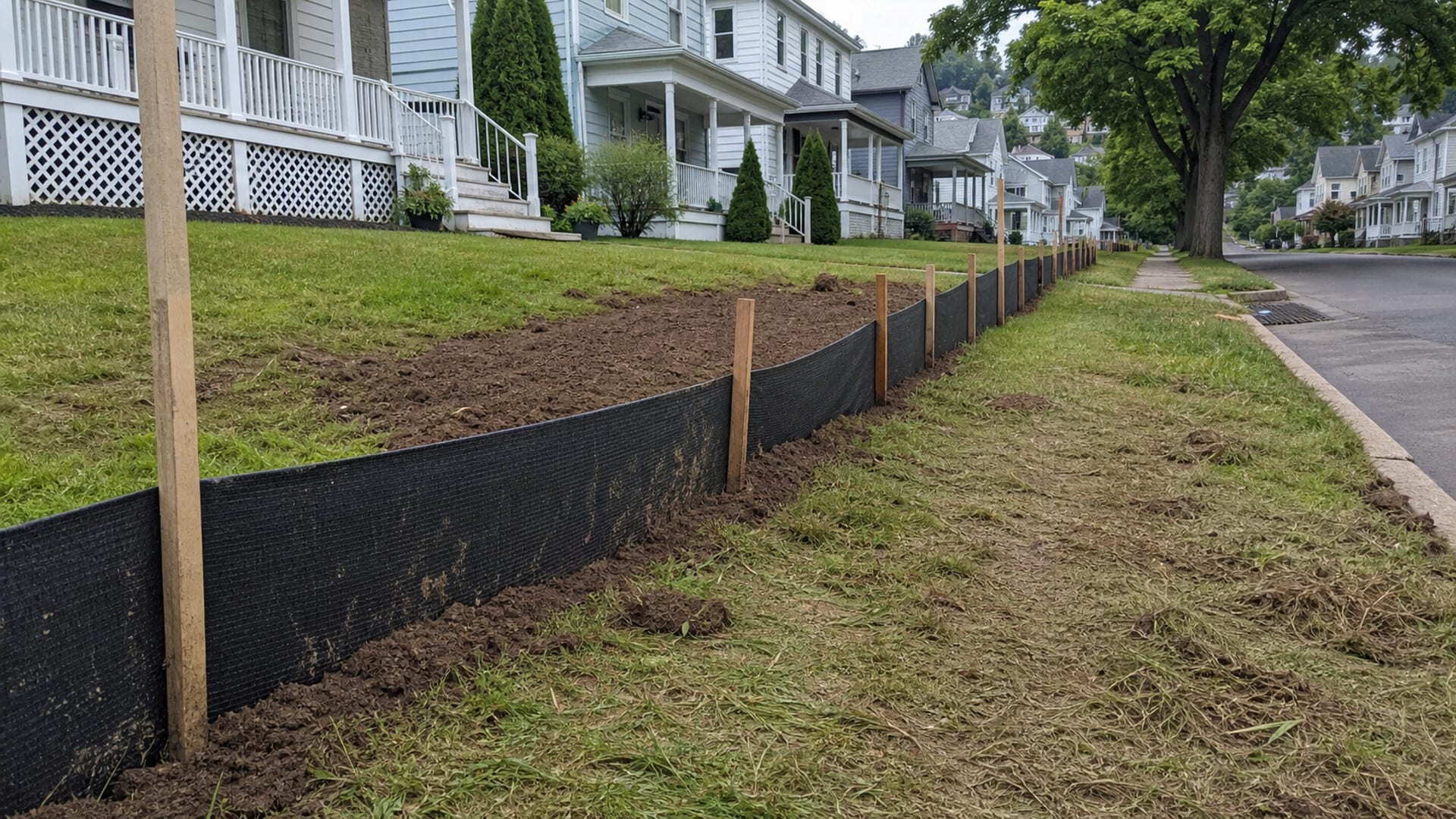
A hard rain cut a channel across the slope that was not there last month. Or soil is collecting at the curb and heading for a catch basin. Or, most frustrating of all, you were partway through a permit application for something else entirely and the City told you it wants a formal erosion and sediment control plan before any more ground gets disturbed, on a lot you had always thought of as too small and too urban for that kind of paperwork. All three of those land in the same place: you need to stop soil moving, and you need to know which parts of that are your call and which parts are Derby's. The useful starting point is that these are two different jobs, not one, and knowing which you have decides everything after.
Key Takeaways
Erosion control and sediment control are different jobs
erosion control holds soil in place at the source, sediment control catches soil that has already started moving before it reaches a catch basin, a wetland, or the river. Most real repairs need both.
Derby's wetland trigger is 50 feet, not the wetland edge
the City's regulations treat earth moving, filling, construction, or clear cutting within 50 feet of wetlands or watercourses as a regulated activity, subject to stated exceptions.
A map does not settle the boundary
Derby's regulations say the precise location of regulated areas is determined by actual land character, wetland soils, and watercourse location, not by a map alone.
Erosion and sedimentation are defined as pollution
Derby's regulations expressly define pollution to include erosion and sedimentation resulting from filling, clearing, or excavation, which is why a small washout repair can need a screen before material moves.
Temporary controls go in before disturbance, not after
the sequence is protect first, then clear, excavate, and grade. Installing controls after the soil is already exposed is the most common way a plan fails.
Erosion Control and Sediment Control Solve Two Different Problems
Erosion is the detachment and movement of soil. Erosion control is everything that stops that happening: managing where water starts, keeping it from concentrating on bare ground, and getting permanent cover established. Sediment control is downstream. It is the capture or containment of soil that has already become mobile, before it leaves the work area and reaches a drain, a watercourse, or a neighbor.
That distinction matters practically, not just semantically. Seeding a washout is erosion control. It does nothing about the soil already sitting in the gutter. Putting a barrier at the bottom of the slope is sediment control. It does nothing about the concentrated water still cutting the channel above it. A repair that does one and calls it finished usually fails at the next storm, and the reason it failed is that the other half was never addressed.
The third category is different again. Slope stabilization is a design question rather than a surface treatment, and it comes up when grade, runoff, soil behavior, structural support, or drainage indicate that cover alone will not produce a stable result.
| Approach | What it actually does | Where it fits | Where it fails on its own |
|---|---|---|---|
| Erosion control | Prevents soil becoming mobile: source control, runoff routing, temporary protection, permanent cover | The disturbed or exposed area itself, and the water arriving at it | A covering will not hold if concentrated water is still running across it |
| Sediment control | Retains or manages soil that is already moving, before it exits the site | The downhill edge, inlets, and the discharge path, installed before disturbance | It does not stop the erosion, so it fills up and needs maintaining |
| Slope stabilization | Addresses grade and stability as a system, combining runoff control, grade revision, drainage, reinforcement, or an engineered retaining solution | Where the slope is moving rather than just shedding surface soil | It is a design exercise, not a product, and the wrong option can make movement worse |
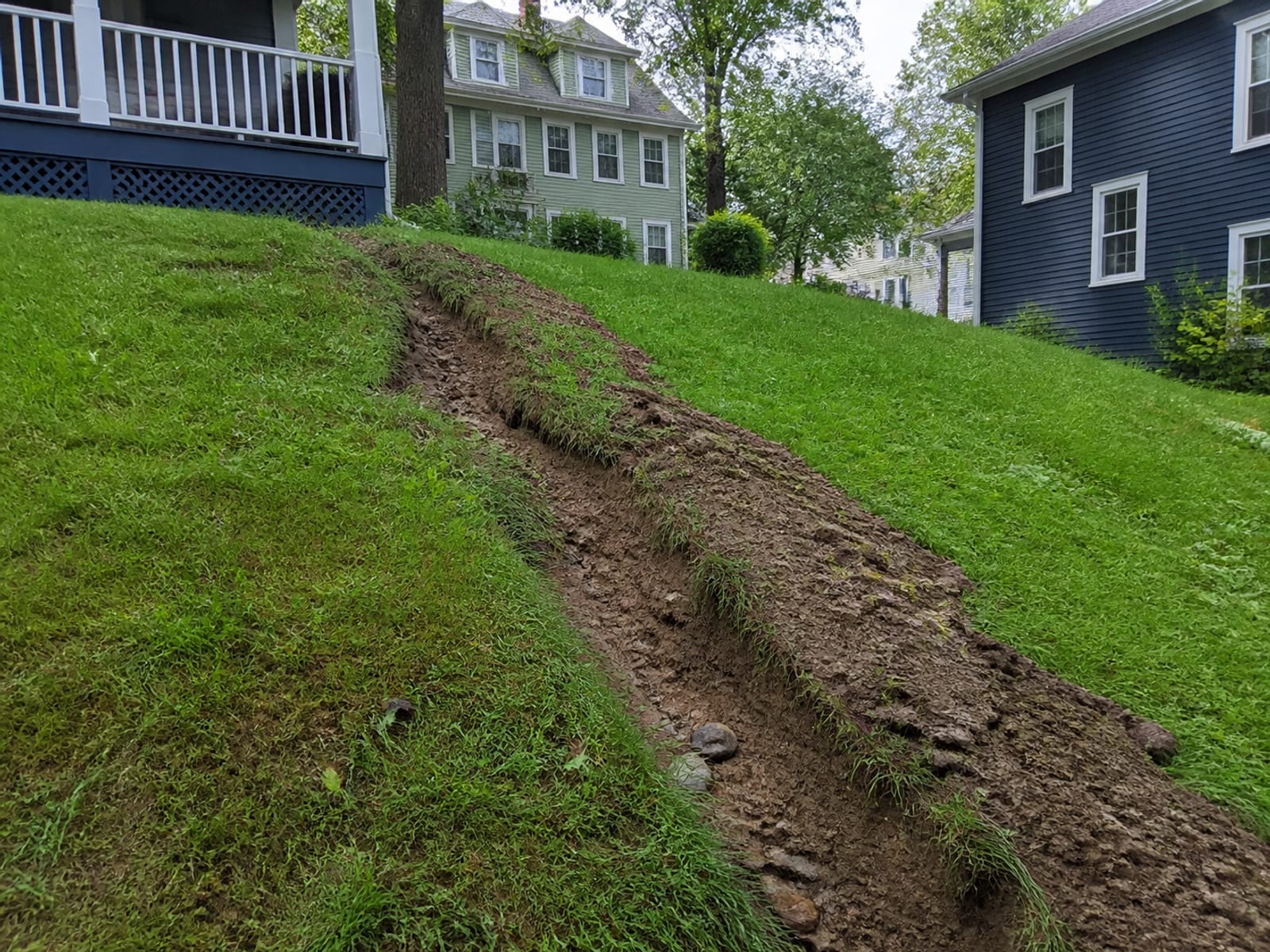
The Water Source Decides the Fix, Not the Visible Damage
The channel you can see is where the water ended up, not where the problem started. A real diagnosis walks it backwards.
Things worth documenting before anyone visits: a new or widening channel after rain, exposed roots, bare or rutted areas on the slope, soil collecting at a curb or catch basin, runoff that looks cloudy, standing water at the top or the toe of the slope, undermined edging or steps, and any change in where a downspout, driveway, sump, or roof discharge sends water. Photograph it during or immediately after rain if you safely can. That single set of photographs is worth more to a contractor than any description.
None of those observations settle a design or a permit question. What they do is locate the drainage and sediment path so the field evaluation starts in the right place. The question the assessment has to answer is whether this is shallow surface erosion, concentrated runoff arriving from somewhere uphill, a drainage failure, or a slope stability issue that needs engineering.
Derby's River Setting Pulls the Wetlands Question Forward
Derby's Plan of Conservation and Development maps alluvial and floodplain soils, poorly drained and very poorly drained soils, floodway, and 100 year and 500 year flood zones along the Housatonic and Naugatuck. That does not prove a condition on any individual parcel. What it does is make drainage routing, sediment movement, floodplain constraints, and wetland delineation unusually live questions for low lying and river adjacent work.
Here is where it gets more specific than most homeowners expect. Derby's wetland definition itself includes poorly drained, very poorly drained, alluvial, and floodplain soils. The Inland Wetlands Agency determines precise regulated boundaries from actual land character, wetland soil distribution, and watercourse location rather than from a map. And the local regulations treat earth moving, filling, construction, or clear cutting within 50 feet of wetlands or watercourses as a regulated activity, subject to the stated exceptions.
Put those together and a modest drainage repair on a river adjacent Derby lot can need a wetland screen before a machine moves. Connecticut DEEP directs private applicants whose work will likely affect a wetland or watercourse to obtain a permit from the municipal inland wetlands agency first. If you believe your work is nonregulated or falls under a permitted use, Derby's regulations describe asking the Agency for a written ruling rather than deciding it yourself.
| Trigger | Who to go to | The detail that matters |
|---|---|---|
| Work in a wetland or watercourse, or regulated work within the City's 50 foot bordering area | Derby Inland Wetlands Agency | Get a determination or permit before regulated work. The City publishes the Agency and its wetlands enforcement contact |
| A use you believe is nonregulated or as of right | Derby Inland Wetlands Agency | The regulations describe seeking a written ruling before work begins, rather than self determining |
| Excavation, filling, removal, clearing, or grading under the earth material provisions | Derby Planning and Zoning Commission | The rules call for drainage, erosion and sediment controls, planting, clearing and grading sequence, temporary protection, and a narrative on potential erosion problems |
| Development in a special flood hazard area | Derby Planning and Zoning and floodplain administration | Floodplain Management Ordinance compliance, plus any flood compliance permit the project requires |
| Private construction disturbing at least one acre and under five | Municipal approval, locally approvable process | Local approval and a local erosion and sediment control plan, without a separate state application |
| Private construction disturbing five acres or more | Municipal approval and CT DEEP | A state application plus a qualified professional prepared and certified Stormwater Pollution Control Plan |
| Any powered excavation | Call Before You Dig, 811 | At least two full days ahead excluding weekends and holidays, and no more than 30 days, outside the emergency exception |
The acreage thresholds are worth reading carefully rather than skimming. They apply to disturbed area, and a small residential repair usually sits well below them. But "usually" is not a determination, and the actual disturbed area is what counts.
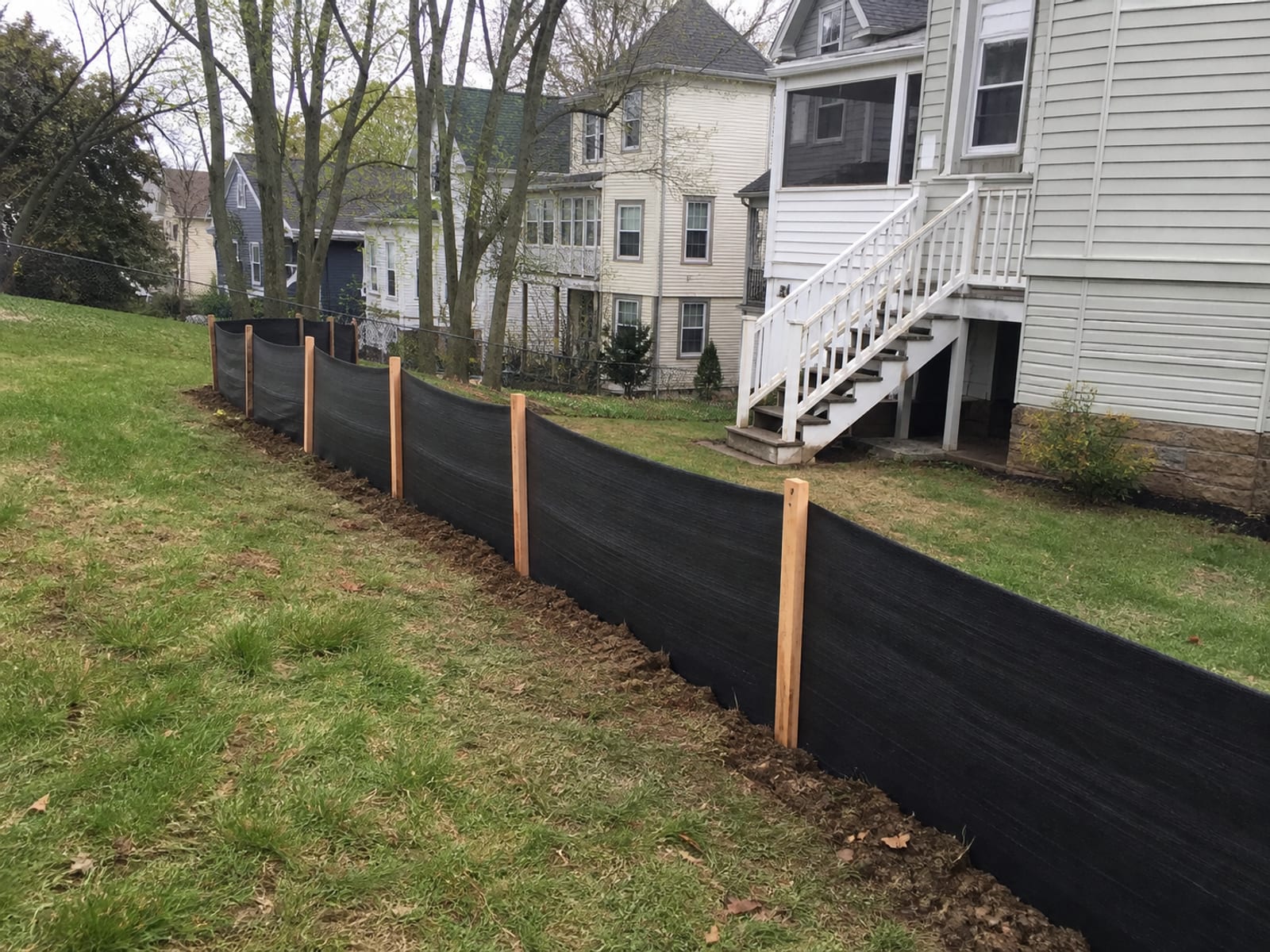
Six Things Change the Scope, and Price Follows Them
No published Derby specific price range for residential erosion control, sediment control, or slope stabilization was found in any authoritative source, and no published local job duration either. The only sourced duration in the reviewed material is DEEP's stated 60 or 90 day processing expectation for applicable Construction Stormwater General Permit applications, which is a review period, not a construction schedule.
What honestly drives the number:
- The failure mechanism. A shallow surface washout is a different job from a slope with seepage, an undermined structure, or a roof discharge that has channelized.
- Water management. Cost rises when runoff needs a designed inlet, pipe, outlet, or energy dissipation rather than surface stabilization.
- Access and staging. Narrow access, existing walls, mature planting, overhead obstructions, or nowhere for a truck all constrain equipment and material movement.
- Soil and excavation conditions. Buried obstructions, ledge, saturated soil, unsuitable material, and any required fill or disposal change the equipment and the hauling. Townwide Derby values for depth to ledge, boulder content, and soil profile do not exist at the precision needed to price an individual parcel.
- Compliance and documentation. Wetland delineation, municipal review, design, erosion and sediment planning, and any applicable state stormwater coverage all add professional and administrative scope.
- The stabilization choice. Seed and mulch, erosion control blanket, stone, drainage, reinforcement, and engineered retaining work are genuinely different scopes and should not be priced as if they were substitutes.
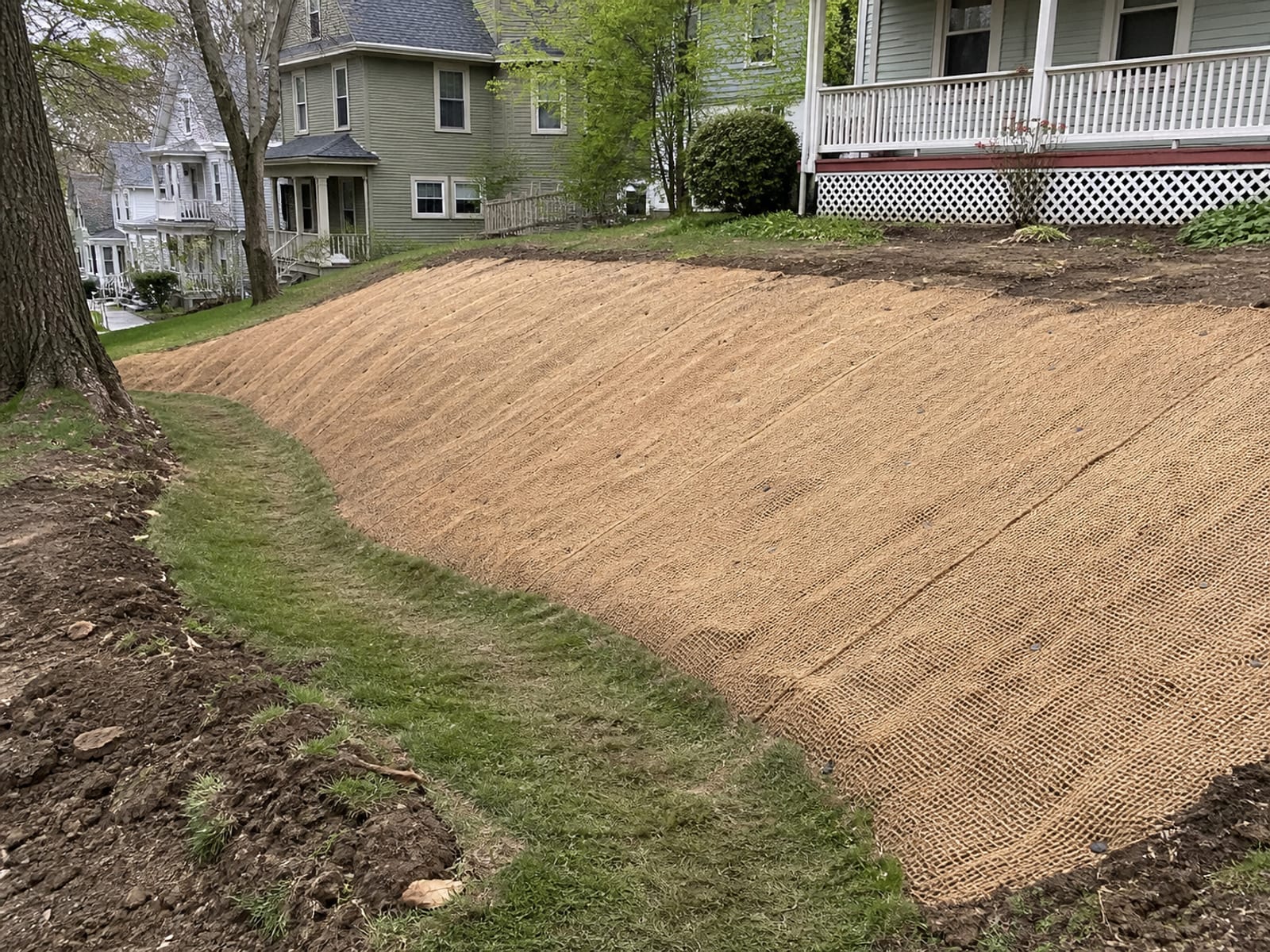
A Working Repair Runs in a Fixed Sequence
| Stage | What happens |
|---|---|
| Assess before disturbing soil | Locate the loss area, the uphill water source, the runoff route, the toe of the slope, adjacent structures, utilities, catch basins, wetlands, watercourses, and property line constraints, plus any evidence of active movement |
| Plan controls and approvals | Sequence so temporary measures go in before clearing, excavation, or grading. Prepare the level of site plan and erosion and sediment controls the scope requires. Derby's wetland application asks for a description of proposed controls and a site plan showing conditions in relation to wetlands and watercourses |
| Mobilize and make the site safe | Mark work limits, protect utilities after the 811 process, define access and staging, and keep traffic, stockpiles, and equipment out of protected areas |
| Install temporary controls before earthwork | Reduce erosion at the source, slow or direct runoff safely, and retain sediment before it exits the site. Inspect and maintain through the disturbance period |
| Do the corrective earthwork and drainage | Avoid leaving bare slopes or stockpiles exposed longer than necessary, and keep a stable downstream path for water throughout |
| Finish, stabilize, and maintain | Final grading, permanent cover or structural treatment, sediment cleaned from temporary controls, and a performance check after rain. Where state coverage applies, final stabilization is maintained for at least a year before standard termination |
Five Mistakes That Make a Washout Come Back
- Treating the visible damage instead of the runoff source. Seed and stone laid across a channel that concentrated water is still cutting will be gone by the next storm.
- Sending soil, water, or sediment toward a catch basin, wetland, river, or neighboring property. In Derby that is not just poor practice, since the regulations define erosion and sedimentation from filling, clearing, or excavation as pollution.
- Starting clearing or excavation before temporary controls are in. The sequence is protect, then disturb. Reversing it means the first rain carries the site away.
- Assuming a wetlands map answers the boundary question. Derby determines regulated areas from actual land character, soils, and watercourse location.
- Running power equipment before the 811 wait is satisfied. The notification and the waiting period are both required, and private facilities may not appear in the markings at all.
Know Where Self Help Stops
You can safely document the condition, photograph it after rain, keep loose mulch, leaves, and soil out of inlets, and redirect a portable downspout extension within your own property when doing so does not create a new drainage problem somewhere else. You can also request a site review, which is usually the highest value thing on the list.
What should wait until the approval screen and the 811 requirements are resolved: using power equipment, placing fill, excavating, altering a channel, removing substantial material, or doing any work within a wetland or watercourse or its regulated area. Derby decides whether a claimed nonregulated or permitted use qualifies, and can make that ruling in writing. That is a better thing to have than an opinion.
Erosion or Sediment, and Whose Call Is It?
1. You seed and mulch a washout, and it reopens after the next storm. What was most likely missed?
2. How far from a wetland or watercourse does Derby's regulated activity trigger extend?
3. Derby's regulations define pollution to include what, in this context?
4. When do temporary sediment controls get installed?
Pick an answer to begin.
Frequently Asked Questions About erosion and sediment control derby ct
What is the typical price range for erosion control in Derby, CT? No published Derby specific range exists in any authoritative source, so a figure quoted before someone has walked the slope is invented. Quotes vary because the failure mechanism, the water management required, access and staging, soil and excavation conditions, the compliance and documentation scope, and the stabilization method chosen are all genuinely different from site to site. Ask for those as separate line items rather than one number.
How do erosion control and sediment control differ? Erosion control prevents soil from becoming mobile in the first place, through source control, runoff routing, temporary protection, and permanent cover. Sediment control retains or manages soil that has already become mobile, before it leaves the site. A project frequently needs both, and doing only one is the usual reason a repair does not hold.
When is slope stabilization a bigger project than erosion control? When the slope geometry, the runoff, the soil behavior, structural support, or the drainage design indicate that surface cover alone is unlikely to produce a stable result. Cracking, movement, seepage, or an undermined structure all point that way, and so does a slope that has been repaired before and moved again.
Do I need an inland wetlands review in Derby? If the work is a regulated activity in a wetland or watercourse, or within the City's stated 50 foot bordering area, it requires review and may require a permit. Ask the Derby Inland Wetlands Agency for a written determination for your actual proposal rather than relying on an assumption, since the Agency determines the regulated boundary from field conditions.
Do I call 811 for a small erosion repair? Before any powered excavation, yes, subject to the stated emergency exception. Connecticut requires the call at least two full days ahead, excluding Saturdays, Sundays, and holidays, and no more than 30 days before work. Size of repair does not change that.
Can I fix a washout myself? Keep self help to observation, photographs, and minor non earthmoving maintenance until the water path, the utilities, the regulated areas, and the approvals are resolved. Redirecting a downspout extension within your own property is usually fine. Moving material, cutting a channel, or running a machine is not the place to start.
What time of year is best? There is no published Derby specific best season for every repair. The real constraints are soil saturation, rainfall, snow and freeze thaw, access, and whether permanent cover can be established and protected. Derby's earth material rules specifically require temporary erosion protection when the time of year or weather prevents permanent vegetative cover from establishing, which is the honest answer to winter work: it is scheduled around, not ruled out.
Erosion and Sediment Control Terms
Tap a term to see what it means.
Erosion. The detachment and movement of soil, usually by water. Controlling it means addressing where the water starts and how it travels.
Wrapping Up
The washout you can see and the soil at the curb are two halves of the same event, and they need two different answers. Holding the remaining soil in place is erosion control. Catching what has already moved is sediment control. Doing one without the other is why repairs come back, and doing either without first finding where the water originates is why they come back quickly.
On a Derby lot, there is a third thing to settle before any of it, which is whether the work is regulated. The 50 foot bordering area, the wetland definition that takes in poorly drained and floodplain soils, and the rule that erosion and sedimentation from clearing or excavation counts as pollution mean the screen comes first, not after the machine is booked. A written determination from the City is cheap compared with stopping work halfway through.
If soil is moving on your Derby property, Prestige Property Maintenance will walk the water path with you, from where the runoff starts to where it can lawfully go, and tell you which parts of the fix are surface work and which need drainage or grade correction underneath. We handle erosion and sediment control alongside the grading, drainage solutions, and retaining wall construction that often have to happen with it, with one crew out of Oxford across the Naugatuck Valley. Call us at (203) 258-3395 or contact us to get it looked at before the next storm takes more of it.
Related Articles
Erosion and Sediment Control Bethany, CT: Stopping a Washout
A washout near a wetland is not just a mess, it can be a regulatory issue too. Here is how erosion and sediment control in Bethany, CT works, start to finish.
What to Expect from Drainage Work in Derby, CT, Start to Finish
Hired someone for drainage work in Derby, CT and wondering how torn up the yard gets? Here is the real sequence, from utility mark-out to grading.
What to Expect from an Excavation Company in Derby, CT
A machine on your small Derby lot does not have to be stressful. Learn what to expect from an excavation company, step by step, before you hire one.