Inland Wetlands Permit in CT: When One Is Needed
Kash CochranePublished
- wetlands
- permits
- site preparation
- connecticut
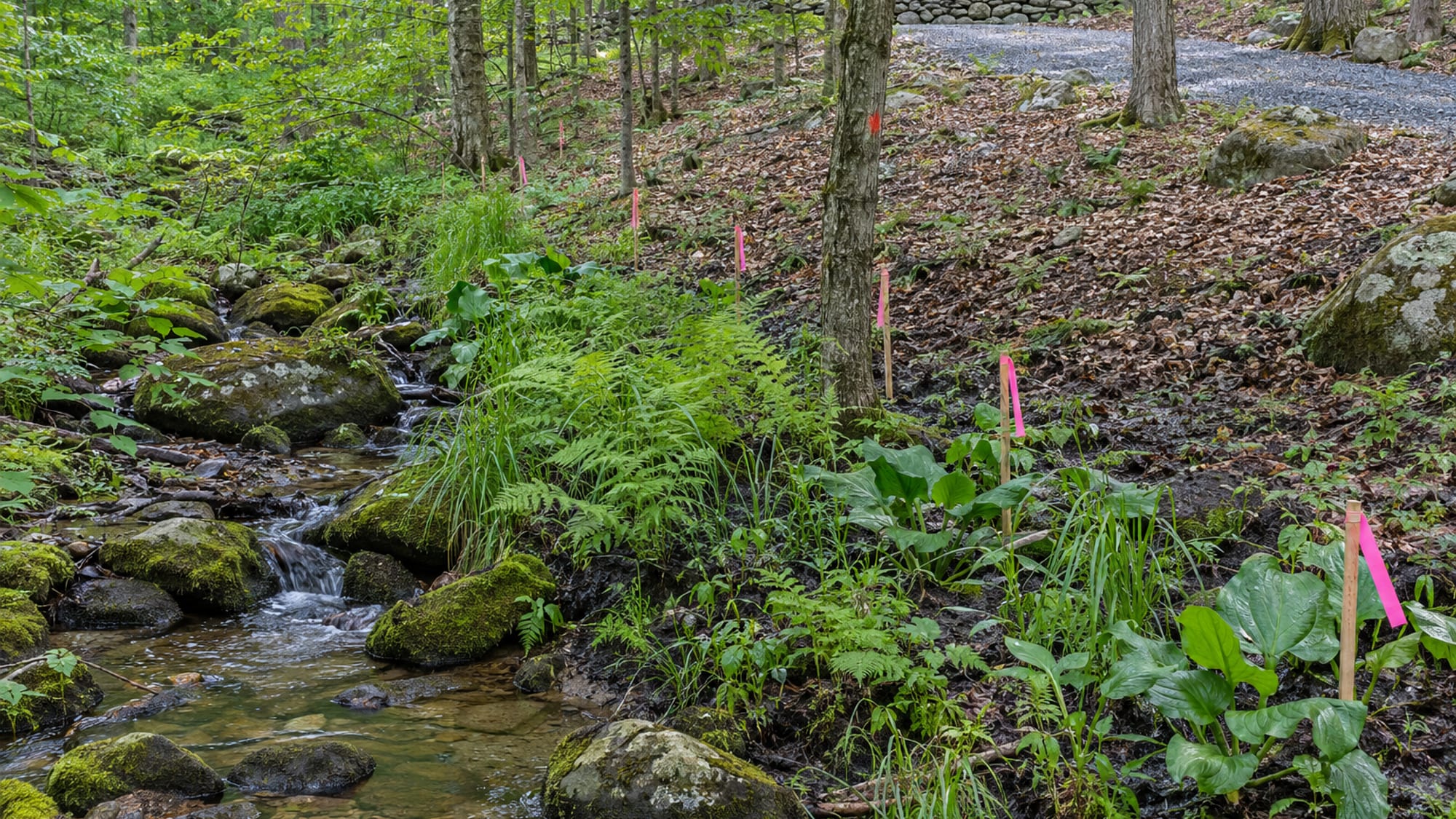
In August the low corner by the brook looks like any other part of the lot. The driveway plan runs past it, the trees on the slope are marked to come down, and somebody asks whether you need an inland wetlands permit in Connecticut before a machine shows up.
That question belongs to your town. A municipal inland wetlands agency decides whether a project is regulated, and an owner cannot settle it alone, however dry the ground looks in August. What you can do is walk into the town office with a sketch, the right questions, and a clear idea of what the answer will mean for your plan.
Wetlands here are defined by soil, not by how wet the surface looks, so the answer is rarely visible from the driveway. The useful move is to ask the town before the contract is signed, not after the first cut.
Key Takeaways
The town agency decides, not the owner
Connecticut's municipal inland wetlands agency rules on whether clearing, grading, filling, excavation, culverts or drainage work is regulated, so ask for a ruling before you sign a construction contract.
Wetlands are defined by soil
Poorly drained, very poorly drained, alluvial and floodplain soils count even when the surface is dry, and the Web Soil Survey is a planning map, not a boundary.
There is no statewide setback
Each town sets its own upland review area, such as 100 feet in Madison and Willington or 200 feet in Goshen, and the wetlands office gives the distance for your lot.
Does Your Connecticut Project Need Inland Wetlands Review?
It can, and the answer turns on what the work touches. Connecticut's DEEP describes a regulated activity as removing or depositing material, obstruction, construction, alteration or pollution in a wetland or watercourse. Its examples include clearing, grading, filling, excavation, piping, culverting, channelizing, diverting, damming and dewatering. A new driveway, an addition, a drainage run or a stand of trees coming down on a bank can each raise the question.
The work does not have to sit inside the wet ground itself. Under the Inland Wetlands and Watercourses Act, activity nearby may also be regulated when the municipal agency decides it is likely to affect a wetland or watercourse. That is why a sketch of the whole work area matters more than a single measurement.
Private projects go through the town. DEEP's guidance on municipal permitting names the local wetlands agency as the first contact for private owners, while DEEP itself handles state-agency projects and certain state-land activity. A building permit does not replace wetlands approval either; zoning, building, driveway, stormwater and septic approvals each have their own office, and the wetlands agent can tell you which apply.
What Counts as a Wetland, Watercourse, or Regulated Activity?
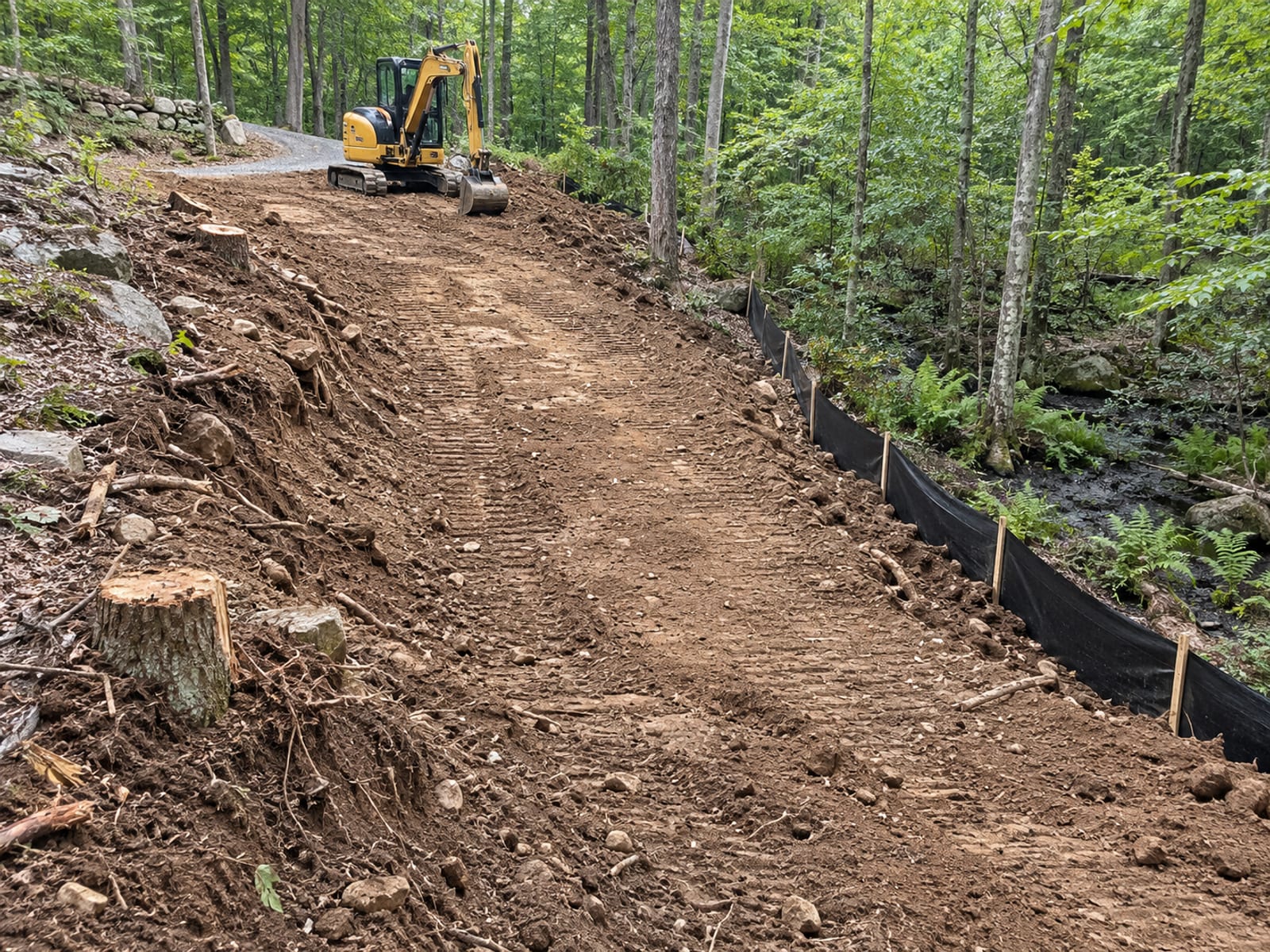
Connecticut defines inland wetlands by soil. Under DEEP's definition, a wetland is land, including submerged land, made up of poorly drained, very poorly drained, alluvial or floodplain soils identified by the National Cooperative Soil Survey. A low corner can look dry in August and still sit on wetland soil, and floodplain soils qualify regardless of drainage class.
Watercourses are a separate list of features: rivers, streams, brooks, waterways, lakes, ponds, marshes, swamps, bogs, and natural or artificial, public or private, intermittent or vernal bodies of water. An intermittent watercourse has a defined permanent channel and bank, plus at least two indicators: scour or recent alluvial deposits, water lasting longer than a single storm, or water-loving vegetation. The Act also lists some uses that are permitted as of right. The table shows how common work tends to sort, and why the agency still gets the last word on your lot.
| Work | How Connecticut treats it | Who answers for your lot |
|---|---|---|
| Clearing, grading or excavation in a wetland or watercourse | A regulated activity under the Act | Municipal inland wetlands agency |
| Filling or depositing material | Regulated unless a statutory permitted use applies; significant filling is not covered as of right | Municipal inland wetlands agency |
| Culverts, piping, channelizing, diverting, damming, dewatering | Named by DEEP as examples of regulated activity | Municipal inland wetlands agency |
| Work in the upland that is likely to affect a wetland | May be regulated when the agency decides it is likely to have an effect | Municipal inland wetlands agency |
| Qualifying farming, gardening, nurseries, certain residential maintenance, forestry | May be permitted as of right within the statute's conditions | The agency may ask for enough information to confirm the work qualifies |
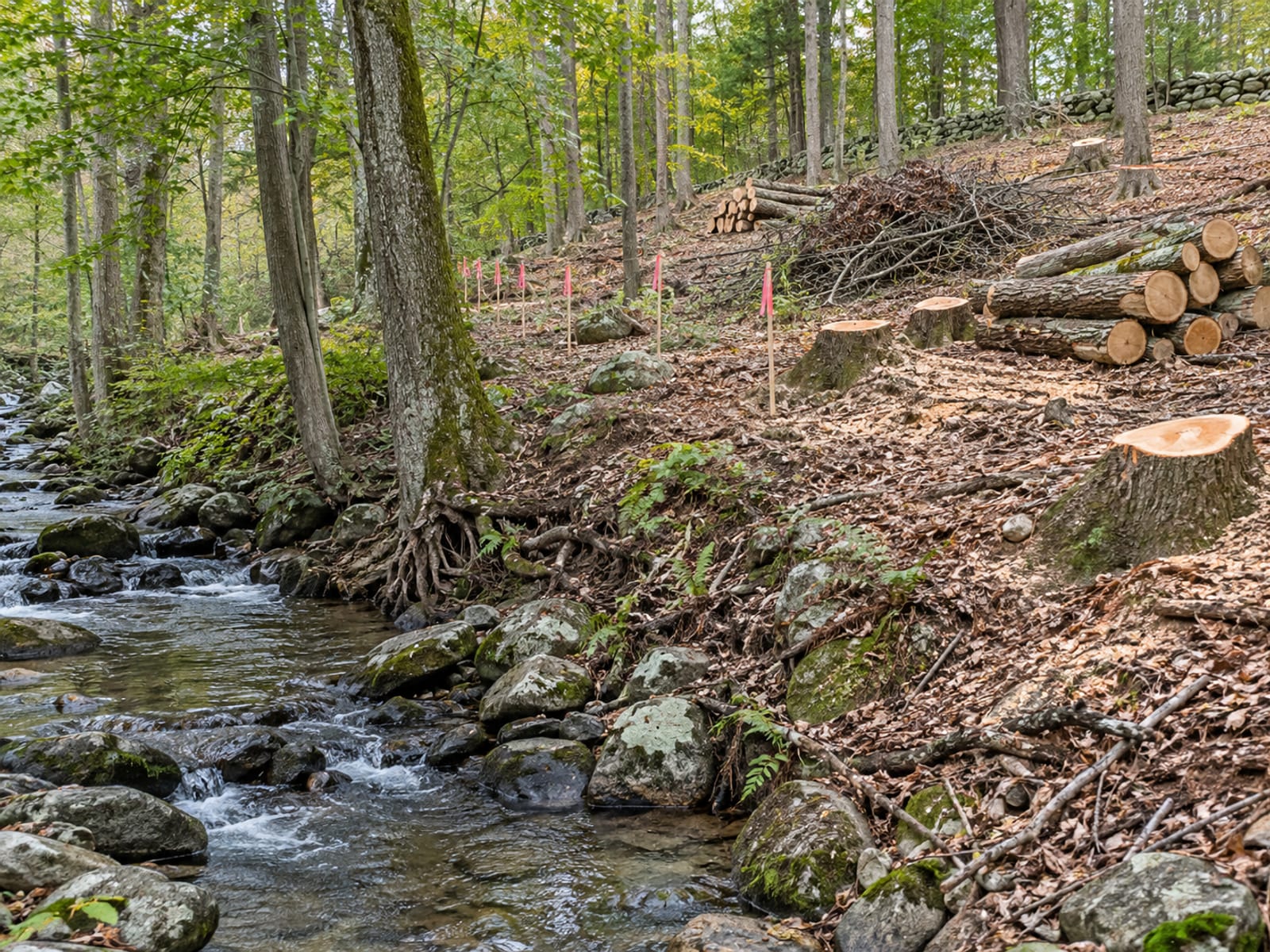
Tree cutting is a good example of why the agency decides. DEEP's page on wetlands and forestry explains that forestry may qualify as of right, while clearing that does not qualify may need a wetlands permit. If the plan includes land clearing near water, bring that detail to the first conversation.
How Close Can You Build to a Wetland in Connecticut?
There is no single statewide distance. Each town sets an upland review area in its own inland wetlands regulations, and DEEP's 1997 guidance encourages towns to regulate nearby upland activity that is likely to affect wetlands or watercourses. The upland review area is the zone outside the wetland or watercourse where specified work gets looked at.
The distances below belong to the named towns only. Use them to see how much the numbers differ, and read your own town's current regulation before relying on any of them.
| Town | Published review distance | Note |
|---|---|---|
| Madison | 100 feet from the inland wetlands boundary | Madison's regulations |
| Willington | A minimum of 100 feet from a wetland or watercourse | Willington's regulations |
| Goshen | 200 feet, up from 100 feet, effective May 15, 2026 | Goshen's announcement |
| Tolland | 50 feet from a wetland and 100 feet from a watercourse, with possible expansion for specified site conditions | Tolland's explanation; confirm against the current regulation |
A review area is not automatically a no-build zone. A driveway, addition, clearing operation, grading project, drainage installation or pool inside it may need a permit or a ruling, and the agency can regulate work farther out when it is likely to affect the wetland. Ask the wetlands office for the distance that applies to your lot and which activities it covers.
How Do You Check Your Property and Start the Permit Process?
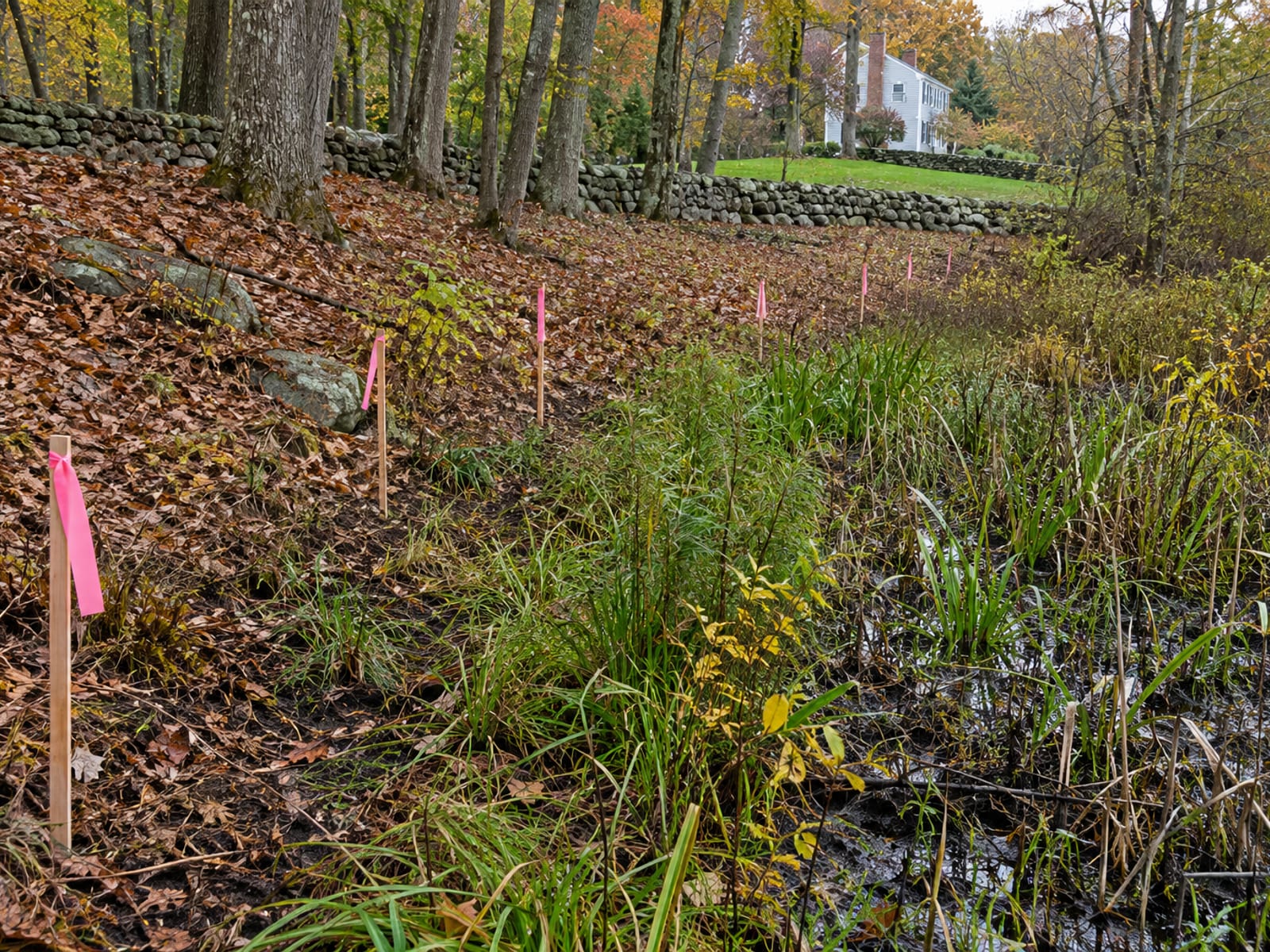
Start at the town's inland wetlands agency. Get its current regulations, wetlands map, application form and the contact for the wetlands agent. DEEP's citizens guide and its land-use overview point owners to the same place. Then mark the proposed work on a sketch of the lot, and bring it to a site walk so the lines match what is on the ground.
A useful sketch shows the following:
- House and driveway: where they sit now and where the new work goes.
- Clearing limits: the line trees come down to, not just the building footprint.
- Grading and drainage: cuts, fills, swales, pipes and where runoff will leave the site.
- Wet features: streams, ponds, brooks and any low or soft areas.
- Material movement: where soil, stone or stumps will be moved, stored or hauled.
Next, compare the sketch with two planning tools. The town map shows mapped wetlands and watercourses, and the USDA Web Soil Survey shows mapped wetland soil types. The Connecticut survey was mapped at roughly 1:12,000 scale with minimum delineations of about three acres, so it is a planning tool and not a site-specific boundary. When the line affects the layout, ask whether a qualified soil scientist should flag the boundary in the field.
Then ask the agent for a ruling on whether the work is regulated, before you sign a construction contract. If it is, the application typically asks for plans, the wetland delineation, site information, proposed grading and drainage, erosion controls, alternatives and the expected impact. The agency may request more information, set conditions or require mitigation, and it can approve or deny. Fees, filing calendars, hearing notices and statutory deadlines vary by town, so ask the wetlands office for the current fee schedule and the calendar for your application.
An application is not permission to start. Work waits for the approval, and filling or clearing without a required permit, or outside its conditions, can bring municipal enforcement, fines, court orders and civil penalties. If the wetland sits within 500 feet of another town, or inside a water-company watershed, notice to that town or the water company and the Department of Public Health may also be required.
What Do Connecticut Soils and Weather Do to Clearing, Grading, and Drainage?
Connecticut ground is not uniform, and the differences show up in the plan. DEEP's aquifer information explains that bedrock is covered by glacial till, a mix of rock, sand, silt and clay that is about 15 feet thick across most of the state. River valleys hold stratified drift, which is layered sand, gravel, silt and clay.
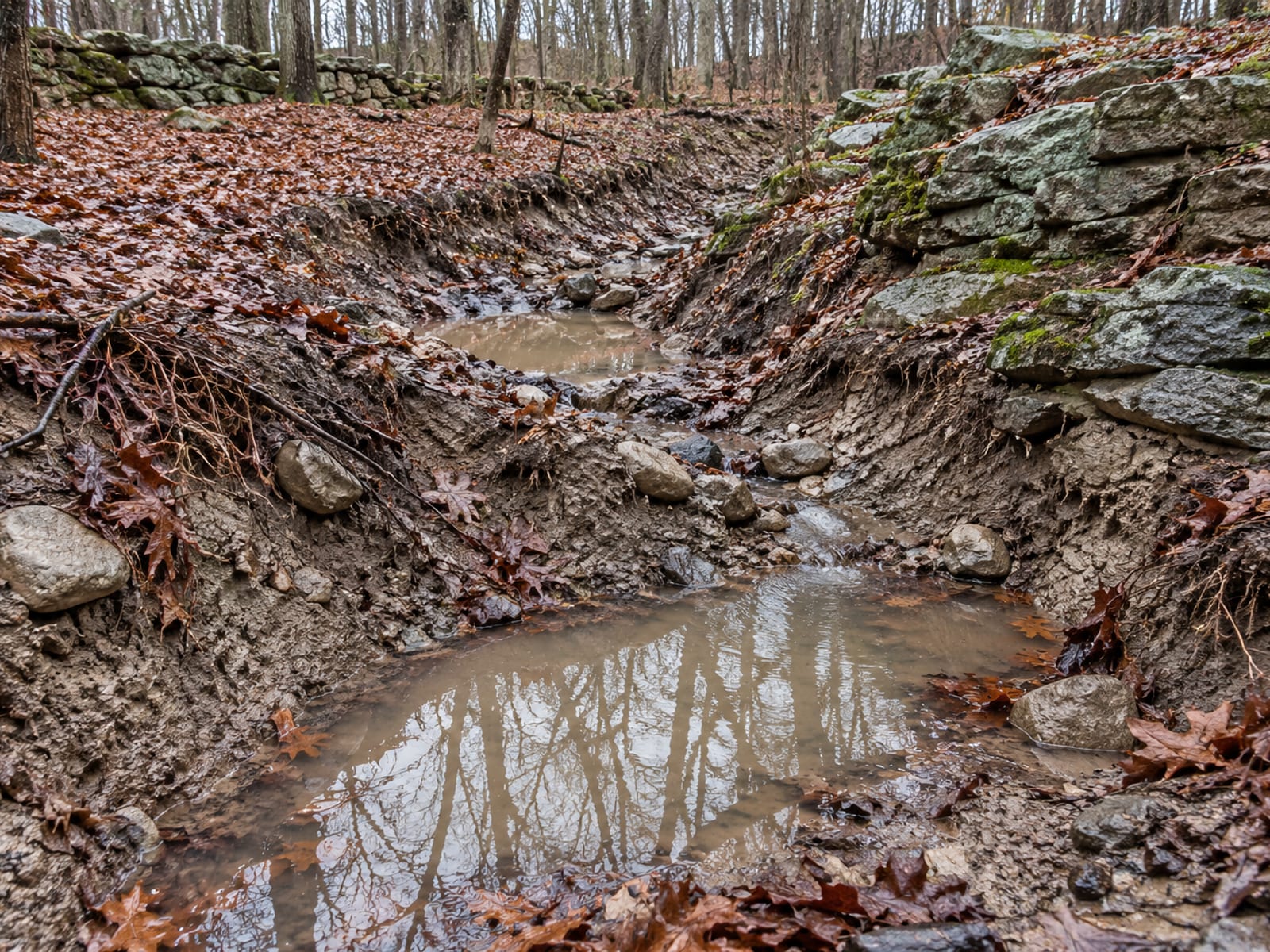
Several of those conditions bear on a wetland-adjacent job. Ledge and shallow bedrock affect how a trench or footing is cut and where drainage can run, which is where rock removal planning comes in. Clay and fine-grained soils hold water and affect compaction, erosion and stability. Wetland and floodplain soils stay regulated when the surface is dry, so dry footing on the day you walk the lot does not settle the question.
Weather moves the schedule and the controls. Saturated soils, frozen ground, spring runoff and storm events change site access, erosion risk and how drainage solutions perform. The Connecticut State Building Code also generally requires permanent building supports to reach at least 42 inches below finished grade unless an approved frost-protection method applies, under the 2022 State Building Code.
Any digging also starts with Connecticut's Call Before You Dig system, reached at 811 or 1-800-922-4455, with at least two full days of notice, excluding weekends and holidays.
What Belongs in a Wetland-Adjacent Excavation Scope?
A written scope for work near a wetland is longer than one for an open lawn, because more of the price depends on conditions that have to be named. The main cost drivers are whether the work falls inside the town's review area, whether a soil scientist, surveyor or engineer is needed, the size of the clearing and grading, how much material comes off, comes in or has to be stored, ledge and saturated soil, access for equipment, erosion and sediment controls, restoration the agency may require, and utility conflicts. Changes the town asks for during review can also change the plans.
A figure for your property comes after we have seen the ground and read any permit conditions that apply, because every item above is specific to the site.
The scope itself should separate what the job includes, line by line. Site preparation work in particular covers several trades at once, so each one needs its own entry:
- Clearing and tree removal: the limits, plus stump grubbing and removal.
- Earthwork: excavation and grading quantities or limits, imported fill, topsoil and stone, and how rock is handled.
- Drainage: structures, pipe, outlets, swales, basins or infiltration features.
- Protection: erosion and sediment control, wetland boundary protection and marked no-work areas.
- Closeout: hauling, disposal, restoration and seeding, along with who carries the permit conditions, inspections and change orders.
How Do You Vet a Connecticut Excavating Contractor?
Start with registration. Under Connecticut's Home Improvement Act, the Department of Consumer Protection requires residential home-improvement contractors to register, and a written contract should include the HIC number, a project description, dates, costs, payment terms and a cancellation notice. You can confirm a registration in the state's eLicense system before you sign. Our HIC number is 0704432, and we are licensed and insured.
Then look at how a contractor handles permits. A contractor who has worked from municipal wetlands permits and erosion-control plans understands why a marked boundary matters. Ask for references on comparable clearing, grading, drainage or driveway work, and for proof of liability insurance.
These questions put the permit responsibilities on paper before the work starts:
- Who files: who prepares and submits the application, and who attends wetlands or zoning meetings.
- Who consults: who hires the soil scientist, surveyor or engineer.
- Who protects: how boundaries and no-work areas are marked, and who installs, inspects and removes erosion controls.
- What happens when the ground differs: how work stops or changes if rock, saturated soil or an unmarked drainage feature turns up.
- How changes are approved: in writing, with pricing, before anyone expands the work area.
Several owner mistakes trace back to skipped steps: treating a town map as a final boundary, assuming dry ground is not wetland, using a statewide setback number, starting before approval, and paying the full amount up front.
Five Questions on Wetlands Review in Connecticut
1. Who decides whether a clearing or grading project is regulated?
2. How does Connecticut identify inland wetlands?
3. Is there one statewide upland review distance?
4. What did Goshen change effective May 15, 2026?
5. Does filing a wetlands application let you start work?
Pick an answer to begin.
Inland Wetlands Permits in CT: Common Questions
Do I need an inland wetlands permit to cut trees near a stream? It depends on whether the work affects the stream or is likely to affect it from the adjacent upland. Forestry and certain agricultural activities may be allowed as of right, and the agency may ask for enough information to confirm that. Clearing that does not qualify may need a permit. Ask the town's wetlands agent for a ruling on your plan.
How close can I build to a wetland in Connecticut? Each town sets its own upland review area, so the distance depends on where the lot sits. Madison and Willington publish 100 feet, and Goshen moved to 200 feet in May 2026. Inside the area, a driveway, addition, grading or drainage work may need a permit or a ruling; the agency can also look beyond it. Get your town's current regulation.
Can I fill in a wetland on my property? Filling is regulated when it deposits material in a wetland or watercourse, unless a statutory permitted use applies, and significant filling is not covered as of right. The agency weighs environmental effects, alternatives, pollution, erosion, flooding, habitat and mitigation. Filling without the required permit can bring enforcement, fines and court orders.
How do I know if my property has wetlands? Start with the town's wetlands map and the USDA Web Soil Survey, which are planning tools. Then ask the wetlands agent whether the project needs a field delineation by a soil scientist, since the legal definition rests on soil and a dry surface does not rule it out.
How much does an inland wetlands permit cost? Fees are set by each town and vary with the project and the application. The wetlands office can give you its current fee schedule, along with the forms and any plans the application requires.
Does a CT DEEP inland wetlands permit apply to a homeowner? Private projects generally go through the municipal inland wetlands agency, while DEEP regulates state-agency projects and certain state-land activities. Ask the town's agent whether any state or federal approval also applies to your site.
Starting With the Town Wetlands Office
The order is short. Find your town's wetlands agency and its current regulations, sketch the work with the wet areas on it, walk the site to mark the sketch, and ask the agent for a ruling before a construction contract is signed. Put applications, plan preparation, permit conditions, inspections and restoration in writing, and keep in mind that an application is not permission to begin.
Doing it in that order keeps the driveway, the clearing and the drainage matched to what the town has approved, and it keeps changes on paper. A project planned around the wet corner from the start keeps the permit, the contract and the machines working from the same plan.
If your Connecticut lot has a brook, a low spot or a wet slope near the plan, Prestige Property Maintenance can walk it with you. We are based in Oxford, we hold HIC #0704432, and one crew handles the work from clearing through finished grade. Call us at (203) 258-3395 or contact us to set up a site visit, and bring the sketch and the town's answer.
Words You Will Hear at the Wetlands Office
Tap a term to see what it means.
Inland wetland. Land, including submerged land, made up of poorly drained, very poorly drained, alluvial or floodplain soils identified by the National Cooperative Soil Survey.
Related Articles
Inground Pool Excavation in Connecticut: What to Expect
The pool plan starts the job. Learn how ledge, groundwater, septic and well distances, permits and final grading shape an inground pool dig in Connecticut.
Regrading Your Yard Away From the House in Connecticut
After a heavy rain the water runs toward the low spot by your foundation. Regrading a yard away from the house in Connecticut starts with the slope.
Site Preparation in Derby, CT: From Approved Plans to Pour
Derby's compact, river adjacent lots make site preparation its own decision. Find out what a plan review and site visit actually confirm before you build.