

Paving Prep in Derby, CT: What a Proper Base Actually Means
Kash CochranePublished
- paving prep
- derby ct
- driveways
- site preparation
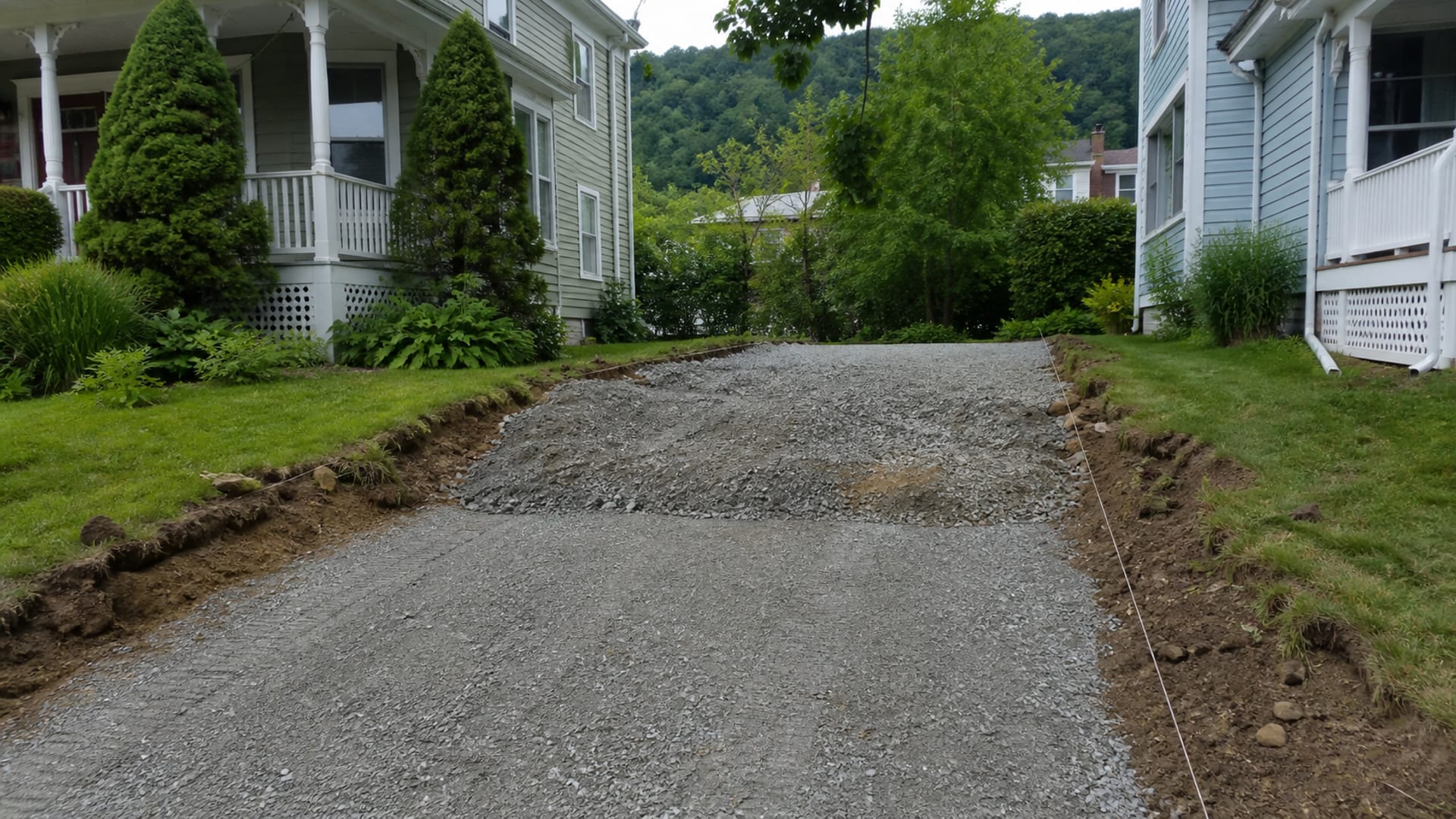
One of the contractors who came out said the last driveway failed because the base was no good. He may well be right. The trouble is that you have no way of checking whether he is, because the base is the part you cannot see, and the quote in front of you is mostly a number for asphalt. So you are being asked to write a substantial check on a promise about something buried, from someone you met once, having already paid for a driveway that did not last. That is a fair thing to be uneasy about. What follows is what a base actually consists of, how it gets verified before paving, and the specific questions that tell you whether the contractor standing in your driveway understands any of it.
Key Takeaways
The asphalt is the thin part of what you are buying
a pavement is a system of subgrade, sometimes a subbase, a compacted granular base, and then the surface, and the layers underneath decide how long the surface lasts.
Proof rolling is the check that matters
the Asphalt Paving Handbook describes rolling the prepared soil and the granular base with heavy equipment to find soft areas and observe deflection, and says that if the base is not stable and dry, or the subgrade distorts, the layer is corrected before asphalt goes down.
Frozen and soft are both disqualifying
CTDOT specifications say asphalt mixtures must not be placed on frozen subbase material, and its municipal manual says no base material should be placed on a soft, loose, or frozen subbase.
Derby's mapped ground is a real planning input
the City's own mapping identifies alluvial and floodplain soils, poorly drained and very poorly drained soils, the floodway, and 100 year and 500 year flood zones along the river corridors, while stating that it is for planning purposes and delineations may not be exact.
The street changes the paperwork
work within, on, through, or under a Derby public street, highway, or right of way needs a permit from the Street Commissioner or designee, and on a state highway inside the City that permit comes before the state one.
Asphalt Is the Thin Part of What You Are Buying
A driveway is not a surface, it is a structure with layers, and each layer has a job.
The subgrade is the native ground under everything. It carries the whole load in the end, and its condition, meaning strength, moisture, and whether it is undisturbed soil or somebody's old fill, sets the ceiling on how good the finished driveway can be.
A subbase is an additional granular layer sometimes placed over the subgrade where conditions call for it, to spread load and help manage moisture. It is not automatic and it is not a product you order by default.
The granular base is the processed aggregate directly under the asphalt, placed and compacted deliberately, shaped to the drainage fall the finished drive needs.
The asphalt is the wearing surface. It sheds water, takes tire wear, and looks like the thing you bought. It contributes very little structurally compared to what is beneath it, and it cannot make a weak layer strong.
That is why "the base was no good" is such a common diagnosis and such a hard one to verify. Everything that decides the outcome gets buried on the day it is built, and after paving nobody can check it without reopening the work.
The Symptoms That Matter Are Movement and Water, Not Age
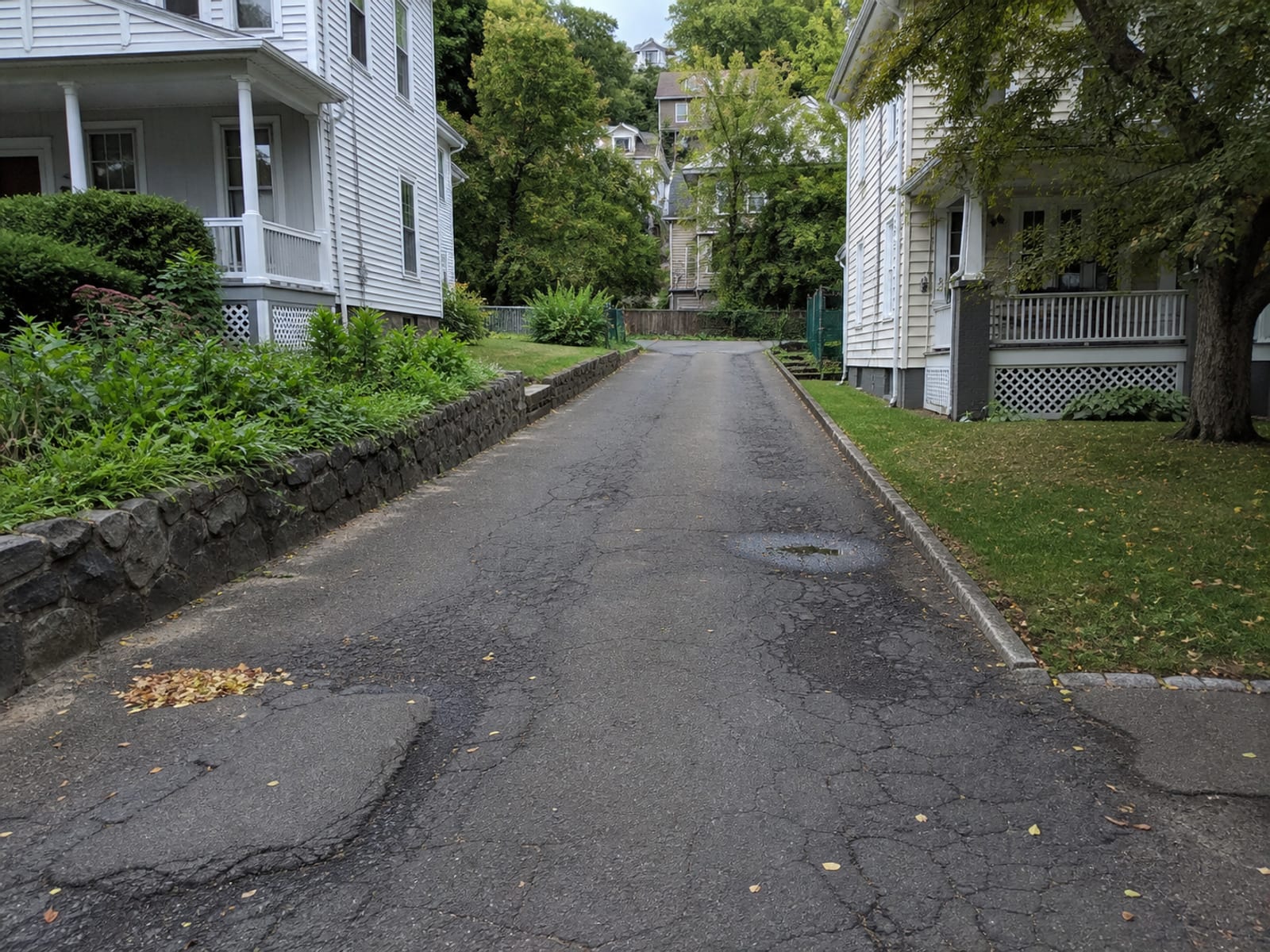
A gray, faded, slightly cracked driveway is not automatically a failing one. What indicates a problem below the surface is movement and moisture.
Watch for depressions in the wheel paths, which suggest the material under the traffic lane is compressing. Low spots that hold water in the same place after every rain, since standing water is both a symptom and a cause. Cracking that comes back in the same lines after being patched, which usually means the patch treated a symptom that lives lower down. Edges breaking down and crumbling away, which often points to no edge restraint and a base that was never carried out far enough. And pavement that visibly moves or springs under a loaded truck.
If you are watching an excavation, two more things are worth noticing: wet material coming up during removal, and pumping, meaning water and fine material working up under the weight of equipment. Both say the moisture problem is present rather than theoretical.
None of these is a remote diagnosis. They are reasons to open the failed area or test it, because surface symptoms cannot tell you soil strength, layer thickness, drainage paths, or whether somebody buried construction debris there in 1958.
Proof Rolling Is the Test That Decides Whether the Base Is Ready
This is the single most useful thing to know before paving day, and it takes one sentence to ask about.
Proof rolling means running suitably heavy equipment over the prepared subgrade and again over the compacted granular base, and watching what the surface does. The Asphalt Paving Handbook describes it as checking compacted soil for soft areas and observing deflection. A sound platform does not deflect noticeably and does not leave marked wheel indentations under a loaded truck. A soft zone shows itself immediately, which is the entire point: it is a test designed to fail in the cheapest possible place, before there is asphalt over the problem.
The standard is behavioral rather than visual. A base can look perfectly level, uniform, and finished and still move under load. Level is easy. Stable is the requirement.
So the question to ask any contractor is simply: will you proof roll the subgrade and the base, what will you use to do it, and what happens if an area deflects. The handbook's own answer to that last part is that work stops and the condition is corrected. CTDOT's municipal manual says the same thing from the other direction: no base material should go on a soft, loose, or frozen subbase.
Driveway Paving Prep in Derby, CT Runs in a Fixed Order
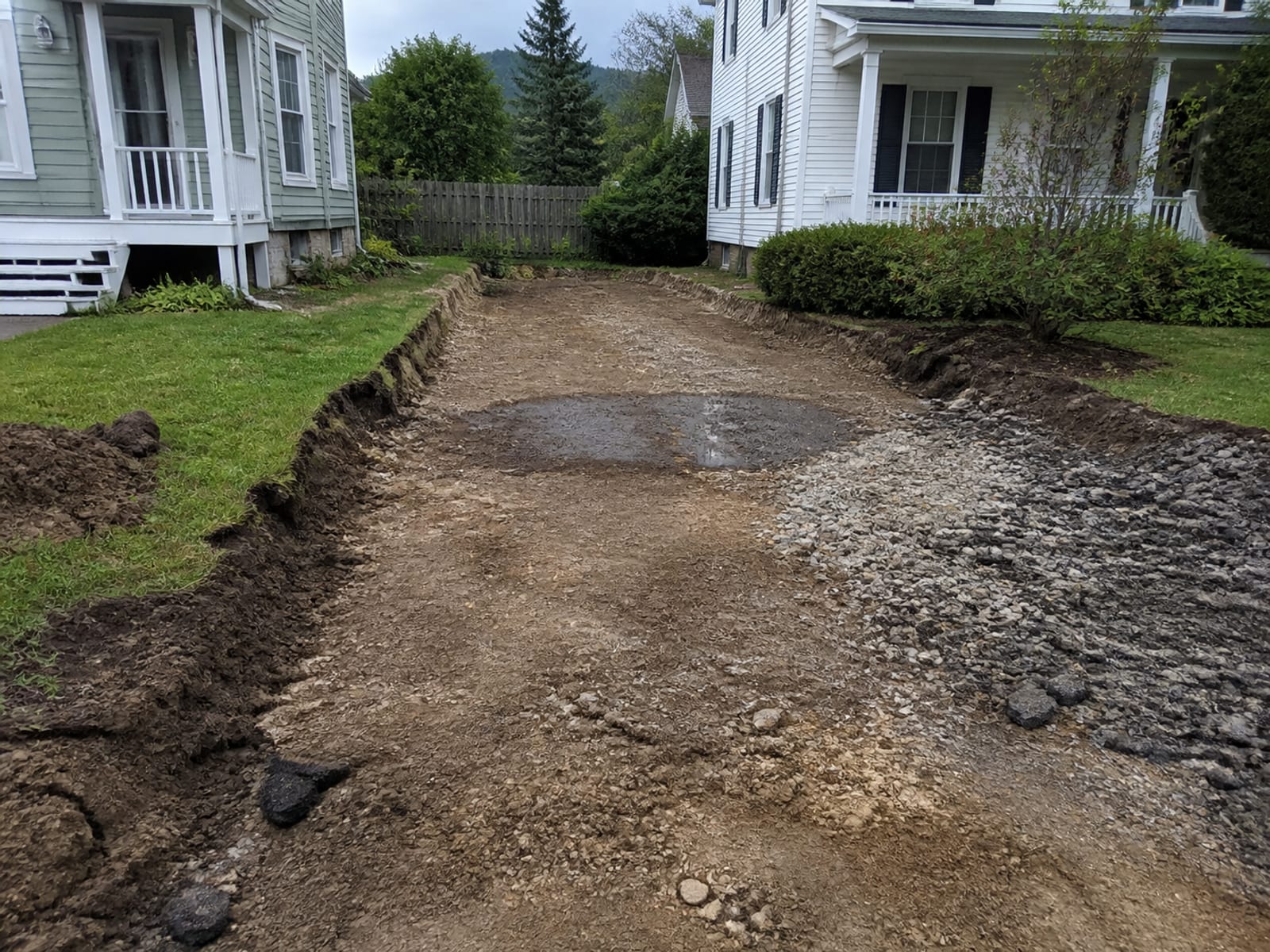
1. Define what the driveway has to carry and where water goes. Passenger cars, a work truck and trailer, or delivery vehicles are different structural demands. Record where water currently sheds and ponds, existing cracks and depressions, the garage slab elevation, utility fixtures, walls, steps, and where the public right of way line sits. 2. Clear the approvals and mark the utilities. File the CBYD request at least two full working days ahead, excluding weekends and holidays, and no more than 30 days ahead. Confirm whether a Derby street opening permit, a CTDOT encroachment permit, or a zoning or wetlands review applies before anything mobilizes. 3. Set access, staging, and protection. On a compact Derby lot this is a real constraint: where the dump trucks, the aggregate deliveries, the roller, and the asphalt truck can enter, turn, and stand without blocking access or damaging curbs, lawns, walls, and drains. Protect drainage inlets and install erosion controls where conditions or approvals require them. 4. Remove the failed pavement and expose the actual condition. Until it is open, nobody knows what is there. This is where weak, wet, organic, or otherwise unsuitable material shows itself, along with old fill, buried debris, rock, and any utility conflicts. If the exposed soil is wet, temporary drainage or pumping may be needed before a stable platform can even be built.
Base prep for asphalt in Derby, CT
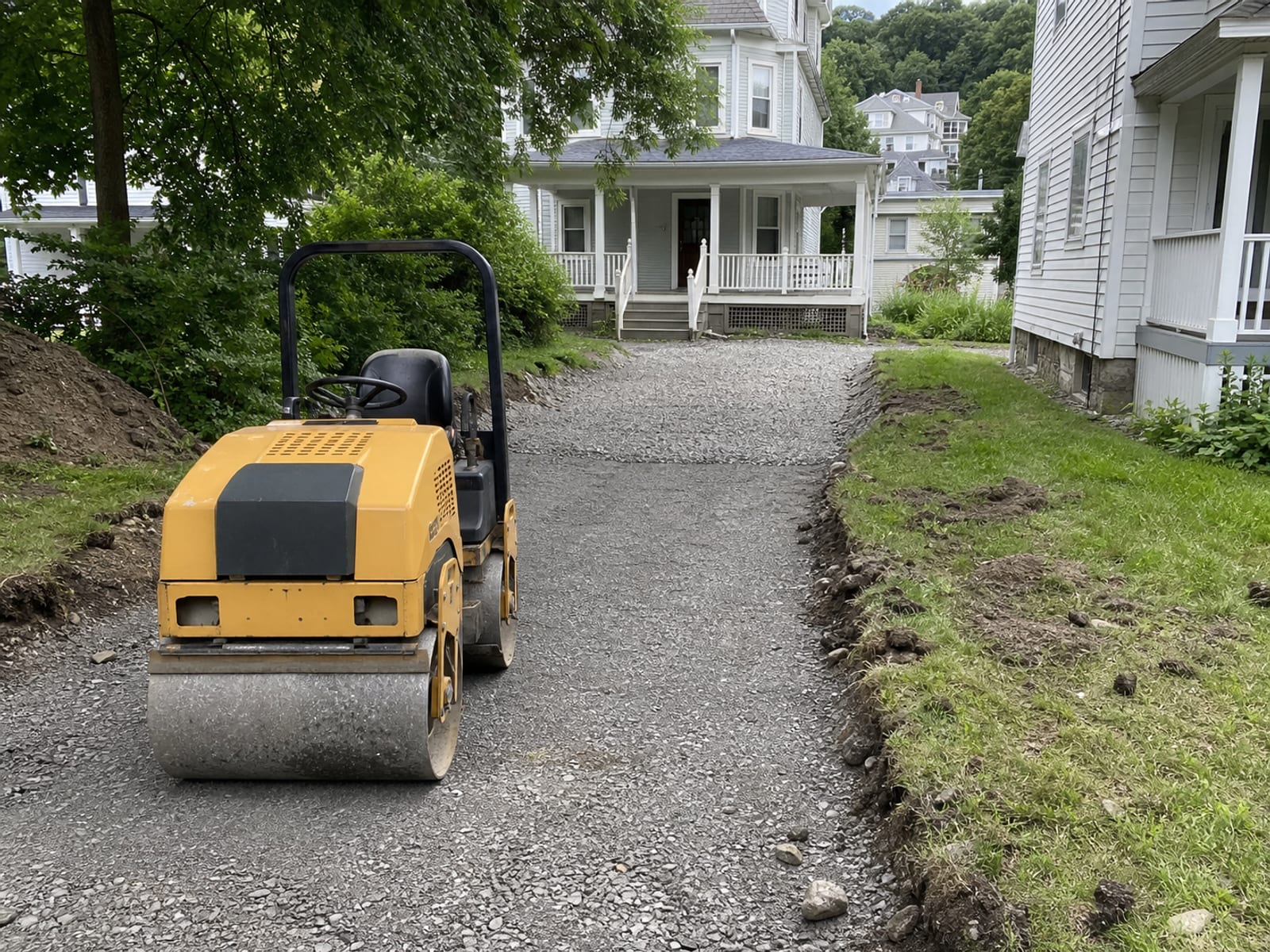
5. Shape and compact the subgrade. Grade to the planned line and the drainage profile. Where fill is needed, compactible material goes in and is compacted in lifts rather than dumped. Then proof roll and correct anything that moves. 6. Install the drainage before stone closes off access. Swales, pipe, basins, daylight outlets, and edge drainage all get built and checked at this stage, because once base and asphalt are down, reaching them again means cutting the driveway open. 7. Place and compact the aggregate base. Processed aggregate spread uniformly over the prepared surface and compacted thoroughly, in controlled courses. CTDOT's specification for processed aggregate base on its own projects limits each compacted course to 4 inches unless otherwise ordered. That is a public works specification rather than a residential requirement, but it makes the underlying point plainly: base is placed and compacted as a layer system, not dumped once and spread. 8. Do the final base check. Elevation, slope, the drainage route, the edge restraint plan, and a proof roll of the granular layer. Anything that deflects gets reworked, stabilized, or replaced before the paver is booked. 9. Pave only when the platform and the weather suit it. Asphalt placed by paver where the geometry allows, handwork limited to edges and tight spots rather than used to disguise an uneven base, and rollers compacting while the mix is in the right temperature range. No paving on frozen subbase, and inclement weather risks inadequate compaction. 10. Protect the new surface and keep the record. Follow the contractor's access instructions, keep point loads and sharp turning off it until it can take service, and ask for photographs of the subgrade and any base corrections before the asphalt covered them. That photo set is the only evidence you will ever have about the buried layers.
Three Scopes Get Called Repaving and Only One of Them Fits Your Drive
| The scope | What it involves | Best fit | Where it goes wrong |
|---|---|---|---|
| Overlay on a verified sound base | New asphalt placed over existing pavement that has been inspected and proof rolled and found stable | A structurally sound driveway with a surface that has worn out but no movement and no water problem | Overlaying active settlement or a wet base. The new surface fails in the same places, usually faster |
| Localized base repair | Opening the failed areas, correcting the cause, rebuilding those sections, then surfacing | Investigation shows a limited failure with a cause that can be fixed locally, such as one drainage issue or a soft pocket | Repairing the symptom without finding the cause, so the same area moves again |
| Full reconstruction | Removing pavement and unsuitable material, rebuilding subgrade, drainage, base, then paving | Broad settlement, widespread base weakness, drainage failure, or previous repairs that have already failed | Nothing much, except paying for it where a lesser scope was genuinely adequate. That is what the inspection is for |
The point of that table is that the right answer comes from evidence, not from preference. A contractor who has proof rolled and opened the failed areas can tell you which row applies. One who has looked at the surface from his truck cannot, and the cheapest of the three is not automatically the one being quoted.
Subbase Preparation in Derby, CT Is a Design Decision, Not a Product
Subbase gets talked about as though it were an upgrade you either buy or skip. It is really a response to conditions.
Where the subgrade is strong, dry, and uniform, a properly compacted granular base directly on it may be entirely appropriate. Where the subgrade is weaker, holds moisture, or varies across the length of the drive, an additional granular layer, and sometimes a separation or stabilization material specified for the conditions, can be what makes the section work. That is a judgment made against the soil that is actually there, the water, and the loads the drive will carry.
Which is why there is no universal depth. Anyone offering a fixed number of inches for every driveway in the city is quoting a habit. The honest version is a proposed section, with the reasoning behind it, and a stated process for what changes if the excavation reveals something different.
Derby's River Corridor Soils Change What the Ground Under a Driveway Does
Derby sits in a compact, built up river valley, and the City's own mapping identifies alluvial and floodplain soils, poorly drained and very poorly drained soils, the floodway, and the 100 year and 500 year flood zones along the river corridors. That is a planning map, and the City says as much: it is for planning purposes and delineations may not be exact. It does not tell you what is under your driveway.
What it does tell you is why the moisture question is worth taking seriously here. A subgrade that stays damp longer than it should is much harder to compact into a stable platform, and it stresses the pavement above it repeatedly through freeze and thaw. On an affected or low lying parcel, drainage and the condition of the exposed subgrade are the whole ballgame, and no thickness of stone substitutes for solving them.
The second Derby specific factor is the built up setting itself. Older lots frequently carry undocumented fill and buried debris from earlier construction, which is exactly the sort of thing that surfaces once the pavement is off. And on a tight lot, truck staging, turning, edges up against existing structures, where the drainage can actually outlet, and the position of the right of way line are all practical planning problems rather than afterthoughts. No townwide depth to bedrock, ledge, boulder, clay, or sand value exists for Derby, so that stays a parcel by parcel question.
A Driveway That Reaches the Street Brings the City Into It
| Trigger | What applies | Who |
|---|---|---|
| Any powered excavation on the project | Call Before You Dig notification, at least two full working days ahead excluding weekends and holidays, and no more than 30 days ahead, except in an emergency. If a contractor is excavating, the contractor makes the call | CBYD, at 811, under PURA oversight |
| Work within, on, through, or under a Derby public street, highway, or right of way, including a driveway approach, pavement, curb, sidewalk, or excavation | A City street opening permit, required before the work. The ordinance states the permit is valid for 90 days, with restoration, bonding, and insurance provisions | Derby Street Commissioner or designee |
| Frontage on a state highway within the City | The City permit first, then the state permit. CTDOT's encroachment system lists residential driveway repaving among its project types | Derby Street Commissioner, then Connecticut DOT |
| A scope that involves zoning or wetlands questions, such as grading, drainage changes, or work near a resource | Confirm the scope and submit the applicable local application before work. A blanket private driveway permit rule was not found, which is not the same as no approval being needed | Derby Zoning Enforcement and Wetland Division, Planning and Zoning, or the Inland Wetlands Agency |
| Removal or deposition of material, obstruction, construction, or alteration in or affecting a wetland or watercourse | The inland wetlands approval pathway. State law defines this as regulated activity and requires municipal regulation | Derby Inland Wetlands Agency and the Wetlands Enforcement Officer |
Two practical notes. The right of way line is frequently further onto the property than owners expect, so the apron where your drive meets the street is often the City's business even when the rest is entirely yours. And the markout covers participating utility facilities, so private service lines still need careful field coordination on top of it.
Ten Questions Separate a Real Quote From a Number
Ask every contractor the same ten and compare the answers rather than the totals.
1. Is this an overlay, a localized repair, or full depth reconstruction, and what field evidence supports that choice? 2. What existing material is being removed, how deep, and what happens if soft soil, fill, water, rock, or a utility conflict turns up? 3. What subgrade elevation and drainage path are planned before any stone is placed? 4. What aggregate is proposed, to what compacted thickness, and will it be placed and compacted in controlled lifts? 5. How will the base be checked for soft spots and deflection before the asphalt arrives? 6. What asphalt course or courses are proposed, and how will tight edges and transitions be handled? 7. Who is making the CBYD call, who obtains the street opening permit if the work reaches the right of way, and who handles any zoning, wetlands, or CTDOT coordination? 8. Where will trucks, spoil, aggregate, and equipment stage on this lot specifically? 9. What drainage, erosion control, and property protection are included? 10. What is excluded, what site condition triggers a written change, and who authorizes it?
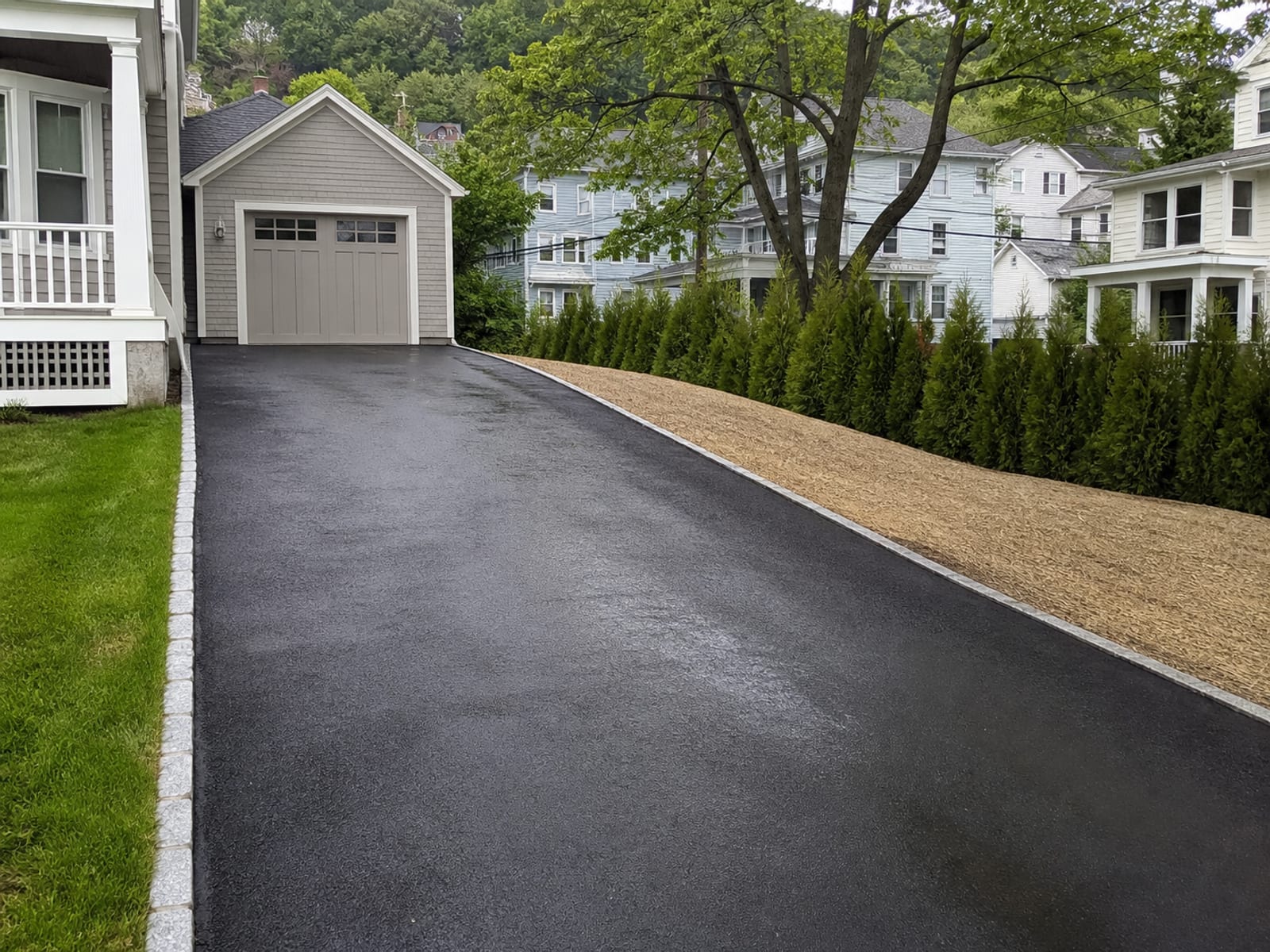
Six Failures Explain Almost Every Driveway That Failed Early
- Paving over a wet, weak, or moving platform. Asphalt cannot make a support layer firm, and the handbook's own instruction is to stop and correct the soil if the subgrade distorts during paving.
- Spreading stone over soft material without solving the cause. Aggregate is not a treatment for water or weak soil, it is a layer that depends on a prepared, stable surface beneath it.
- Skipping the proof roll. A level looking base can still deflect under load, and that check is precisely what exposes it in time.
- Compacting only what shows. Material has to be placed and densified as a controlled layer system rather than dumped, spread, and rolled once at the top.
- Leaving drainage to the finished surface. Water held in or under the pavement stresses the whole system repeatedly, and the components that would have carried it away are buried by the time anyone notices.
- Assuming a private driveway has no public implications. Right of way, state highway frontage, zoning, and wetlands can all touch a job that felt entirely private.
Frozen and Wet Are the Two Conditions That Stop the Work
No official Derby paving season, seasonal shutdown date, or townwide frost depth figure was found, so the calendar is not the rule here. Condition is.
Frozen ground is disqualifying by specification: CTDOT says asphalt mixtures must not be placed on frozen subbase material, and its municipal manual says no base material should be placed on a soft, loose, or frozen subbase. That is not a preference to be negotiated on a cold morning to keep a schedule.
Wet is the other one, and in Derby it is the more common problem. Mapped poorly drained, very poorly drained, alluvial, and floodplain soils mean a saturated platform is a live possibility on plenty of parcels, and a base that cannot be compacted to a stable condition has to be corrected or the work delayed. Inclement weather during paving itself risks inadequate compaction of the asphalt.
The right question to a contractor is therefore not which month, it is what conditions would cause you to stop, and what happens to my schedule if they occur.
Five Questions to Ask Before You Sign
1. What does proof rolling test?
2. What do CTDOT specifications say about frozen subbase?
3. Your driveway apron meets the public street. What does that bring in?
4. What is the honest way to decide between an overlay and reconstruction?
5. What can you never verify after paving day?
Pick an answer to begin.
Frequently Asked Questions About paving prep derby ct
How do I know whether my base is actually bad? By opening it or testing it, not by looking at the surface. The signals worth investigating are movement and moisture: wheel path depressions, water standing in the same spots, cracking that returns after patching, edges breaking down, wet material or pumping during excavation, and pavement that springs under a loaded truck. The definitive check is proof rolling the exposed subgrade and the compacted base with suitable heavy equipment and watching for deflection.
What does paving prep cost in Derby, CT? No reliable Derby specific range exists in any government or technical source, and converting a national calculator into a local quote would be inventing a number. The scope drivers are the area and shape, removals and disposal, excavation depth, the soil and any fill, drainage repairs or additions, aggregate quantity and haul distance, whether stabilization is specified for the conditions, the number of mobilizations, truck and roller access, utility conflicts, ledge or boulders found during excavation, the traffic the drive carries, right of way work, erosion controls, and required approvals. Compare written scopes rather than totals.
Can I just overlay what is there? Only if the existing pavement is structurally sound, which is something to be established rather than hoped. An overlay on a base that is moving or holding water reproduces the original failure, usually in the same places and often sooner, because you have added weight without adding support. Inspection first, then the decision.
Do I need a permit to repave my own driveway in Derby? For work entirely on your property, outside the right of way and away from any regulated wetland or watercourse, no standalone private paving permit requirement was found in the sources reviewed, which is not the same as saying no approval applies. The moment the work touches the public street, highway, or right of way, a City permit from the Street Commissioner or designee is required first, and where the frontage is a state highway, the City permit comes before the state permit. Grading and drainage changes can also bring zoning or wetlands review into play, so confirm your actual scope with Derby before work starts.
When should the CBYD call be made, and who makes it? At least two full working days before powered excavation, excluding Saturdays, Sundays, and holidays, and no more than 30 days ahead, outside an emergency. If you have hired an excavator, the contractor is the one who has to call. The markout locates participating utility facilities, so private service lines on the property still need careful attention in the field.
What is subbase preparation and does my driveway need it? A subbase is an additional granular layer placed over the subgrade where soil conditions, moisture, or loads call for it, to spread load and manage water. Whether your driveway needs one is a design judgment made against the actual soil, water, and use, not a standard product every job includes. Ask for the proposed section and the reasoning behind it, and be wary of a fixed depth quoted for every driveway in the city.
Can paving happen in cold or wet weather? The base work often can, within limits. The paving itself has hard constraints: asphalt mixtures must not be placed on frozen subbase, base material should not be placed on a soft, loose, or frozen subbase, and inclement weather can prevent adequate compaction. A contractor who is willing to stop and reschedule when conditions are wrong is telling you something useful about how the rest of the job will be run.
What This Means for You
The uncomfortable truth about a driveway is that every decision that determines its lifespan gets buried on the day it is built, and after that you are trusting whoever built it. That is exactly why the conversation before paving day matters more than the conversation about price.
Three things give you real leverage. Insist that the base is verified by proof rolling rather than by appearance. Get the proposed section, the drainage path, and the change condition process in writing. And ask for photographs of the subgrade and any corrections before the asphalt covers them, because that is the only record either of you will have.
If you are weighing a driveway rebuild in Derby, CT, Prestige Property Maintenance can open the failed areas, look at what is actually under there, and tell you whether you need a repair or a rebuild before anybody quotes asphalt. We handle paving prep, excavation, grading, and drainage solutions with one crew working out of Oxford, so the subgrade, the drainage, and the base are one responsibility rather than three. See how we work across Derby, call (203) 258-3395, or contact us to have the base assessed before you commit to a surface.
Base and Paving Terms, Defined
Tap a term to see what it means.
Subgrade. The native ground beneath everything. Its strength and moisture condition set the ceiling on how well the finished driveway can perform.
Related Articles
Land Clearing in Derby, CT: What Is Under the Brush?
An overgrown Derby parcel hides more than brush. Learn how land clearing in Derby, CT reveals ground conditions, limits, and drainage before you build.
Site Preparation in Derby, CT: From Approved Plans to Pour
Derby's compact, river adjacent lots make site preparation its own decision. Find out what a plan review and site visit actually confirm before you build.
Excavation in Derby, CT: What Homeowners Need to Know
Planning excavation in Derby, CT? See how floodplain rules, zoning approvals, access, and 811 timing shape your project before any machine arrives.