

Rock Removal in Derby, CT: When the Dig Hits Ledge or a Boulder
Kash CochranePublished
- rock removal
- derby ct
- ledge
- excavation safety
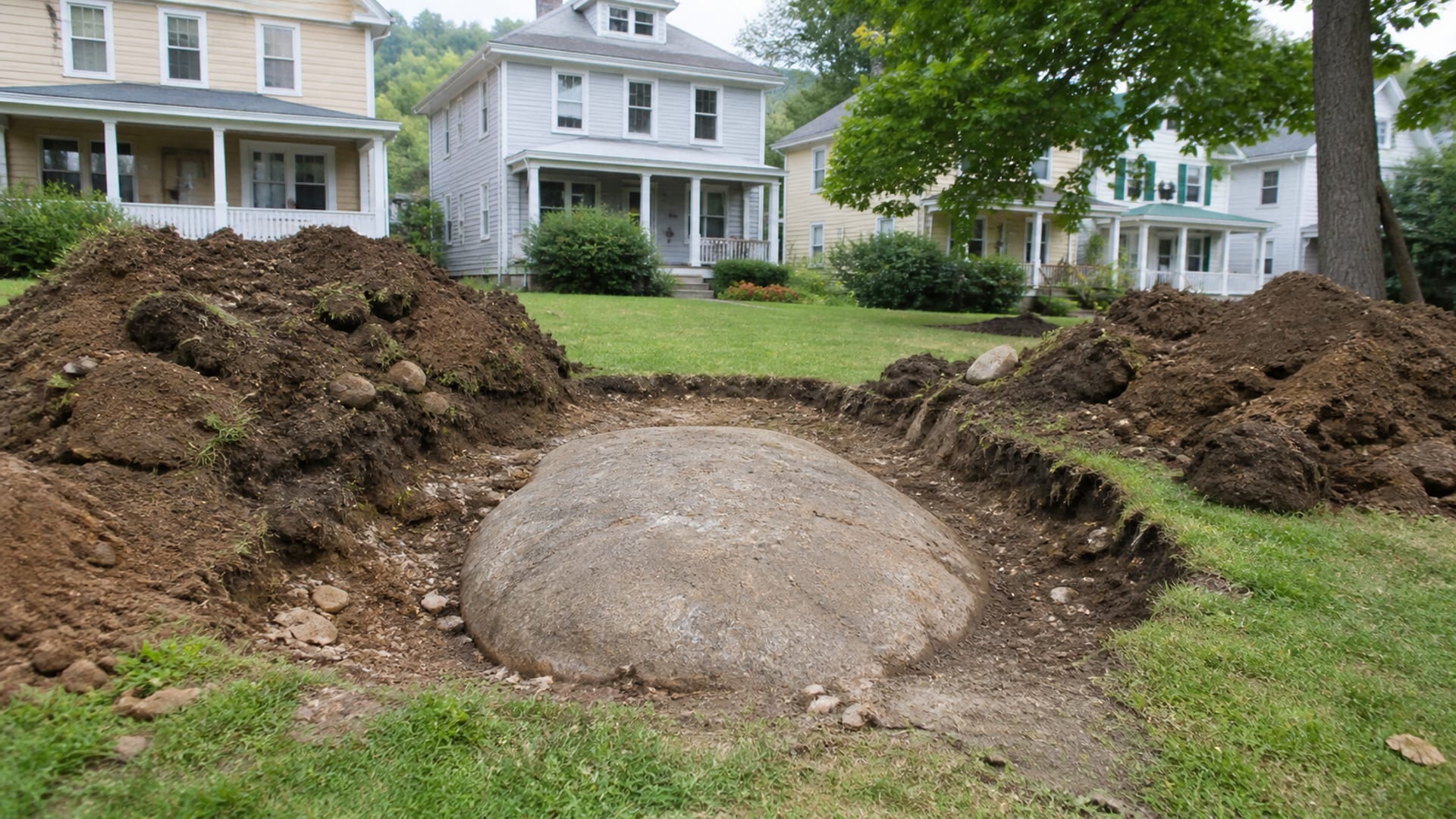
There is an open hole in your yard, a machine sitting idle beside it, and a conversation about to happen that costs money nobody budgeted. The bucket found something at four feet that will not come up, and now the schedule, the concrete order, and possibly the inspection all depend on what that something turns out to be. The instinct is to ask what it costs to get rid of it. The better question, and the one that actually gets the job moving, is what it is, because a boulder and a ledge are two entirely different problems with two different plans, and nobody can tell them apart from what is showing at the surface.
Key Takeaways
The first job is classification, not removal
a buried boulder can often be exposed and lifted, while ledge is attached bedrock that continues below grade and needs a different method entirely, and the difference is established by digging around it.
Rock can push a small job past Derby's exemption
the zoning rules require a temporary special exception before soil is dug, excavated, scraped, disturbed, moved, or filled unless an exemption applies, with listed exemptions including a work area of one half acre or less and necessary foundation or trench work on a lot with issued zoning and building permits where it does not exceed one half acre.
Depth changes the safety requirements
OSHA requires a protective system for a trench five feet deep or greater unless the excavation is made entirely in stable rock, with the choice of sloping, benching, shoring, or shielding depending on the actual conditions and the competent person's assessment.
The open cut needs managing while the decision is made
loose rock and soil have to be prevented from falling or rolling into the excavation, and spoil and equipment normally stay at least two feet back from the edge unless retained.
Derby's river setting puts water in the scope
the City's own mapping identifies alluvial and floodplain soils, poorly drained and very poorly drained soils, the floodway, and the 100 year and 500 year flood zones, while stating it is a planning map whose delineations may not be exact.
Stop the Job Properly Instead of Pushing Through It
The worst version of this situation is the one where a crew keeps trying. A machine working at something it cannot move damages the machine, enlarges the excavation in an uncontrolled way, and destroys the very information that a proper assessment needs.
The right response is a controlled pause, and it involves four things.
Establish what the final grade actually has to be at that point. Not the design intent in general, the specific elevation the footing, the pipe, or the base needs at the place the rock is. That number converts rock from an obstacle into a measurable quantity, and it occasionally reveals that the rock does not need to move at all.
Make the excavation safe as it stands, since it may sit open for days while decisions are made.
Confirm the locate position is still current, because an excavation that expands beyond the marked area is a new risk.
Then get the rock exposed enough to classify. Everything after this point depends on that classification, and it is a small amount of work compared with what follows.
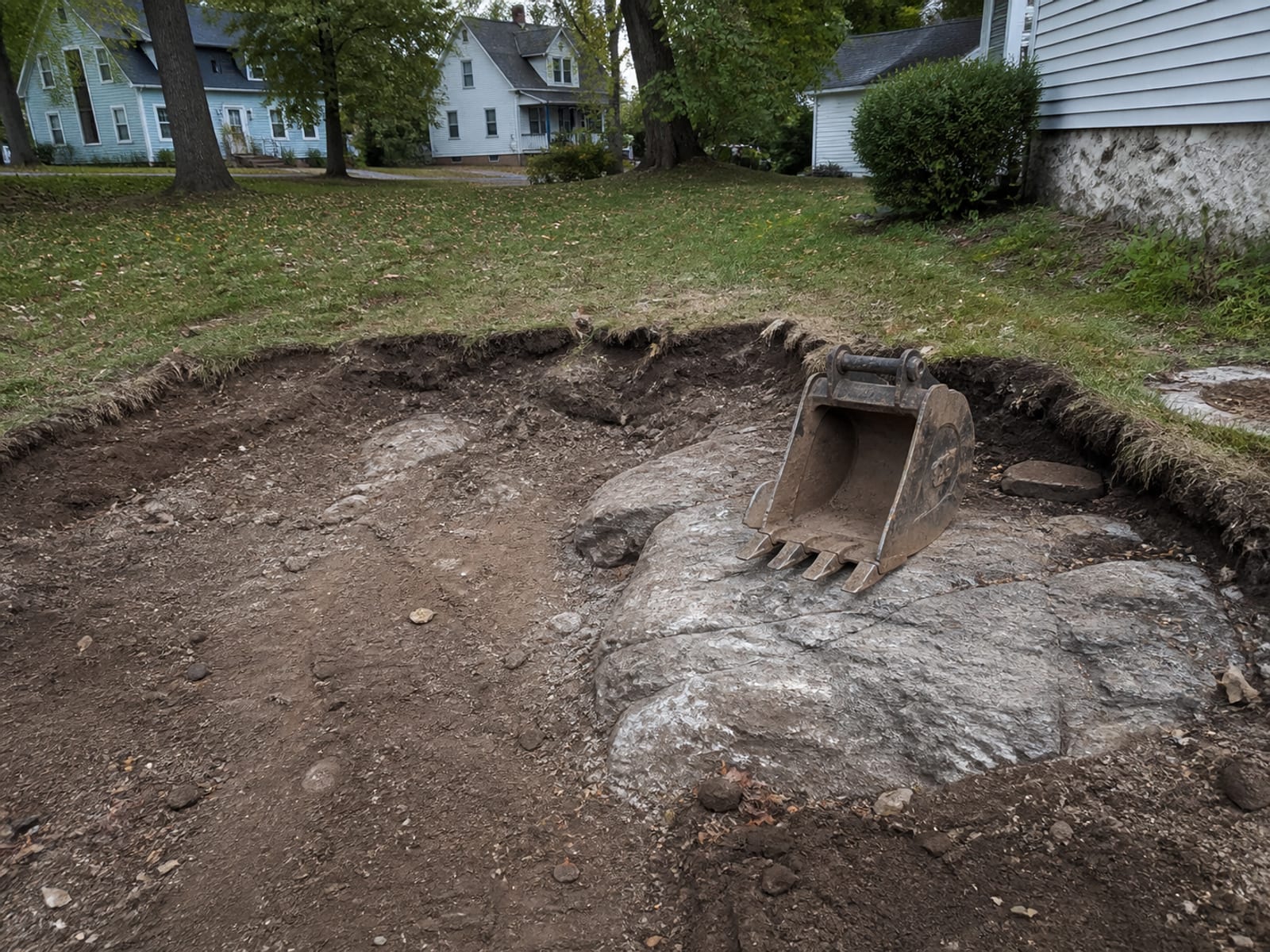
Expose It Before Anyone Prices It
| What is in the excavation | The decision point | What changes the scope | What has to be checked |
|---|---|---|---|
| An isolated boulder | Whether it can be exposed and lifted, broken down, or repositioned | Its actual size and embedment, the lifting plan, machine reach, and where it goes afterward | Access for handling, clearance to structures, and lawful disposal or on site reuse |
| Shallow ledge at or above final grade | How much material has to come off to reach the required elevation | The rock profile across the footprint, since it is rarely level | Whether the required elevation is negotiable, and the method the conditions support |
| Ledge or rock near a structure, a wall, or a utility | Whether the method is compatible with what is standing beside it | Clearance, vibration considerations, and how the adjacent structure is protected | The distances, the condition of the neighboring structure, and any engineering input |
| Rock in wet or flood sensitive ground | How water is controlled while the cut is open and after | Groundwater, weather, and where any pumped water is allowed to go | The City's review position where wetlands, watercourse, or floodplain conditions may apply |
None of those rows can be filled in from a photograph, which is why a fixed price quoted over the phone for rock is a price that will change. What a contractor can honestly give you before exposure is a rate structure and an allowance. What they can give you after exposure is a scope.
Handle Boulder Removal in Derby, CT as a Lifting Problem
An isolated boulder is a handling job before it is anything else, and on a compact Derby lot the handling is the constraint.
Start with the excavation to expose it, because the visible face is regularly a fraction of the mass, and the hole needed to get around it can be considerably wider than the hole you were digging. On a lot where the excavation is already close to a foundation, a wall, a drive, or a property line, that widening is the thing to check before committing to the approach.
Then the lift itself, which needs a plan rather than an attempt: the actual weight, the machine's capacity at the reach required, how the rock is secured, and where it swings. A rock coming out of a hole is a suspended load in a confined space, and confined spaces are exactly where the mistakes happen.
Then the destination. Out of the hole is not a destination. Removal from the property, breaking down into usable material, or repositioning somewhere it does not compromise a finished grade are three different costs, and choosing before the lift rather than after avoids a boulder living beside your driveway for a month.
And once more, the question that saves the most money: does it actually have to move. If the rock sits below the required elevation and outside anything that has to bear load or be trenched, leaving it is a legitimate answer.
Plan Ledge Removal in Derby, CT Around the Structures Standing Next to It
Ledge on an open lot is a volume problem. Ledge on a Derby lot is a volume problem with a house, a wall, a driveway, and a neighbor's structure standing within a few feet of it, and that changes the method selection more than the rock itself does.
The volume is set by two numbers: where the rock surface actually sits across the footprint, and where the bottom of the excavation has to be. Establishing the first means probing or test exposure across the area rather than at one point, because a rock surface at two feet in one corner and five in another produces two very different quantities.
The method then has to be compatible with the surroundings. Mechanical breaking with a hydraulic hammer is the usual answer and it is not quiet, quick, or vibration free, all of which matter more when there is a foundation nearby. Where a specialty method is being considered, it should be conditional on the applicable approvals and the specialist's own plan rather than assumed available, and it is never something to present as routine.
The alternative worth exploring first is design. Raising a finished elevation, shifting a footprint, or rerouting a trench line can remove most of the quantity for the price of a conversation with whoever produced the drawings.
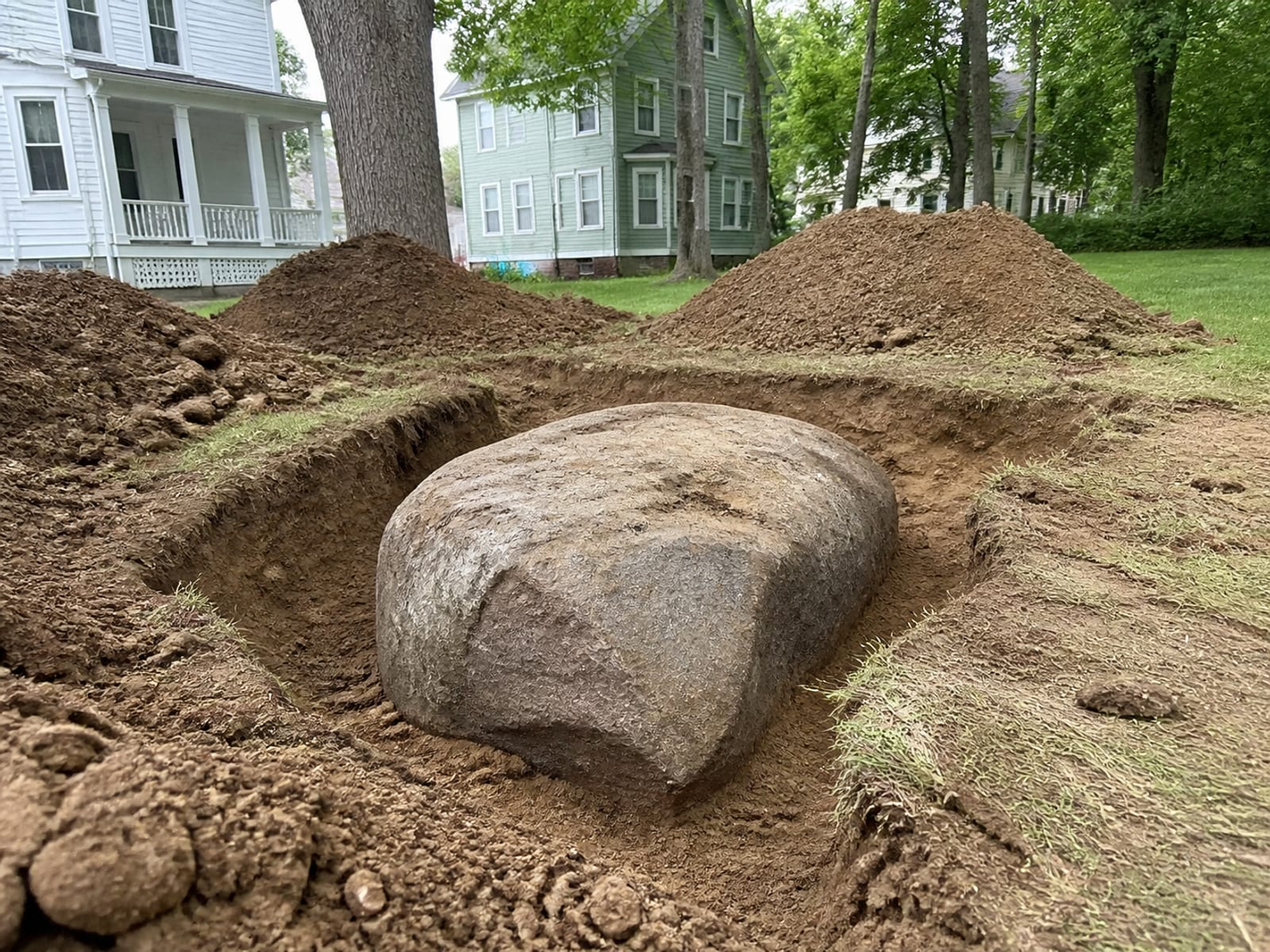
Keep the Open Cut Safe While the Decision Gets Made
An excavation waiting on a decision is still an excavation, and the requirements do not pause with the work.
Loose rock and soil have to be prevented from falling or rolling into the cut, which usually means scaling back the face and setting protection at the edge. Spoil and equipment normally stay at least two feet back from the edge unless retained by a device designed for it, because edge loading is what collapses walls.
Inspections continue. OSHA requires daily competent person inspections of the excavation, the adjacent areas, and the protective systems where employees may be exposed, and additional inspections after a rainstorm or any other event that increases hazards. On a lot in Derby's river corridor, where mapped soils include alluvial, floodplain, poorly drained, and very poorly drained types, the after rain inspection is not a formality.
And depth still governs. A trench five feet deep or greater requires a protective system unless the excavation is made entirely in stable rock, with sloping, benching, shoring, or shielding selected against the actual conditions, water, depth, nearby loads, and the competent person's judgment. Note the wording of that exception carefully: it is stable rock, established as such, not "there is rock in the hole".
Check Whether the Scope Has Outgrown Your Approval
| Trigger | What applies | Who |
|---|---|---|
| Soil dug, excavated, scraped, disturbed, moved, or filled | A temporary special exception unless a listed exemption applies. The exemptions include a work area of one half acre or less, and necessary foundation or trench work on a lot with issued zoning and building permits where it does not exceed one half acre | Derby Planning and Zoning, through the Zoning Enforcement and Wetland Division |
| Construction or alteration of a building or structure | The building permit process, with an application filed and a permit issued before the work. Whether standalone rock removal needs one is not stated as a general rule, so confirm the particular scope | Derby Building Department |
| Mapped or field identified wetlands, watercourses, or floodplain conditions | City review before treating the removal as routine excavation | Derby Inland Wetlands Agency and the Inland Wetland Enforcement Officer |
| Any power operated excavation | A Call Before You Dig ticket at least two full days ahead, excluding Saturdays, Sundays, and holidays, and no more than 30 days ahead, except in an emergency | CBYD, at 811 or 1-800-922-4455 |
| Private, customer owned lines | Not covered by the locate. They need identifying separately in the site plan | You and your contractor |
The trap specific to rock is this. Your original job may have sat comfortably inside an exemption. Then rock appeared, the excavation widened to expose it, spoil and broken material accumulated, and the disturbed area grew. Whether you are still inside that exemption is a question with a definite answer, and it is worth asking before the answer is discovered by somebody else.
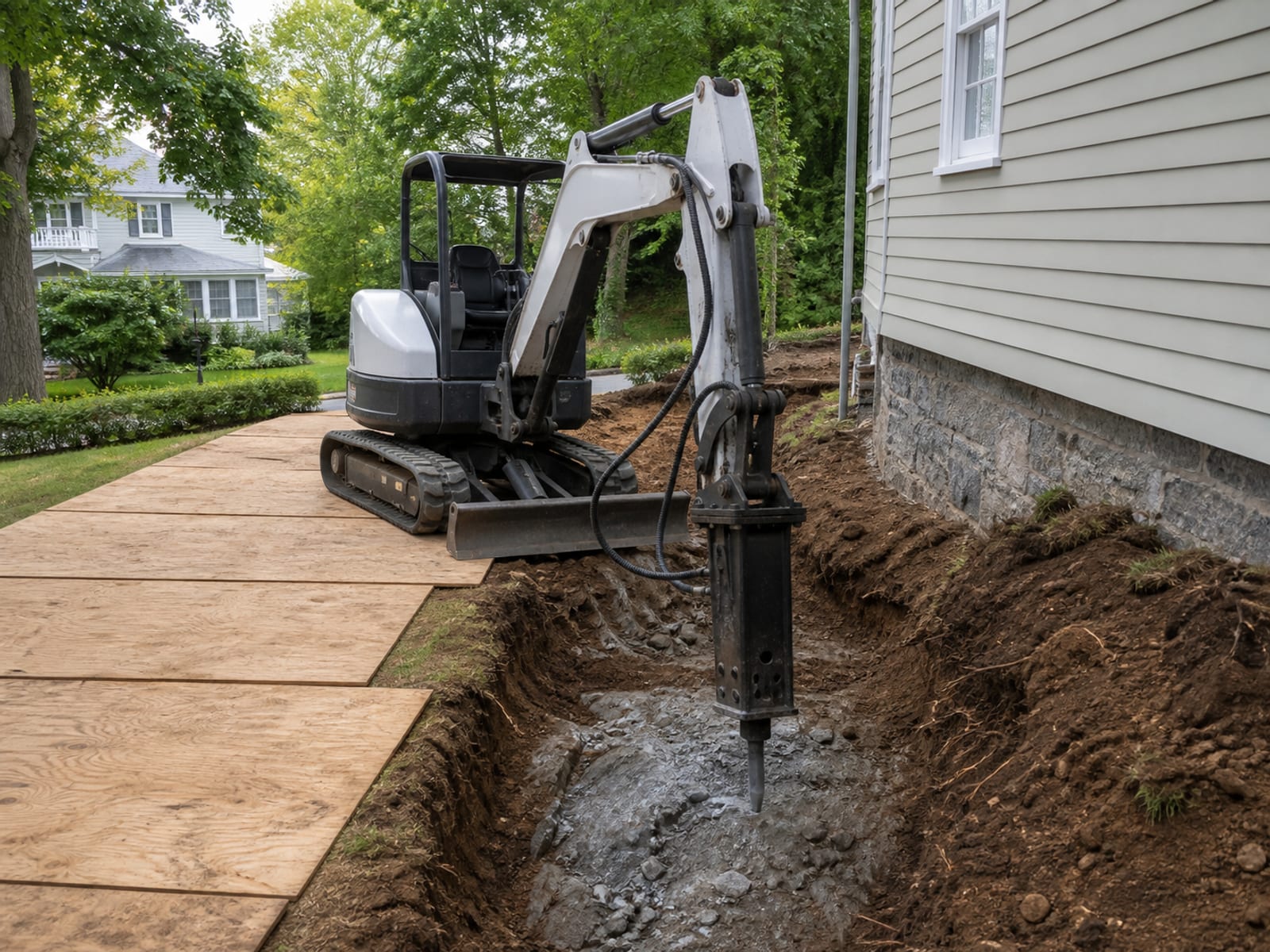
Run Rock Excavation in Derby, CT Through the Full Site Sequence
1. Confirm the locates and the work area. Current ticket, verified marks, private lines addressed separately, and the excavation limits understood before they expand. 2. Set the site controls. Edge protection, spoil setback, access for people and equipment, pavement and structure protection, and erosion controls where conditions or approvals require them. 3. Expose the rock under control. Enough to classify it and to establish the profile across the footprint, without enlarging the cut more than the assessment needs. 4. Have a competent person assess it. Soil and rock conditions, water, the protective system requirement, and the effect on anything standing nearby. 5. Select the method against the findings. Lift, break, work the seams, or redesign around it, with the equipment and the handling plan following the classification rather than the other way round. 6. Manage the water throughout. Groundwater, weather, and where anything pumped is permitted to go, which is a separate question from whether it can be pumped. 7. Establish the grade and restore. The required elevation reached and verified, backfill and compaction where the design calls for it, the surface put back, and any conditions attached to an approval satisfied rather than left open.
Get an Estimate That Names Its Own Assumptions
No published Derby, Connecticut, or state agency price range exists for residential boulder removal, ledge removal, or rock excavation, and no transferable duration range exists either. Both absences are honest, because the range on this work within a single street is wide.
What a credible estimate does instead is separate its parts and state what it assumes:
- Investigation or test exposure, as its own line rather than folded into the removal.
- Mobilization, particularly where specialist equipment is involved.
- Access and staging, which on a tight lot can rival the removal itself.
- Utility locating and protection, including how private lines are handled.
- The removal method, and what happens if the exposure findings differ from what was assumed.
- Hauling or on site reuse, with a named destination.
- Water and erosion controls.
- Restoration, including pavement, lawn, and anything the access damaged.
- Engineering or permit work, where the scope has grown into it.
Then ask the question that matters most on rock: what condition triggers a written change, who decides, and who authorizes it. Rock scopes without an honest change mechanism are the ones that end in a dispute.
Protect the Access, the Pavement, and the Neighbors' Patience
On a compact in town lot the collateral effects of rock work are a real part of the job.
Equipment reaches the excavation across something, and that something is usually a driveway, a lawn, or a sidewalk. Tracked machines and loaded trucks mark up all three, so protection and a restoration position belong in the scope rather than in a conversation afterward.
Breaking rock is loud and it continues for a long time. Telling the neighbors what is happening and roughly how long it will run costs nothing and prevents most of the friction. Where a neighboring structure sits close to the work, the conversation is worth having before the hammer starts rather than after somebody notices a crack that may or may not be new.
And the street itself is a consideration. Material leaving the site, trucks staging, and anything reaching the public way can bring the City into a job that was otherwise entirely private.
Avoid the Five Mistakes That Keep the Hole Open Longer
- Treating the locate as optional, or scheduling equipment before the notice period has run. The requirement does not bend for a job that has already started.
- Accepting a bid that skips access, hauling or reuse, water control, utility protection, and restoration. Those five are where the difference between two rock quotes usually lives.
- Letting spoil, boulders, or equipment sit at the excavation edge. It is the most common cause of a wall failure and the easiest thing to get right.
- Entering or directing work in an unprotected excavation. Depth, conditions, and the competent person's assessment govern, and rock in the hole does not by itself make it stable rock.
- Assuming the exemption still applies. The disturbed area is what the rule looks at, and rock work is very good at increasing it.
Four Questions With a Machine Sitting Idle
1. How do you tell a boulder from ledge?
2. At what depth does OSHA require a protective system in a trench?
3. Where do spoil and equipment normally have to sit relative to the excavation edge?
4. Rock work has widened your excavation considerably. What should be rechecked?
Pick an answer to begin.
Frequently Asked Questions About rock removal derby ct
What does rock removal in Derby, CT cost? No published local range exists, so a figure here would be invented. What sets it is whether the material is a movable boulder or continuous ledge, how much has to come out to reach the required elevation, the access and staging on your particular lot, clearance to structures and utilities, water conditions, where the material goes, and whether the scope has grown into an approval or engineering requirement. Ask for an estimate that separates investigation, mobilization, access, removal, hauling, water control, restoration, and permit work, and that states what it assumes.
Is boulder removal in Derby, CT different from ledge removal in Derby, CT? Yes, and they are not on a spectrum. A boulder is an isolated object sitting in the soil with material continuing beneath it, so exposing and lifting it is usually available. Ledge is attached bedrock that continues below grade, so there is nothing to lift and the work is reduction rather than removal. The exposure findings choose the method, which is why classification comes before pricing rather than after.
Do I need to call 811 before rock excavation in Derby, CT? Yes, for any power operated excavation, outside an emergency. The ticket must be obtained at least two full days ahead, excluding Saturdays, Sundays, and holidays, and no more than 30 days ahead. Note also that a locate ticket does not identify private, customer owned lines, so ask specifically how those are being addressed in the site plan, particularly on an older lot where several may exist.
Does Derby require an approval before soil or rock is moved? Often, and it depends on the disturbed area and the project. The zoning rules require a temporary special exception before soil is dug, excavated, scraped, disturbed, moved, or filled unless an exemption applies, and the listed exemptions include a work area of one half acre or less and necessary foundation or trench work on a lot with issued zoning and building permits where it does not exceed one half acre. Confirm the actual scope with the City, especially once rock work has enlarged it.
What if the dig is close to wetlands, a watercourse, or river floodplain? Then City review comes before treating the removal as routine. Derby's mapping identifies alluvial and floodplain soils, poorly drained and very poorly drained soils, the floodway, and the 100 year and 500 year flood zones, and the map itself says it is for planning purposes with delineations that may not be exact. That makes it a screening tool rather than a determination for your parcel, and the Zoning Enforcement and Wetland Division is who resolves it.
How long will the work take? No transferable local duration range exists, and promising days without seeing the exposure findings would be a guess. What is fixed is the locate notice period. Everything else depends on what the rock turns out to be, whether municipal review applies, the access, water conditions, the method, the hauling, and the restoration. A contractor who gives you a schedule after exposure rather than before it is giving you a more useful number.
Can rock work damage a nearby structure? Mechanical breaking produces vibration and noise, and clearance to whatever is standing nearby is part of the method selection rather than an afterthought. On a compact lot with a foundation, a retaining wall, or a neighboring structure close to the work, that clearance and the condition of what is beside the cut belong in the assessment, and engineering input is sometimes warranted. It is also a sound reason to document the condition of nearby structures before work begins.
Moving Forward
Rock in an open excavation is a scope change, and a scope change handled in order costs a fraction of one handled in a hurry. Establish the required elevation. Expose the rock enough to know whether it is a boulder or ledge. Make the cut safe while the decision is made. Check whether the growing disturbed area has moved you out of the exemption you were relying on. Then choose a method and price it once.
The most valuable question is still the one that is easiest to skip: does this rock have to move at all, or can the design move instead. On a tight Derby lot, where widening the excavation has its own consequences, that conversation is worth having before the hammer comes off the trailer.
If a dig has stopped on rock in Derby, CT, Prestige Property Maintenance can expose and classify what you have hit, probe the profile across the footprint, and put a written scope together with an honest change mechanism in it. We handle rock removal, excavation, site preparation, and earth moving with one crew working out of Oxford, and more than a decade in Connecticut ground means we plan for ledge and buried boulders rather than being surprised by them. See how we work across Derby, call (203) 258-3395, or contact us to get the job moving again.
Rock Work Vocabulary
Tap a term to see what it means.
Ledge. Bedrock attached to the ground beneath, continuing below grade. Digging around it finds more of it rather than an underside.
Related Articles
Bethany, CT Rock Removal and What It Adds to Your Project
Bethany sits on glacial till, so hitting a boulder or ledge mid-dig is common, not bad luck. Here is how rock removal in Bethany, CT actually works.
What to Expect from Drainage Work in Derby, CT, Start to Finish
Hired someone for drainage work in Derby, CT and wondering how torn up the yard gets? Here is the real sequence, from utility mark-out to grading.
What to Expect from an Excavation Company in Derby, CT
A machine on your small Derby lot does not have to be stressful. Learn what to expect from an excavation company, step by step, before you hire one.