
Tree Removal in Derby, CT: What a Tight Lot Changes
Kash CochranePublished
- tree removal
- derby ct
- storm damage
- stump grinding
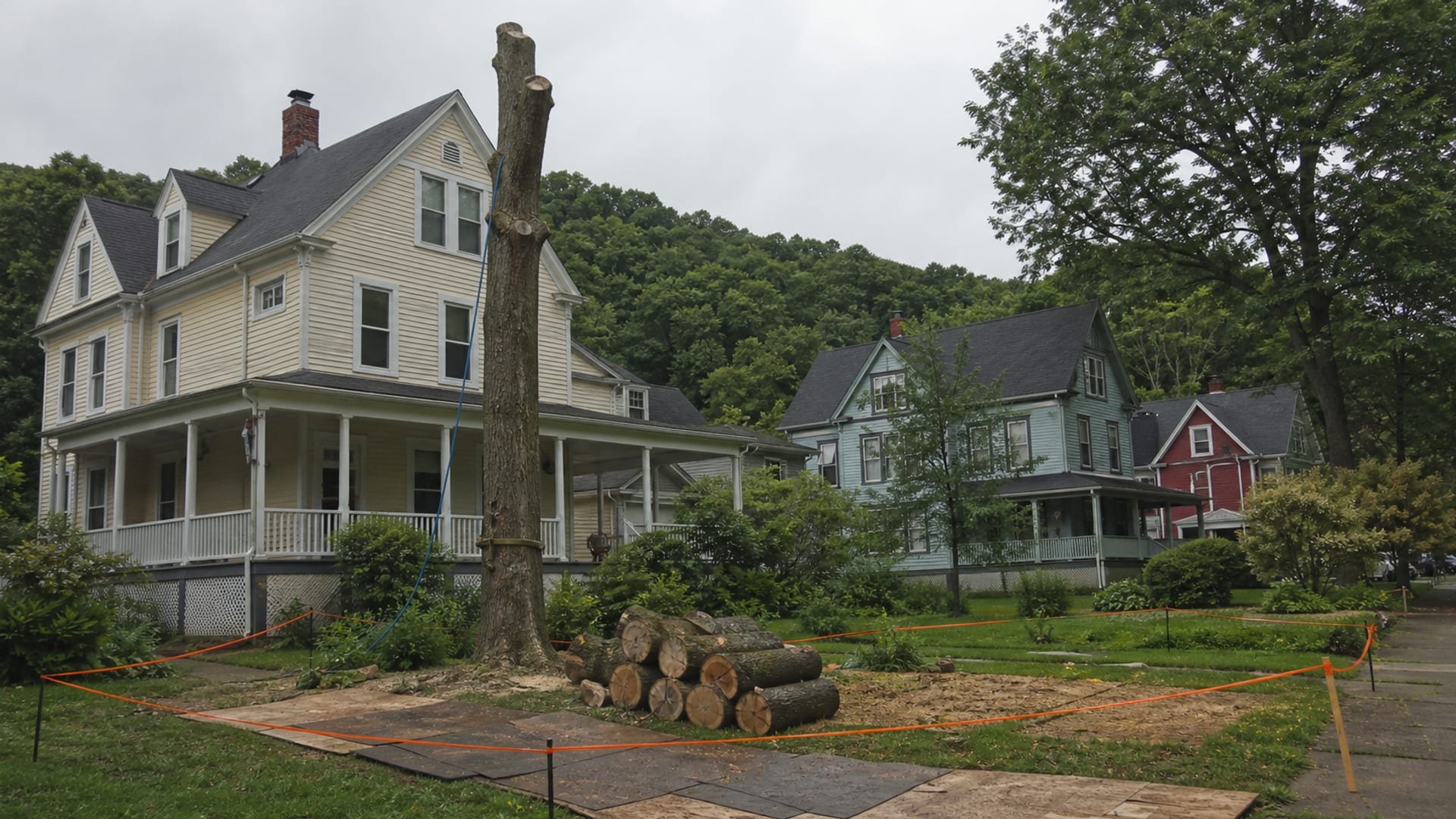
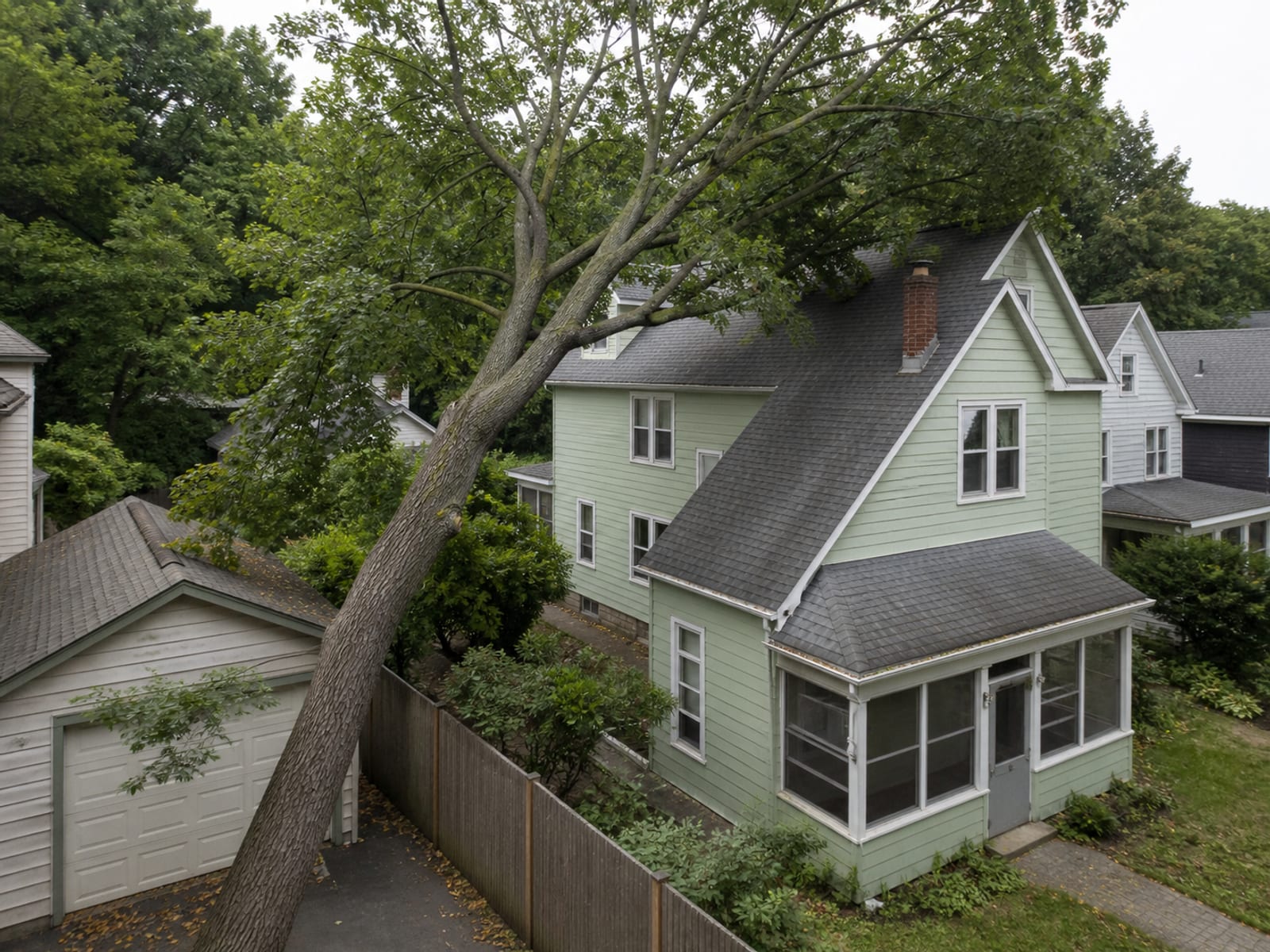
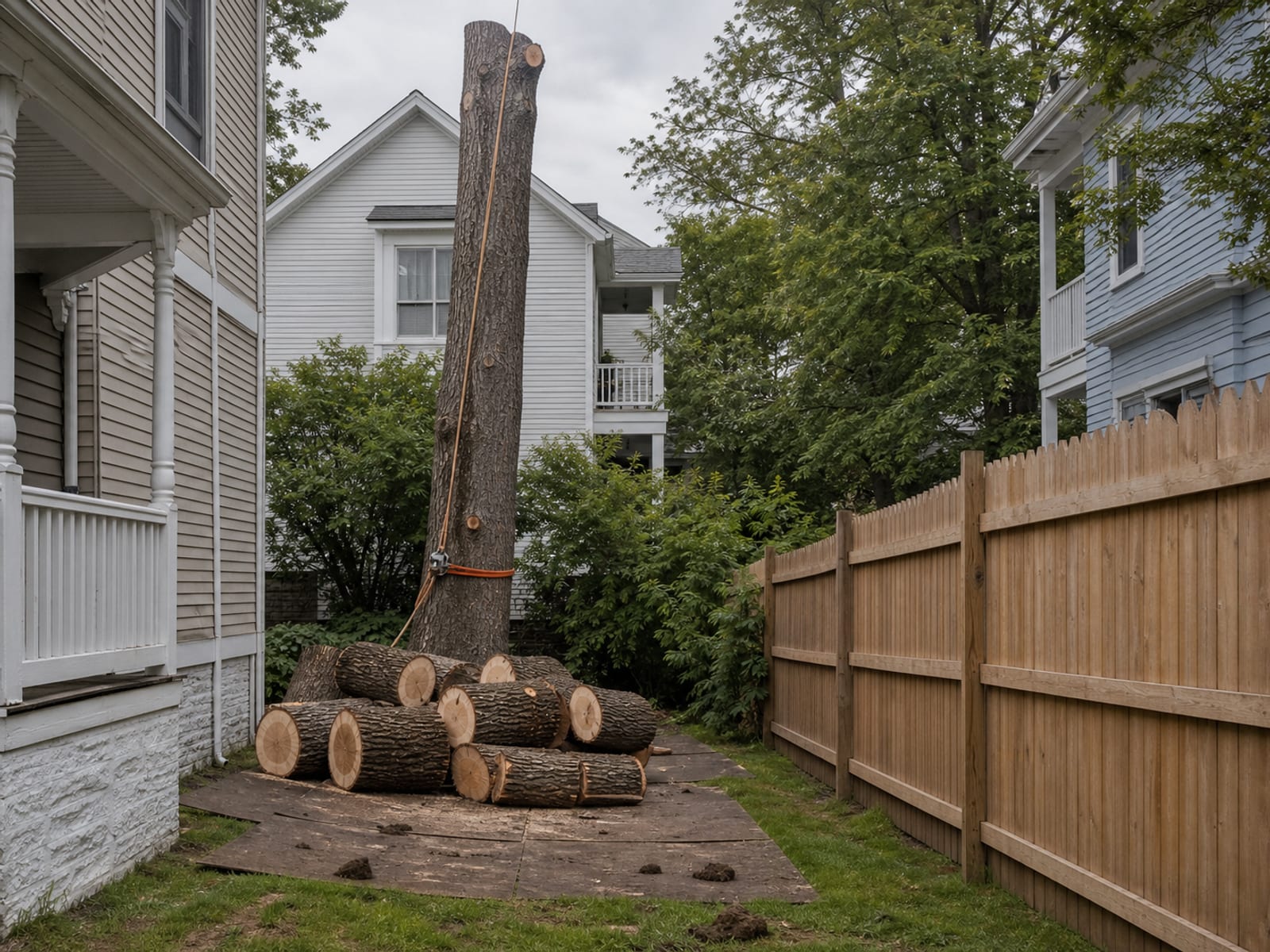
Stand in the back yard and look up, then look around. The tree leans toward the roof, or the top of it sits closer to the wires than it did five years ago. Now look for somewhere it could fall without hitting anything. On most Derby lots there is nowhere. The house is there, the fence is right there, the neighbor's garage is on the other side, and the front is a street with cars on it. That absence of a drop zone is the whole story of this job, and it is why removing a large tree here is a dismantling problem rather than a felling problem, priced and planned completely differently from the same tree standing in a field.
Key Takeaways
With no drop zone, the tree comes down in controlled pieces
sectional dismantling with rigging, an aerial lift, or a crane depending on the site, so that every piece lands where the crew intends rather than where gravity chooses.
Access to a legal staging point is a real constraint, not a detail
whether a chipper, a truck, a lift, or a crane can reach a lawful place to stand without crossing a neighboring property is often what decides the method and the price.
Derby regulates clear-cutting of trees within 50 feet of wetlands or watercourses
the City's regulation defines regulated activity to include earth moving, filling, construction, and clear-cutting of trees within 50 feet of a wetland or watercourse, with the actual boundary determined from land character and, where needed, field inspection and soil scientist testing.
Some trees are not yours to remove
a tree on municipal property, a public road, or public grounds needs written permission from the tree warden or the authority with jurisdiction, and work along a state road needs a state DOT encroachment permit.
A tree touching electrical equipment is a utility call first
state guidance is to avoid direct and indirect contact and to call the electric utility, rather than treating it as ordinary tree work.
Accept That the Tree Is Coming Down in Pieces, Not in One Go
Felling a tree means putting it on the ground in one piece, in a controlled direction, into a space large enough to receive it. It is the fastest and cheapest method available, and it is unavailable on most of Derby's lots because that space does not exist.
What replaces it is sectional dismantling. A climber, or an operator in an aerial lift, works the tree from the top down, removing limbs and then trunk sections in a planned order. Anything that cannot simply be dropped into a clear area below gets rigged, meaning it is attached to a rope running through a block and lowered under control rather than released. Each piece is a small, planned event instead of one large unplanned one.
That difference explains almost everything about a tight lot quote. It is slower, because the work happens piece by piece. It needs more people, since somebody is always tending the ropes on the ground. It needs equipment positioned within reach. And it needs a landing area, however small, that is protected so the sections do not damage what they land on.
The upside is control. On a lot where a mistake means a roof, control is the entire product you are buying.
Find Out Where the Chipper and the Truck Can Legally Stand
Before method comes access, and this is the question a good assessor asks first on a compact lot.
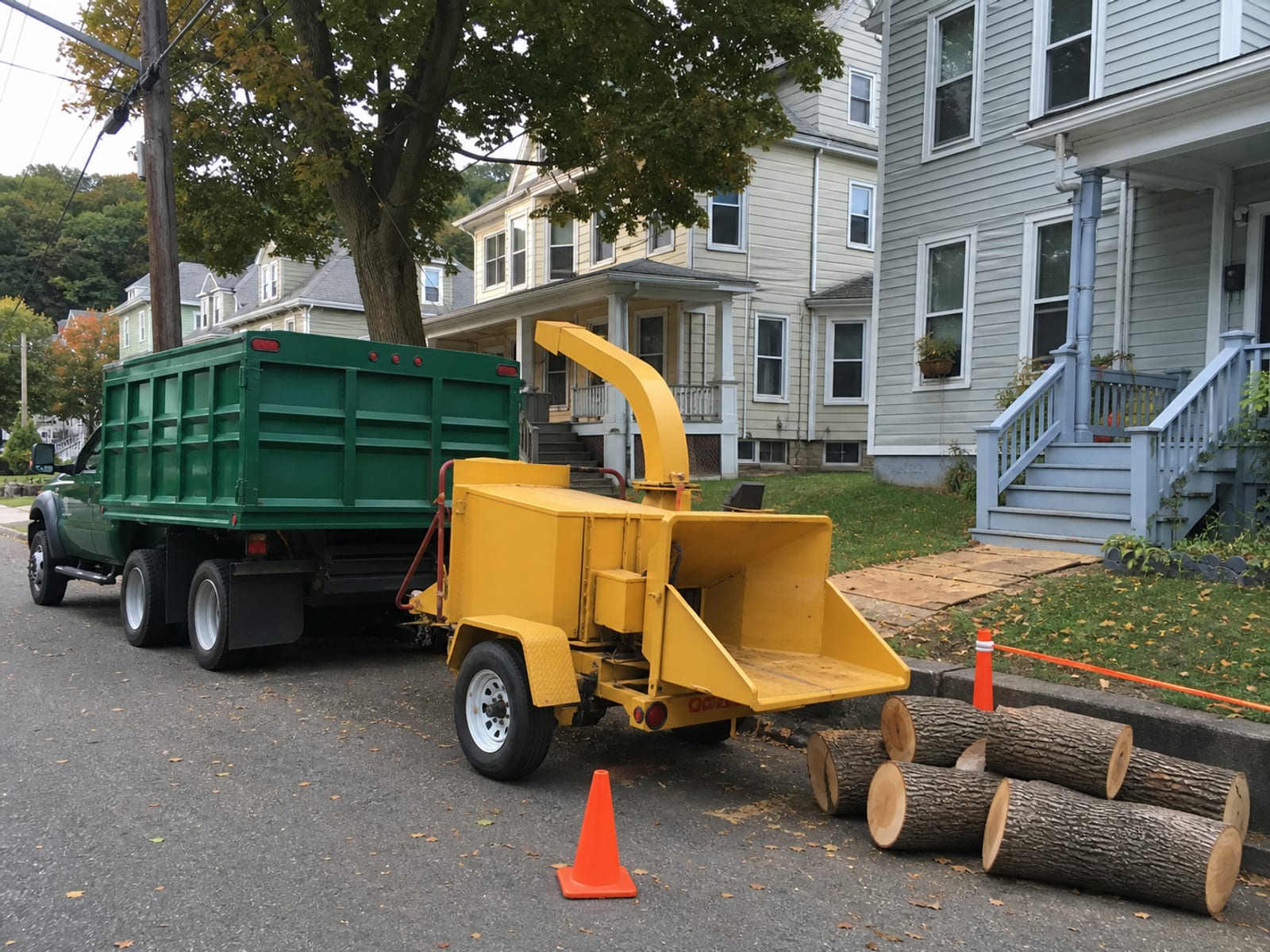
Can a chip truck and chipper reach a legal place to stand? On many Derby streets that means the road itself, which brings traffic control into the plan. Can an aerial lift get to a position with a workable angle to the tree, and will the ground or pavement take it? Is a crane even possible, meaning is there a setup position with clearance overhead and around, and a route to it? What surface protection is needed so the work does not leave ruts or cracked pavement behind?
Then the one that causes the most trouble: does any part of the plan involve crossing a neighboring property? Setting a machine, dragging brush, or dropping a section over the line is not something a contractor can decide on your behalf. Where it is genuinely necessary, it needs the neighbor's agreement in advance, and that conversation belongs to you rather than to the crew on the morning.
If the answer to all of the above is difficult, the method usually shifts toward more climbing and more rigging, which is slower and more expensive but often the only way in. That is a legitimate reason for a quote to be higher, and it is worth asking a contractor to explain rather than assuming.
Work Out Whether This Is a Today Problem or a Three Quotes Problem
Not every worrying tree is urgent, and not every calm looking one is safe.
| What you can see | How urgent | What to do now |
|---|---|---|
| Any part of the tree on or near overhead electric equipment | Utility first, before anything else | Keep clear, treat it as energized, and call the electric utility. Nothing else proceeds until they have dealt with it |
| Soil lifting or cracking around the roots, particularly after flooding | Urgent assessment | State guidance points to a prompt arborist safety assessment where flooding is followed by a lean or lifted soil around roots. Clear the area on the lean side |
| Broken limbs hanging in the crown | Urgent, and not a homeowner task | Keep everyone out from underneath. Suspended wood can come down without warning |
| A lean toward the house that is new or increasing | Prompt assessment | Note it, photograph it from a fixed spot, and get it looked at rather than watched |
| Storm damage on a tree near a structure, a road, or a line | Prompt assessment | Extension guidance recommends professional assessment for trees near structures, roads, or power lines after storm damage |
| Dead or declining, clear of everything, no visible defect near a target | Plannable | Get several written scopes and book it properly. This is the version you want to be dealing with |
The pattern behind the table is straightforward: it is about the target and the condition of the wood, not the size of the tree. A modest tree over a bedroom is a more serious problem than a large one over an empty side yard.
Handle a Storm Damaged Tree in Derby, CT Without Adding a Second Emergency
After a storm, the danger shifts from the tree to what the tree is now doing.
Wires come first. If anything is on or near electrical equipment, stay away, treat every line as live, and call the utility. Trees conduct electricity, so contact does not have to be visible to be dangerous.
Then leave the tensioned wood alone. A limb that is bent, pinned, resting on something, or hung up in the crown holds stored energy, and a saw cut is what releases it. This is where people who have run a chainsaw for years get hurt, because ordinary firewood behavior is not what damaged wood does.
What you can usefully do: keep an exclusion area, move vehicles if you can reach them without entering the fall zone, photograph everything from a safe distance for the insurer, keep access clear for emergency vehicles, and get an assessment booked. Understand too that emergency work and full cleanup are usually two separate jobs. Making the property safe happens first, and the tidy up, the wood, and the stump can follow on a normal schedule.
Know Which Trees Are Not Yours to Remove
| Situation | What applies | Who |
|---|---|---|
| A tree entirely on your private lot, no regulated area, no public way, no related construction | No stand alone municipal tree removal permit was found in the Derby materials reviewed. That is not the same as nothing applying, since related construction, demolition, encroachment, wetland activity, or use of public space each have their own triggers. Confirm your parcel and scope | Derby Building Department |
| Work in a wetland or watercourse, or earth moving, filling, construction, alteration, pollution, or clear cutting of trees within 50 feet of one | A permit for the regulated activity. The regulation also allows an applicant to seek a written ruling in advance where a proposed use might disturb the natural character of the area | Derby Inland Wetlands Agency and its Wetlands Enforcement Officer |
| A tree on municipal property, a public road, or public grounds | Written permission before cutting or removal. Under Connecticut law the authority is the tree warden or other authority with jurisdiction | Derby's tree warden function, identified through the City |
| A tree along a state road | A state DOT encroachment permit before planting, pruning, or removing a tree or shrub | Connecticut Department of Transportation |
| A tree touching or near overhead electric distribution equipment | Not ordinary tree work. Avoid direct and indirect contact and call the utility | Your electric utility |
| Stump grinding, excavation, root removal, replanting, or any mechanized digging | Notify Call Before You Dig before excavating. Mechanized excavation requires notice ahead of the work | CBYD, at 811, under PURA oversight |
Two rows deserve emphasis in a river city. The 50 foot clear cutting trigger is closer to the house than people expect on a lot near a stream, a wetland, or the river corridor, and Derby's own natural resource mapping identifies alluvial and floodplain soils, poorly and very poorly drained soils, the floodway, and the 100 year and 500 year flood zones along the rivers. The regulation is also explicit that the precise regulated area boundary comes from the actual character of the land and, where needed, field inspection and soil scientist testing, so a map is a starting point rather than an answer.
And the street tree question catches people every year. The tree at the edge of the property, between the sidewalk and the road, is frequently not yours, and removing it without written permission from the authority with jurisdiction is a problem you cannot undo.
Get a Tree Removal Service in Derby, CT to Put the Constraints in Writing
On a constrained lot, a written scope is worth more than a low number, because the number depends entirely on things that need to be stated. Ask for:
- The method. Climbing and rigging, aerial lift, crane, or a combination, and why that suits this site.
- How pieces are controlled. Where sections land, what protects that landing area, and how anything over the house or a fence is lowered rather than dropped.
- The staging plan. Where the truck, chipper, and any lift will sit, whether that involves the street, and whether anything crosses a neighboring property.
- Surface protection. What is done to keep equipment from damaging pavement, the drive, or the lawn, and what restoration is included if it does.
- The debris outcome. Brush chipped and taken, logs removed, or wood cut to a length you specify and left. These are three different prices.
- The stump. Left, ground, or excavated, and to what depth. Frequently excluded and frequently assumed.
- Permissions. Who confirms the wetlands position, who handles anything involving a public tree or a state road, and who makes the locate call if there is digging.
- Credentials and insurance. Current certificates, and the relevant licensing for the work being performed.
- Exclusions. Written down, in plain language.
Compare those answers rather than the totals. Two quotes for the same tree can differ enormously and both be honest if one includes the stump, the wood, and street traffic control and the other does not.
Decide the Stump Question Before the Crew Leaves
Removal and stump work are separate jobs, and the decision belongs to what the ground has to do afterward.
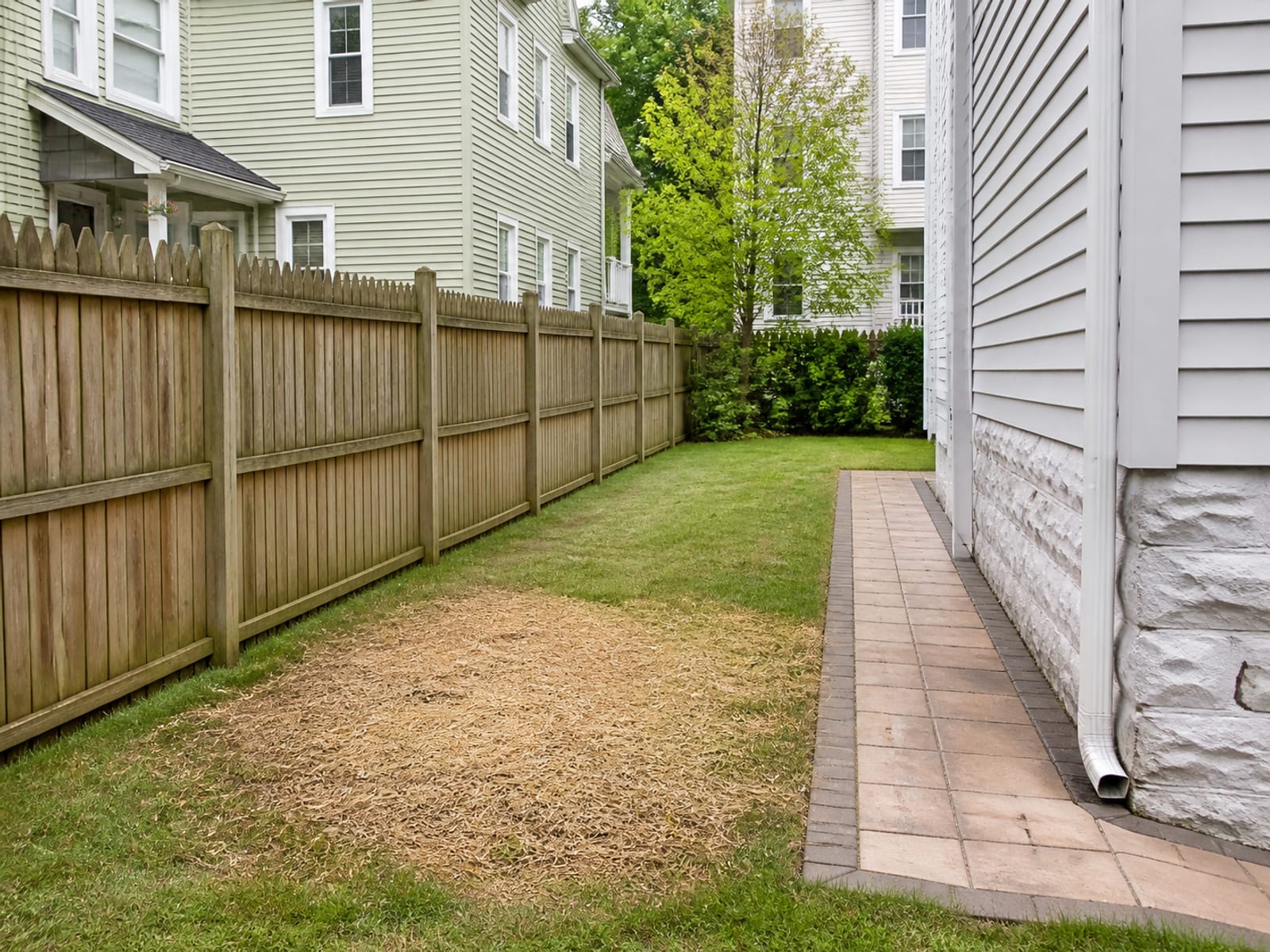
Leaving it costs nothing now and leaves a trip hazard and an obstacle to mowing. Grinding reduces it below grade so the area can be lawn or planting again, with the chip either left in place, removed, or replaced with soil, which is itself three different scopes. Excavating the stump and root mass is different work again, and it is what you need if a structure, a slab, a driveway base, or a trench is going where the tree was.
The trigger everyone forgets: both grinding and excavation are mechanized digging, so the locate notice applies. That is a scheduling item, not a formality, and on a small lot with a service drop, a water line, and possibly an old drain in the same few square meters, it is not a box to tick lightly.
Follow the Sequence From Assessment to Cleanup
1. Assess the site and plan the work zone. The tree's condition and lean, the targets in every direction, overhead lines, access, staging, ground conditions, and where sections can land. 2. Sort the permissions and notifications. Wetlands screening where the work is anywhere near water or wet ground, the public tree or state road position if either applies, the utility call if wires are involved, and the locate request if there will be digging. 3. Set up and control the zone. Traffic control where the street is being used, surface protection, an exclusion area, and communications agreed between the climber and the ground crew. 4. Dismantle under control. Limbs and sections removed in a planned order, rigged and lowered where they cannot be dropped, with nobody working beneath a suspended piece. 5. Process the debris and settle the stump. Brush chipped, logs handled as agreed, and the stump left, ground, or excavated according to the written scope. 6. Clean up and look ahead. The site left as agreed, any surface damage addressed, and a short conversation about the other trees, since a removal is a good moment to identify the next problem while it is still cheap.
Avoid the Five Mistakes That Turn a Removal Into a Claim
- Assuming a nearby patch of open ground is a drop zone. It usually is not big enough, and "usually" is not a standard you want applied over your roof.
- Letting anyone cut a tree or limb on or within 10 feet of utility lines. That is the utility's work and their clearance rules, not a scheduling problem to route around.
- Starting stump grinding or excavation before the locate. Mechanized digging is mechanized digging regardless of what it is for.
- Comparing quotes with different debris, wood, stump, and access scopes. The cheapest is very often the one that leaves the most behind.
- Treating storm damaged tensioned wood as firewood. It behaves nothing like sound timber, and it is the most common way homeowners get badly hurt after a storm.
Keep Your Own Role Small and Useful
Photograph the tree from a fixed position over time, which is the best evidence of a lean that is changing. Note what sits under it in every direction. Measure the access: gate widths, the side passage, where a truck can park. Find out whether the tree near the road is actually on your property. Check whether there is a watercourse or wet area within striking distance of 50 feet. Move what can be moved. Talk to the neighbor early if anything is likely to need their side.
Then stop. Climbing, ladder work with a saw, cutting suspended or tensioned wood, felling anything that could reach a target, working near lines, and running a saw for any cut you cannot make with both feet on the ground all belong to a qualified crew. On a tight lot the margin for error is measured in feet, and there is no version of this where improvising is the cheap option.
Four Questions About Removing a Tree on a Small Lot
1. Why is a tight lot removal more expensive than the same tree in a field?
2. What does Derby's wetlands regulation say about clear cutting trees?
3. The tree between your sidewalk and the road needs removing. What comes first?
4. Does stump grinding require a locate call?
Pick an answer to begin.
Frequently Asked Questions About tree removal derby ct
What is the typical tree removal price range in Derby, CT? No Derby specific published pricing exists, and figures quoted nationally are not a quote for a constrained city lot, where access and control drive the number more than the tree does. What sets it here is the height and condition, the proximity to the house and the wires, whether pieces can be dropped or have to be rigged, where equipment can legally stage, whether the street is involved, what happens to the brush and the wood, whether the stump is ground or excavated, and whether the work is scheduled or an emergency. Get written scopes that describe the same work, then compare.
Does Derby require a permit to remove a tree on my private property? No stand alone municipal tree removal permit turned up in the Derby materials reviewed, which is not the same as nothing applying. Separate requirements can be triggered by related construction, demolition, encroachment, wetland activity, or use of public space. And a tree on municipal property, a public road, or public grounds needs written permission from the tree warden or the authority with jurisdiction. Confirm the parcel and the actual scope with the City before work.
How is large tree removal in Derby, CT handled when there is no room to drop the tree? By taking it apart from the top down. A climber or an operator in an aerial lift removes limbs and then trunk sections in a planned sequence, rigging and lowering anything that cannot be dropped into a clear area. Whether that is done by climbing, from a lift, or with a crane depends on access, the tree's condition, and what is beneath it, which is why the method comes after the assessment rather than before it.
What should I do with a storm damaged tree in Derby, CT? Keep clear of it. If anything is on or near a wire, call the electric utility and treat the line as live. Do not cut anything hanging, bent, pinned, or resting on something, because damaged wood holds tension that releases when it is cut. Establish an exclusion area, photograph the damage from a safe distance for your insurer, keep access clear, and get an assessment. Expect the emergency work that makes the site safe and the full cleanup to be two separate pieces of work.
Do I need to call 811 for stump grinding or stump removal? Yes, for either. Both are mechanized digging, and the notice requirement applies before excavation. Grinding reduces the stump below grade, while excavation takes out the stump and root mass and leaves a hole to fill, so they are different scopes with different results, but neither is exempt. Remember also that the markout covers participating utility facilities rather than the private lines on your property.
Can I remove a tree near a wetland or watercourse? Not without checking first. Derby's regulation defines regulated activity to include earth moving, filling, construction, alteration, pollution, and clear cutting of trees within 50 feet of a wetland or watercourse, and the actual boundary is determined from the character of the land and, where needed, field inspection and soil scientist testing. The Inland Wetlands Agency makes that determination, and its regulation also allows an applicant to seek a written ruling in advance.
Can I handle the cleanup myself? The tidy up, yes, within limits. Once the tree is safely down and nothing is under tension, moving brush, stacking rounds you have arranged to keep, and raking are reasonable owner work. What is not is cutting anything suspended or loaded, working from a ladder with a saw, or operating machinery near a stump without the locate call. Deciding to keep the wood is also worth agreeing in advance, since it changes what the crew loads out.
What This Means for You
The tree in your Derby yard is not really a tree question, it is a space question. There is nowhere for it to fall, which means it comes down in pieces, which means the whole job is about control: where the crew works from, where each section lands, and what protects everything you cannot move.
So the useful preparation is not researching prices. It is measuring the access, working out where a truck and chipper could legally stand, finding out whether that tree by the road is actually yours, checking whether there is water within 50 feet, and deciding in advance what you want done with the brush, the wood, and the stump. Bring those answers to the first conversation and the scopes you get back will be comparable and realistic.
If you have a tree to remove on a tight lot in Derby, CT, Prestige Property Maintenance can assess the tree and the access together and put a written scope in front of you that names the method, the staging, and what happens to the debris and the stump. We handle tree removal, stump grinding, land clearing, and excavation with one crew working out of Oxford, so the tree, the stump, and the ground afterward do not become three separate companies. If anything is touching a wire, call your electric utility first. See how we work across Derby, call (203) 258-3395, or contact us to arrange an assessment.
Words Used on a Constrained Removal
Tap a term to see what it means.
Drop zone. The clear area a tree or a section is meant to land in. Its absence is what makes a tight lot removal a dismantling job.
Related Articles
Stump Grinding in Derby, CT: What Stays Behind After Grinding
Left with a stump after removal? Stump grinding in Derby, CT can clear it for mowing, but building or replanting may call for more work first.
Tree Removal in Bethany, CT After Storm Damage: A Safety Guide
Tree removal in Bethany, CT means different things for a hazard versus a routine job. Learn how to tell them apart and stay safe while you wait.
What to Expect from Drainage Work in Derby, CT, Start to Finish
Hired someone for drainage work in Derby, CT and wondering how torn up the yard gets? Here is the real sequence, from utility mark-out to grading.