

Land Clearing in Bethany, CT: What the Property Looks Like After
Kash CochranePublished
- land clearing
- bethany ct
- what to expect
- debris disposal
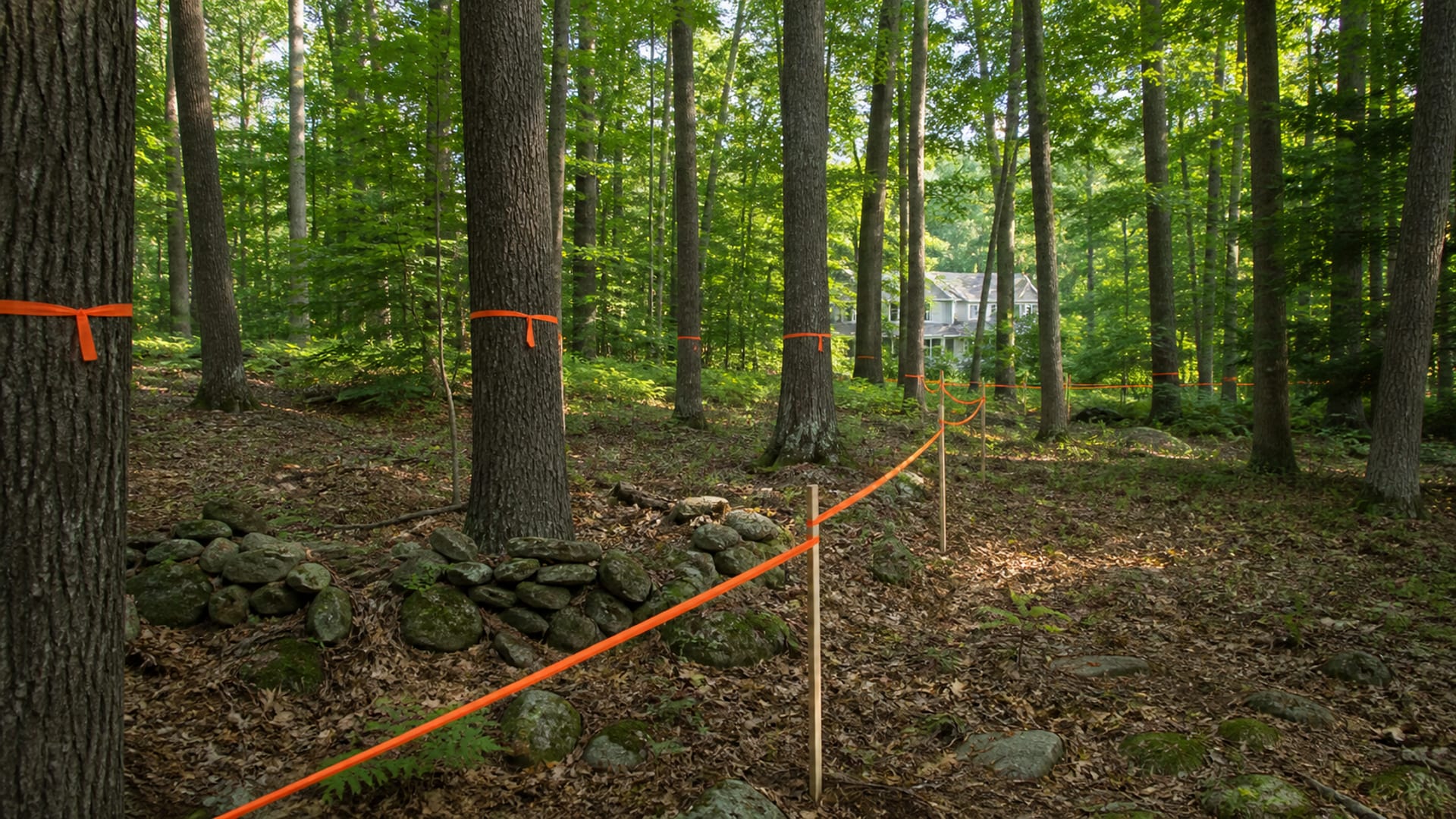
The word clearing does a lot of unhelpful work. Most people hear it and picture a flattened, scraped rectangle where a wood used to be, which is why agreeing to it and then waiting for the start date can feel uneasy. That picture is wrong for almost every job. A scoped clearing project on a wooded Bethany property removes what is inside a marked limit and leaves everything outside it standing, and the interesting question is not whether the trees come down but where all the material goes afterward, which is governed by rules most owners have never had reason to read.
Key Takeaways
Only what is inside the marked limit comes down
clearing is defined by a boundary staked and flagged before work starts, and retained trees and features are marked individually.
Land clearing debris cannot be buried on your property
Connecticut treats trees, stumps, and brush removed in site preparation as land clearing debris, which may not be buried on site and has to go to a permitted recycling or disposal facility, although suitable material may be chipped or mulched on site where the applicable requirements are met.
Burning is not an option either
Connecticut does not permit open burning to clear land before construction or to dispose of land clearing debris.
Stumps are a separate decision, not an automatic inclusion
mulching, flush cutting, grinding, extraction, and rough grading are different scopes with different results, and the written scope decides which you are getting.
Half an acre of cumulative disturbance changes the paperwork
Bethany requires a certified erosion and sedimentation control plan for cumulative land disturbance greater than one half acre, and no zoning or building permit is issued until that plan is approved or the designated agent determines it is not required.
What Actually Stays Standing?
Everything you decide stays, and the decision gets made on the ground rather than on a plan.
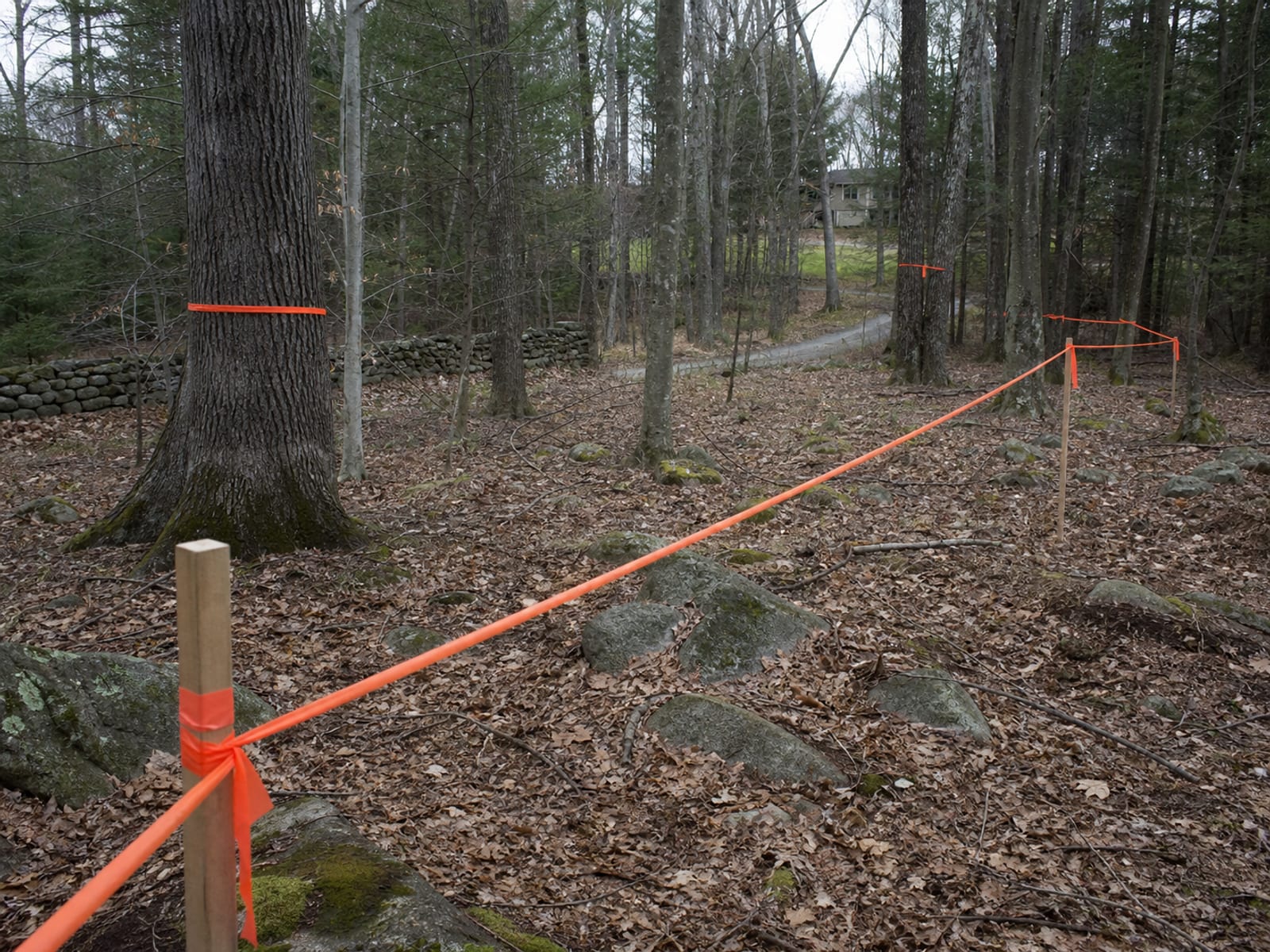
Before any machine starts, the limit of the clearing area is staked and flagged so it exists physically rather than as a line on paper. Inside it, individual trees you want kept get marked as well, along with stone walls, boundary markers, a well head, septic components, a drainage feature, a specimen tree, or anything else that matters to you. Anything unmarked inside the limit is fair game, which is exactly why the marking session is worth attending.
That process is also your best opportunity to change your mind cheaply. Standing in the woods looking at a flagged line is when people realize the opening should be ten feet further from the house, or that the big oak on the corner is worth keeping and working around. Both changes cost nothing at that moment and quite a lot later.
The other decision made at the same time is the access route. On a wooded property the machine has to reach the work, and the path it takes is part of the disturbance. Agreeing that route in advance means the drive, the lawn, and the trees along it get protected deliberately rather than negotiated afterward.
What Does the Land Clearing Process in Bethany, CT Involve?
The scope, the constraints, the approvals where they apply, the utility notification, protection and staging, the clearing itself, material handling, and stabilization. That is the whole shape of it, and the order is not adjustable in the middle.
The land clearing steps in Bethany, CT, in order
1. Mark the limits and the retained items. The clearing boundary staked and flagged, keep trees and features individually marked, and the access route agreed. 2. Verify the approvals and the utility markings. Whether a wetlands review, an earthwork path, or an erosion plan applies, then the locate request with its notice period, plus a separate conversation about private lines that the markout will not show. 3. Create the access and install the required controls. A workable route into the site, protection for what stays, and erosion and sediment measures where the job calls for them, installed before disturbance rather than after. 4. Cut, process, and sort the vegetation. Working inside the limits, with material separated as it comes off rather than piled together and sorted later. 5. Handle stumps or grade only where the scope includes it. This is where clearing projects most often differ from what the owner assumed. 6. Process or remove the debris lawfully. Chipping or mulching on site where the requirements are met, otherwise hauled to a permitted facility. Neither burying nor burning is available. 7. Stabilize and clean up. Exposed soil given cover, the access route restored, and the site left in the condition the scope describes.
Where Do the Trees, Brush, and Stumps Go?
This is the part almost nobody asks about in advance and everybody notices at the time, because the volume of material coming off a wooded area is genuinely surprising.
| What comes off | The options | What is not available |
|---|---|---|
| Brush and small woody growth | Chipped or mulched on site where the requirements are met, or hauled to a permitted facility | Burning it, or burying it on the property |
| Merchantable or usable wood | Cut to a length you specify and stacked for your own use, or removed | Leaving it indefinitely in a pile that was never agreed |
| Stumps and root balls | Removed to a permitted facility where extraction is in the scope, or left in the ground where it is not | Burial on site. Buried organics decompose and cause settlement later |
| Rock and soil | Reused on site where the design allows, stockpiled, or hauled | Assuming it can stay wherever it lands |
| Anything unexpected, such as dumped material | Assessed, then routed appropriately | Mixing it into another stream to make it disappear |
Connecticut is explicit on the first point. Trees, stumps, and brush removed in site preparation are land clearing debris, they may not be buried on site, and they have to go to a permitted recycling or disposal facility, with the exception that suitable material may be chipped or mulched on site where the applicable requirements are met. Open burning to clear land before construction, or to dispose of land clearing debris, is not permitted.
The practical consequence is that hauling is a real line item on a wooded property, and mulching on site, where it is appropriate, is often the difference between a manageable number and a large one. That is worth discussing when the scope is written rather than when the trucks arrive.
What Will the Property Look Like While the Work Is Happening?
Untidy, purposeful, and less dramatic than the mental image.
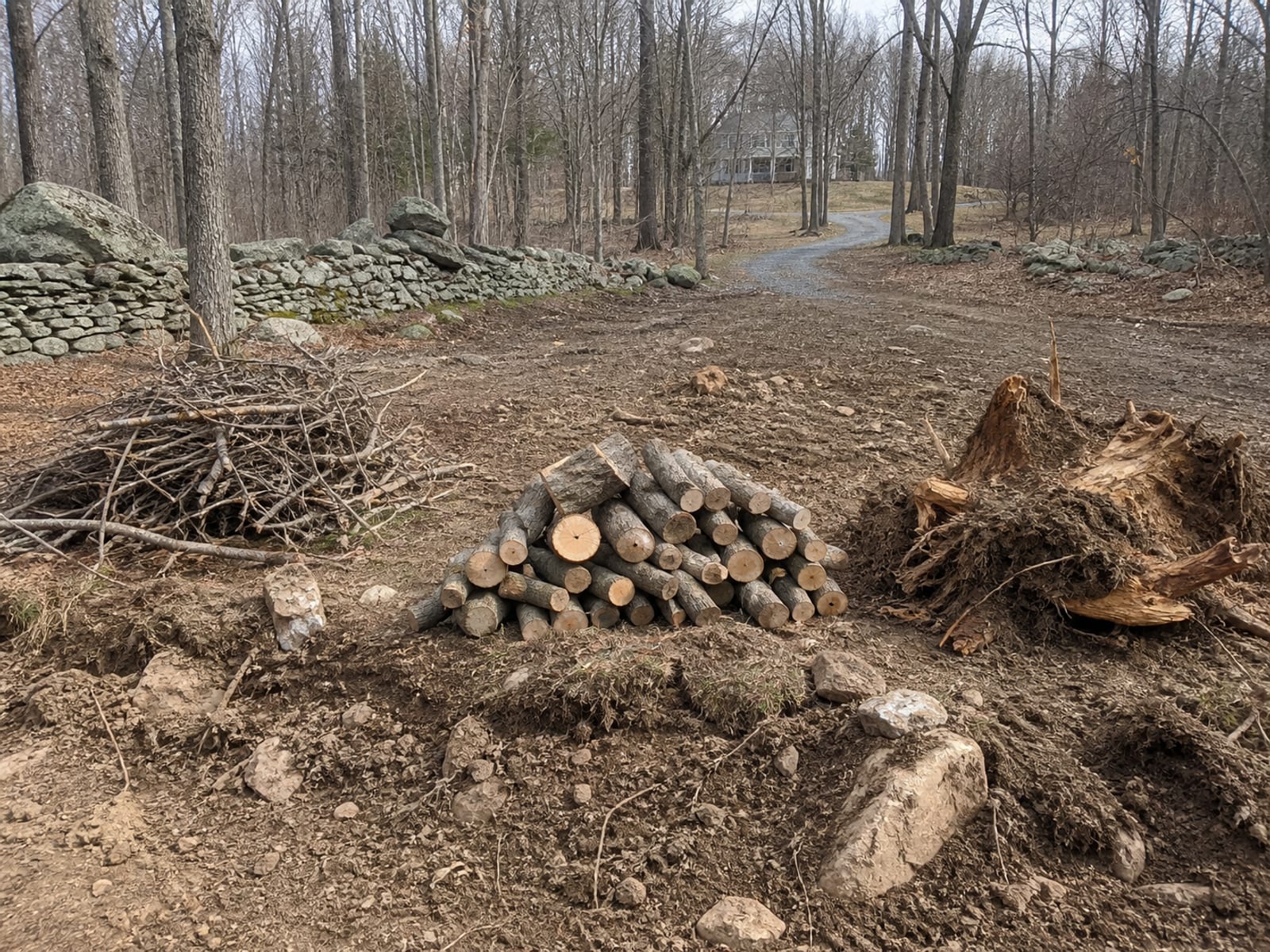
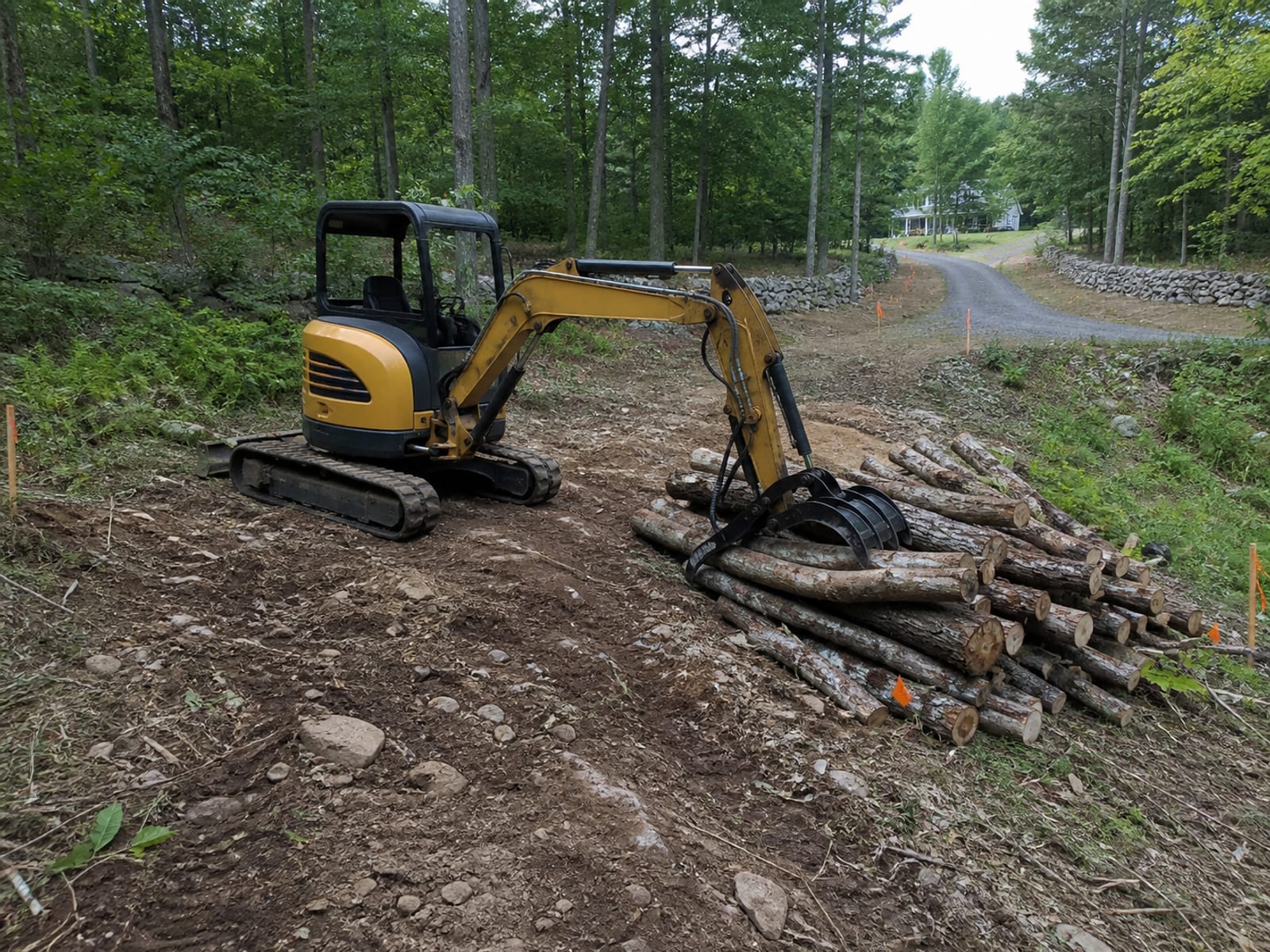
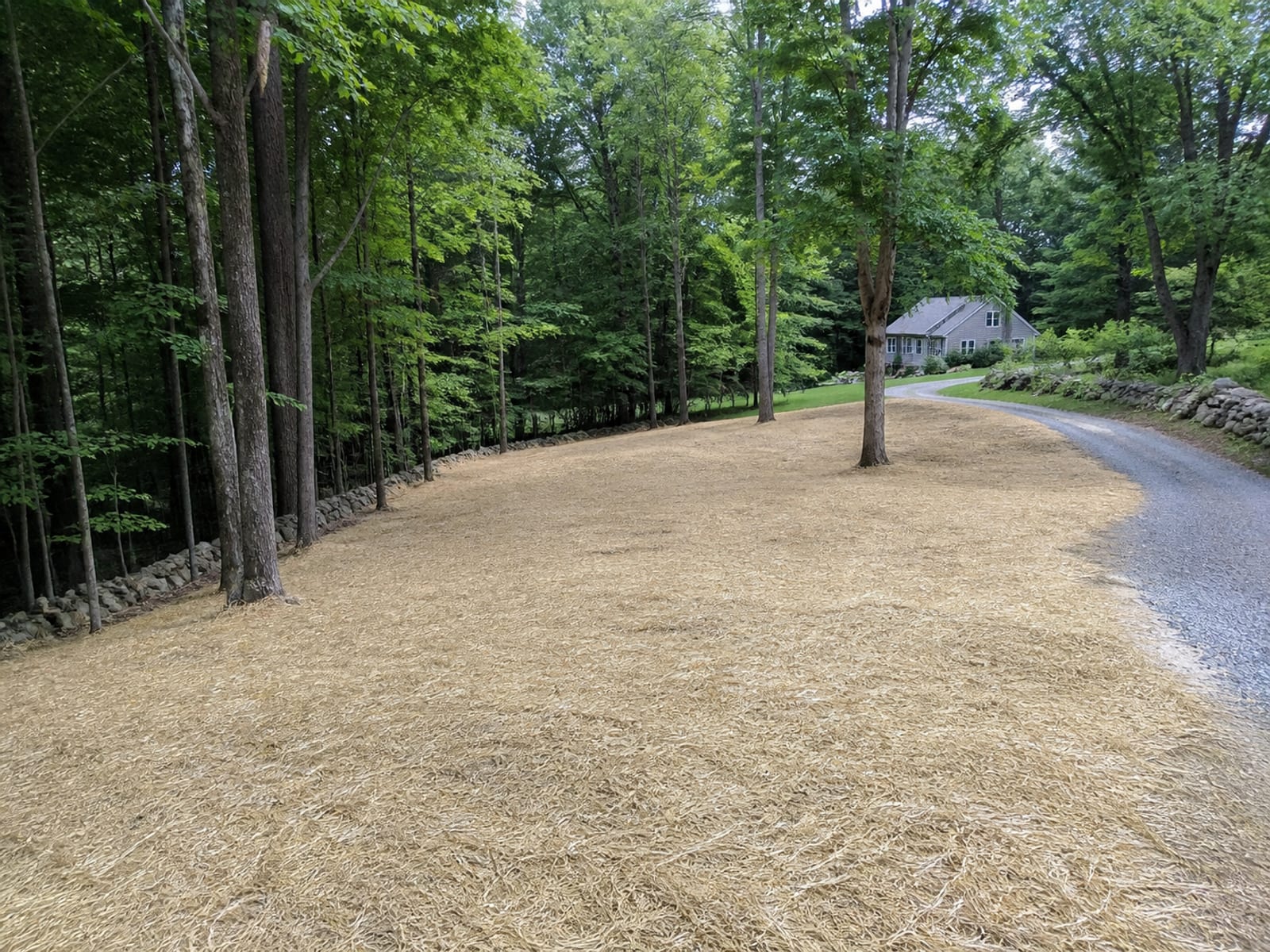
Expect a staging area near the access point holding equipment and processed material. Expect separate piles rather than one, since material gets sorted as it comes off: brush in one place, logs in another, stumps in a third if they are being removed. Expect exposed ground inside the limits, sometimes with tracks and ruts from the machine, which is normal during work and gets addressed at the end.
Expect machinery moving through the site repeatedly rather than working in one spot. Equipment is scope dependent, but the usual roles are a tracked excavator with a thumb, grapple, or rake to sort and move trees, stumps, and rock, a compact tracked loader for moving material in tighter areas, a mulcher for suitable brush and smaller growth, and a chipper where chipping is part of the plan. On uneven wooded ground that movement is constant, because material has to travel from where it was cut to where it is processed or loaded.
What you should not see is disturbance outside the flagged limit, damage to marked retained trees, material stacked against the boundary, or spoil in a wet area. If any of those appear, that is the moment to say so rather than at the end.
Will Every Stump Be Gone?
Only if the scope says so, and this is the single most common source of disappointment on a clearing job.
There are five different outcomes people describe with the same word. Mulching reduces standing brush and small woody growth in place and leaves the root systems entirely. Flush cutting takes the stump down level with the ground and leaves the roots. Grinding reduces the stump and reachable wood below grade, leaving structural roots behind. Extraction removes the stump and root mass as material, which is excavation and leaves a hole that has to be filled and compacted. Rough grading reshapes the ground afterward and is its own separate scope again.
Which one you need depends on what the ground has to do next. Lawn or pasture is well served by grinding. A building area, a driveway base, or anything with a trench through it needs extraction, because decaying wood under a structure is a settlement problem that arrives years later. And if the answer is that nothing is happening there for a while, leaving stumps is a legitimate choice rather than a failure.
Ask which of the five is in your written scope, and ask what happens to the material each one produces.
Which Bethany Rules Can Change the Plan?
| Item | When it applies | Who |
|---|---|---|
| Inland wetlands review | Work in, or likely to affect, an inland wetland or watercourse. The published commission process identifies an application package and states that a soil scientist report or review is required before final commission review | Bethany Inland Wetlands Commission, through Land Use |
| Earth removal, excavation, filling, stockpiling, and grading | Bethany's zoning regulations regulate this work through exemptions, administrative permits, or special exceptions depending on the activity. Ordinary tree cutting alone is not automatically in scope, so confirm whether your project includes regulated earthwork | Bethany Planning and Zoning |
| Certified erosion and sedimentation control plan | Cumulative land disturbance greater than one half acre. No zoning or building permit is issued until the plan is approved or the designated agent determines it is not required | Bethany Planning and Zoning or its designated agent |
| Construction stormwater requirements | Construction activity disturbing one acre or more, with the program distinguishing locally approvable private projects of at least one acre and under five acres from other categories | Bethany land use process and CT DEEP |
| Call Before You Dig | Before any powered excavation, at least two full days ahead excluding Saturdays, Sundays, and holidays, and no more than 30 days ahead, outside an emergency | CBYD, at 811 |
The pattern is worth noticing: none of these attaches to every clearing job, and several attach to the earthwork rather than to the cutting. That is why the scope conversation matters so much. A vegetation only project and the same project with stump extraction and grading behind it are different animals in the eyes of the town.
How Long Does Land Clearing Take in Bethany, CT?
No Bethany specific public duration range exists, and any number offered before the site walk is a guess. What can be described is which parts of the calendar are which.
The fixed part is the utility notice period, which runs before any powered excavation. The uncertain part at the front is any approval that applies, since a wetlands review runs on its own timeline and a certified erosion plan has to be approved before the associated permit is issued. The variable part is the field work, which depends on the area, the vegetation density, tree size, stump scope, slope and ground conditions, access, how much material has to be hauled and how far, and the weather.
The honest way to plan is in phases rather than dates: approvals and notification, mobilization and protection, clearing and material handling, then stabilization and cleanup. A contractor who gives you a realistic window with those dependencies named is being more useful than one who gives you a date before knowing what is under the brush.
What Moves a Land Clearing Estimate?
No Bethany specific published price range exists for this work, so what follows is the list of things that actually change the number.
The defined area and its shape. The vegetation, meaning density, tree size, and how much of it is thorny, vined, or downed. What is being retained, since working around keep trees is slower than working without them. The stump and root scope, which is the largest single swing on most jobs. Slope and ground conditions, including whether machines can work safely and whether rock appears. Access, which on a wooded parcel with a long drive affects everything. Hauling and disposal, driven by volume, distance, and whether material can be processed on site instead. Erosion controls, where they are required. And the approvals, including any soil scientist or engineering input.
Ask for those separated in writing, along with what is excluded and what condition triggers a written change. On a wooded property where nobody can see the ground, an honest change process is worth more than a low headline number.
What Should You Do Before the Crew Arrives?
Genuinely useful owner work, none of it involving equipment:
- Decide what stays and be present when the limits and retained items are marked.
- Decide about the wood. If you want logs cut to a length and stacked for your own use, say so before cutting begins, because that changes how material is handled from the first tree.
- Move personal property out of the work area and off the access route, including anything stored under trees you have forgotten about.
- Share what you have. A survey, an approved plan, wetland information, a septic as built, the well location, and anything you know about private lines.
- Agree the access route and understand what will be protected and what will be restored.
- Tell the neighbors if the work is near a boundary or the access is shared.
One thing not to do: handle the debris yourself by burning or burying it. Neither is permitted, and both create a problem that is harder to fix than the disposal cost you were trying to avoid.
Why Work With Us
Prestige Property Maintenance is a licensed and insured excavating contractor based in Oxford, CT, established in 2015, owned by Kash Cochrane, CT HIC #0704432. We serve Bethany from Oxford, along with the other towns across the Naugatuck Valley and western Connecticut, and we do not operate a Bethany office or yard.
What matters on a clearing job is that one crew carries the whole sequence. Running forestry mulching equipment alongside an excavating fleet means brush can be processed on site rather than hauled where that is appropriate, and it means a project that turns out to need digging behind the clearing does not become a second company and a second mobilization. More than a decade in Connecticut glacial soil means we plan for ledge and buried boulders rather than treating them as a surprise.
The commitments are process ones: a site walk before any number, limits and retained items marked with you present, a written scope that states the stump and material plan explicitly, and a straight account of what the ground turns out to be once it is exposed.
How to Request an Estimate
Call (203) 258-3395 or use the estimate form on this site. Include the property address, the clearing limit you have in mind, the finished condition you want, whether stump or grading work is part of the plan, the access constraints, whatever you know about utilities, and any survey, wetland information, plan, or permit status you already hold.
Two things worth starting early: the utility notification period runs before any powered excavation, and where a wetlands determination or an erosion plan applies, those run on their own timelines. Beginning both at the scoping stage is what keeps a start date realistic.
Four Questions Before the Machines Arrive
1. What decides which trees stay standing?
2. Can land clearing debris be buried on your property in Connecticut?
3. Will a clearing job remove every stump?
4. At what cumulative disturbance does Bethany require a certified erosion and sedimentation control plan?
Pick an answer to begin.
Frequently Asked Questions About what to expect from land clearing in bethany ct
What does land clearing include? Vegetation removal within a defined limit and the handling of the material that comes off it. What is not automatically included is stump removal, root removal, hauling, rough grading, and restoration, and each of those should be stated explicitly in the written scope. Two quotes that both say land clearing can describe very different work, which is why the material plan and the stump scope are the two lines worth reading first.
How long does land clearing take in Bethany, CT? No Bethany specific public duration range exists. The fixed element is the utility notice period before powered excavation. Any approval that applies runs on its own timeline, and a certified erosion plan has to be approved before the associated permit is issued. Field work then depends on the area, the vegetation, the stump scope, slope and ground conditions, access, hauling distance, and weather. Plan in phases rather than dates.
Do I need a permit to clear land in Bethany? It depends on the work and the parcel. Wetlands review applies where the work is in or likely to affect a wetland or watercourse. Bethany's zoning regulations regulate earth removal, excavation, filling, stockpiling, and grading through exemptions, administrative permits, or special exceptions depending on the activity. And a certified erosion and sedimentation control plan is required above one half acre of cumulative disturbance. Bethany Land Use makes the determination for your specific proposal.
Do I need to call 811 before land clearing? For any powered excavation, yes, with notice at least two full days ahead excluding Saturdays, Sundays, and holidays, and no more than 30 days ahead. Vegetation cutting alone may not require it, but stump work, grubbing, and any digging certainly do. Remember that the public markout does not establish where owner installed private lines run, so those need identifying separately from your own knowledge and records.
Can the brush and stumps be buried or burned on my property? No to both. Connecticut treats trees, stumps, and brush removed in site preparation as land clearing debris, which may not be buried on site and must go to a permitted recycling or disposal facility, with suitable material able to be chipped or mulched on site where the applicable requirements are met. Open burning to clear land before construction, or to dispose of land clearing debris, is not permitted.
Will every stump be removed? Only where the scope includes stump treatment, and the treatments differ. Mulching leaves root systems entirely. Flush cutting leaves the roots. Grinding reduces the stump below grade and leaves structural roots. Extraction removes the stump and root mass and leaves a hole to fill. Rough grading is separate again. Match the choice to what the ground has to do next, then confirm which one is written into your scope.
What should I do before clearing begins? Identify what stays and be there when it is marked. Decide whether you want usable wood kept and cut to a length. Move personal property out of the work area and off the access route. Share your survey, plans, wetland information, septic as built, and well location. Agree the access route and what gets protected and restored. And leave the machinery, the felling, and the regulatory determinations to the contractor and the town.
What This Means for You
Clearing is a bounded operation, not a scorched earth one. What comes down is what you marked, what stays is what you flagged, and the part that surprises most owners is not the cutting but the sheer volume of material and the fact that neither burning nor burying it is available. That single rule is what makes the material plan the most important paragraph in your scope.
The second most important is the stump line, because mulching, cutting, grinding, and extraction produce four different pieces of ground and only one of them is ready to build on. Get those two right and the rest of the project follows a well established sequence you can watch with confidence from the window.
If you have clearing planned on a Bethany, CT property, Prestige Property Maintenance can walk the limits with you, mark what stays, and put a scope in writing that names the stump treatment, the material destinations, and the stabilization. We handle land clearing, forestry mulching, stump grinding, and site preparation with one crew working out of Oxford. See how we work across Bethany, call (203) 258-3395, or contact us to arrange a site walk before anything is scheduled.
Clearing Words You Will Hear on Site
Tap a term to see what it means.
Clearing limit. The staked and flagged boundary of the area being cleared. Everything outside it stays, and anything unmarked inside it does not.
Related Articles
Stump Grinding in Bethany, CT: Clearing a Field of Stumps
Can not mow or build until the stumps are gone? Here is how stump grinding in Bethany, CT works, and when grinding alone will not be enough.
Land Clearing Bethany, CT: Wetlands, Scope, and Where to Start
Most of Bethany carries a land constraint, wetlands, slope, or poor septic soil. Land clearing in Bethany, CT starts by finding out which ones apply.
What to Expect from Drainage Work in Derby, CT, Start to Finish
Hired someone for drainage work in Derby, CT and wondering how torn up the yard gets? Here is the real sequence, from utility mark-out to grading.